Argelers concentration camp
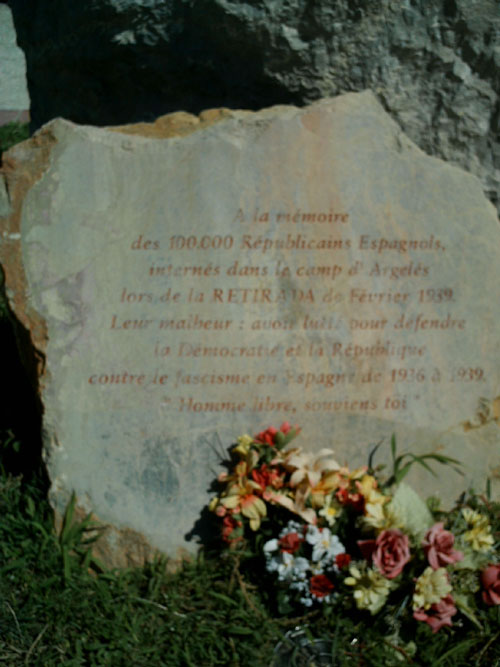
The beach at Argeles-sur-Mer faces the Mediterranean under the shadow of the Albera Massif, eight kilometers north of the Spanish border. In February 1939 it became a prison. More than 100,000 Spanish men and women -- soldiers, civilians, families -- stumbled across the frontier fleeing the Francoist armies that had just taken Barcelona, only to be disarmed, arrested, and herded onto this stretch of sand behind barbed wire. There were no barracks, no latrines, no running water. The French government called it an internment camp. The people who survived it called it something worse.
La Retirada
The fall of Barcelona in January 1939 triggered the final collapse of the Spanish Republic in Catalonia. What followed was La Retirada -- the withdrawal -- as hundreds of thousands of Republican soldiers and civilians marched north toward France in winter. The remnants of the Eastern Region Army Group crossed the border, including veterans of the elite V Army Corps under commanders like Juan Modesto and Enrique Lister, men who had fought on the Ebro and believed they were making a tactical evacuation to regroup and continue the resistance. France had other plans. Every Republican who crossed the frontier was disarmed immediately. The French government refused to allow the military units to be transferred to the remaining Republican territory in central Spain. Instead, the soldiers were swiftly interned in camps strung along the northern foot of the Pyrenees.
Sand, Wire, and Petroleum Baths
Conditions at Argeles were deliberately minimal. The camp had no structures -- just sand enclosed by barbed wire, open to the wind off the sea and the winter cold rolling down from the mountains. Inmates dug holes in the ground for shelter. Food was thrown over the wire by French officials, as though feeding animals rather than people. Republican doctors among the prisoners were denied medical supplies and equipment. Disease spread quickly through the crowded, unsanitary camp. Guards administered petroleum baths in a crude attempt to combat the infestations of fleas and lice. People died of hypothermia, of dysentery, of despair. It was common to see bodies piled in the open, uncollected, across the camp. French authorities actively encouraged the refugees to return to Spain -- to the regime that had driven them out.
The Lives Behind the Wire
Among the more than 100,000 prisoners were people whose stories would ripple far beyond that beach. Marcel Langer, a member of the International Brigades, would later become a hero of the French Resistance in Toulouse before being guillotined by the Nazis in July 1943. Josep Bartoli, the Catalan artist, would document the camps in drawings that became an essential record of the internment. Arthur Adamov, the playwright who became one of the foremost voices of the Theatre of the Absurd, passed through the wire. Andres Garcia La Calle, commander of the Republican Air Force's fighter units, and Peko Dapcevic, who would later fight as a Yugoslav partisan, were among the military men confined here. Each carried a life of conviction and creativity into captivity, and many carried the trauma of Argeles for the rest of their lives.
What the Sand Remembers
The French government eventually established additional camps along the Pyrenees to relieve the worst overcrowding -- Gurs, Saint-Cyprien, Le Barcares -- but the pattern of neglect and hostility remained consistent. When World War II began months later, many of the Spanish Republicans still in the camps faced new choices: enlist in the French Foreign Legion, join labor battalions, or risk deportation. Some ended up in Nazi concentration camps. Others joined the Resistance, fighting the same fascism that had driven them from Spain. Today, a commemorative monument stands on the northern beach of Argeles-sur-Mer, and the town maintains a memorial center. The sand looks peaceful now, warm under the Roussillon sun. But the ground holds a memory that France was slow to acknowledge: that on this beautiful coast, a democracy turned its back on people fleeing tyranny and left them to suffer in the open air.
From the Air
Located at 42.562N, 3.046E on the Mediterranean coast near Argeles-sur-Mer, Roussillon. The beach is visible between the town and the sea, 8 km north of the Spanish border. Perpignan-Rivesaltes Airport (LFMP) lies 25 km northwest. The Albera Massif rises to the south. Best viewed from 2,000-3,000 ft AGL along the coastal approach.