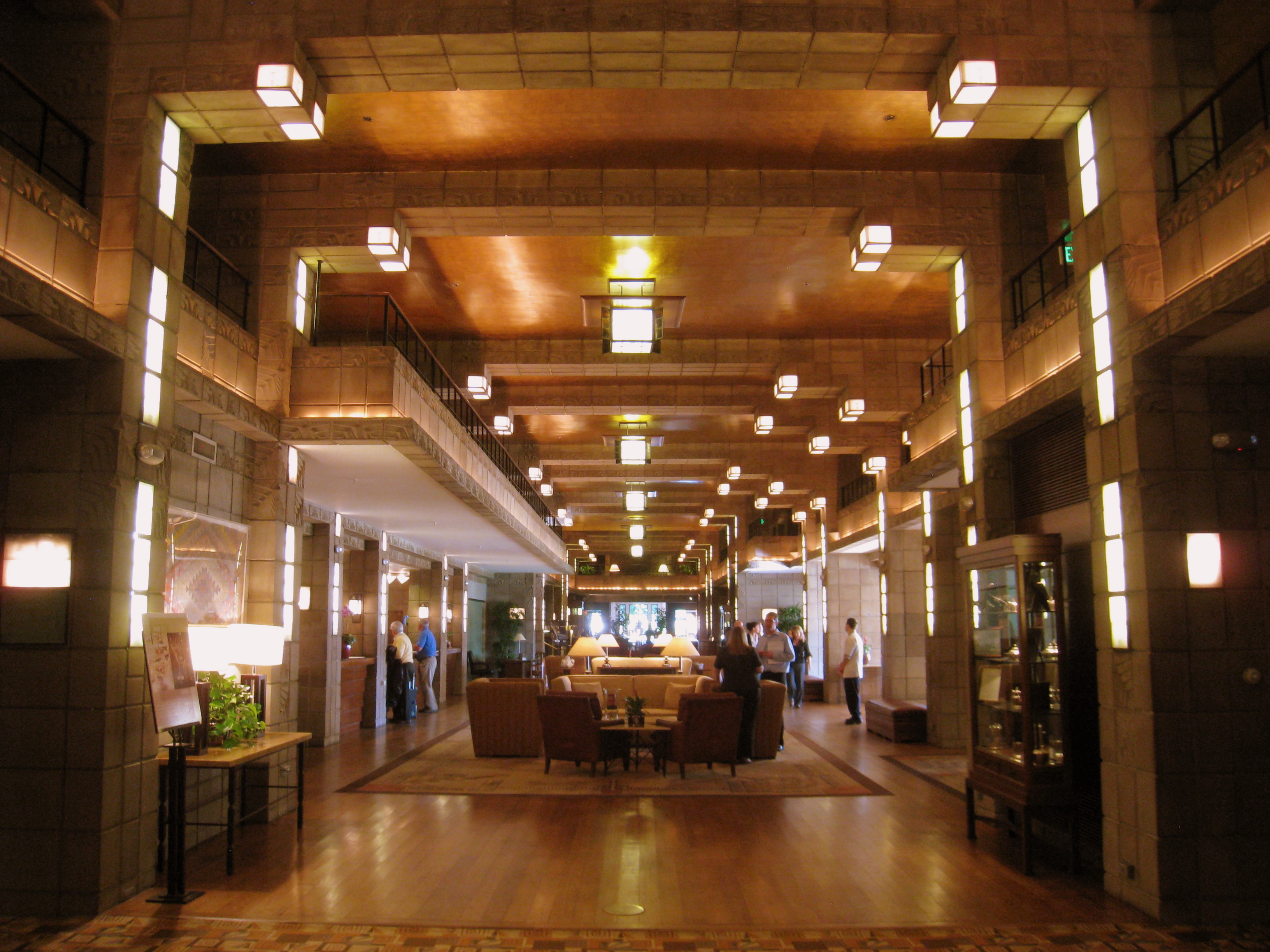
Arizona Biltmore Hotel
The argument began before the hotel even opened and has never really stopped. Who designed the Arizona Biltmore? The geometric textile blocks that make this 1929 resort shimmer in the desert sun bear the unmistakable influence of Frank Lloyd Wright, yet the building belongs to another architect entirely. Albert Chase McArthur, Harvard-trained and Arizona-licensed, created the 'Jewel of the Desert.' Wright consulted on the project for four months, then spent decades claiming credit. The truth lives in the Arizona State University Library archives, where McArthur's original linen drawings prove his authorship. The debate has only added to the hotel's mystique.
Blocks Made from Desert Sand
The Arizona Biltmore's signature is written in concrete. The pre-cast textile blocks that cover its facades were made on site from desert sand, their geometric patterns catching light differently as the sun moves across the sky. McArthur had once worked as a draftsman for Wright and specifically requested his former employer's help implementing the textile block system Wright had pioneered on four Los Angeles homes. Wright wanted square blocks; McArthur insisted on mathematically proportioned rectangles. McArthur won. These 'Biltmore Blocks' became the building's defining feature. Wright publicly condemned McArthur's modifications and claimed the design as his own, though in a carefully worded 1930 letter to Architectural Record, he stopped short of outright ownership.
Wright's Ghost Walks the Halls
Over the decades, Wright's influence has seeped deeper into the property through deliberate additions. During the 1973 renovation following a fire, Taliesin students fabricated a stained glass window from Wright's 1926 'Saguaro Forms and Cactus Flowers' design and installed it in the lobby. Reproductions of the geometric sprite statues Wright created for Chicago's 1915 Midway Gardens now dot the grounds. Three restaurants bear his name: Wright's at the Biltmore, The Wright Bar, and Frank & Albert's - the last a diplomatic nod to both architects. The original solarium became Wright's restaurant in 1973. The building that Wright did not design has become a shrine to his memory.
Where Hollywood Came to Play
The Biltmore opened on February 23, 1929 - a memorable debut marked when Scenic Airways dropped a ceremonial wooden key onto the ballroom roof. Clark Gable and Carole Lombard made it their regular desert retreat. In March 1952, Ronald and Nancy Reagan honeymooned in Cottage I, which became their favorite escape. Irving Berlin reportedly composed 'White Christmas' poolside at the Catalina. The hotel also claims a liquid legacy: the Tequila Sunrise cocktail was invented within these walls, its orange-and-red gradient echoing an Arizona dawn. When chewing gum magnate William Wrigley Jr. took full ownership in 1930 after the McArthur brothers lost control, he built his own mansion nearby in 1931, now a private club overlooking the resort.
A History Room Where Keys Fall From the Sky
The third floor houses the Biltmore History Room, a small museum of the hotel's storied past. Above the fireplace hangs that wooden key dropped from the airplane on opening day. Display cases hold artifacts from nearly a century of desert hospitality. Former Arizona Governor Rose Mofford donated her mineral collection and kachina dolls when the museum relocated to its current building in 1991; she promised that if the mining museum ever closed, she would scatter the collection to rural Arizona museums rather than see it absorbed elsewhere. Martha Raye played chess on a giant board near the Cowboy house. The room preserves these odd, charming details that give the Biltmore its character beyond architecture.
Surviving Fire, Changing Hands
The Biltmore has passed through many owners: the Rostland Corporation in 1979, the Grossman Properties in 1992, Singapore's sovereign wealth fund in 2013. A fire threatened to end the story, but crews rebuilt the hotel in ninety days to meet the 1973 winter season opening. Taliesin Associated Architects oversaw the restoration, adding the Valley Wing in 1979 and the Terrace Court Wing in 1982. Today the resort operates under Hilton's LXR Hotels & Resorts brand. Through all these changes, the textile blocks remain, geometric patterns holding desert sand in shapes that two architects fought to define.
From the Air
Located at 33.524°N, 112.023°W at 24th Street and Camelback Road in Phoenix. The hotel complex is recognizable by its distinctive low-rise geometric architecture surrounded by golf courses. Wrigley Mansion visible on the hill to the north. Best viewed at 2,000-3,000 feet AGL. Nearest airports: Phoenix Sky Harbor International (KPHX) 6nm south, Scottsdale Airport (KSDL) 5nm northeast, Phoenix Deer Valley (KDVT) 10nm northwest.