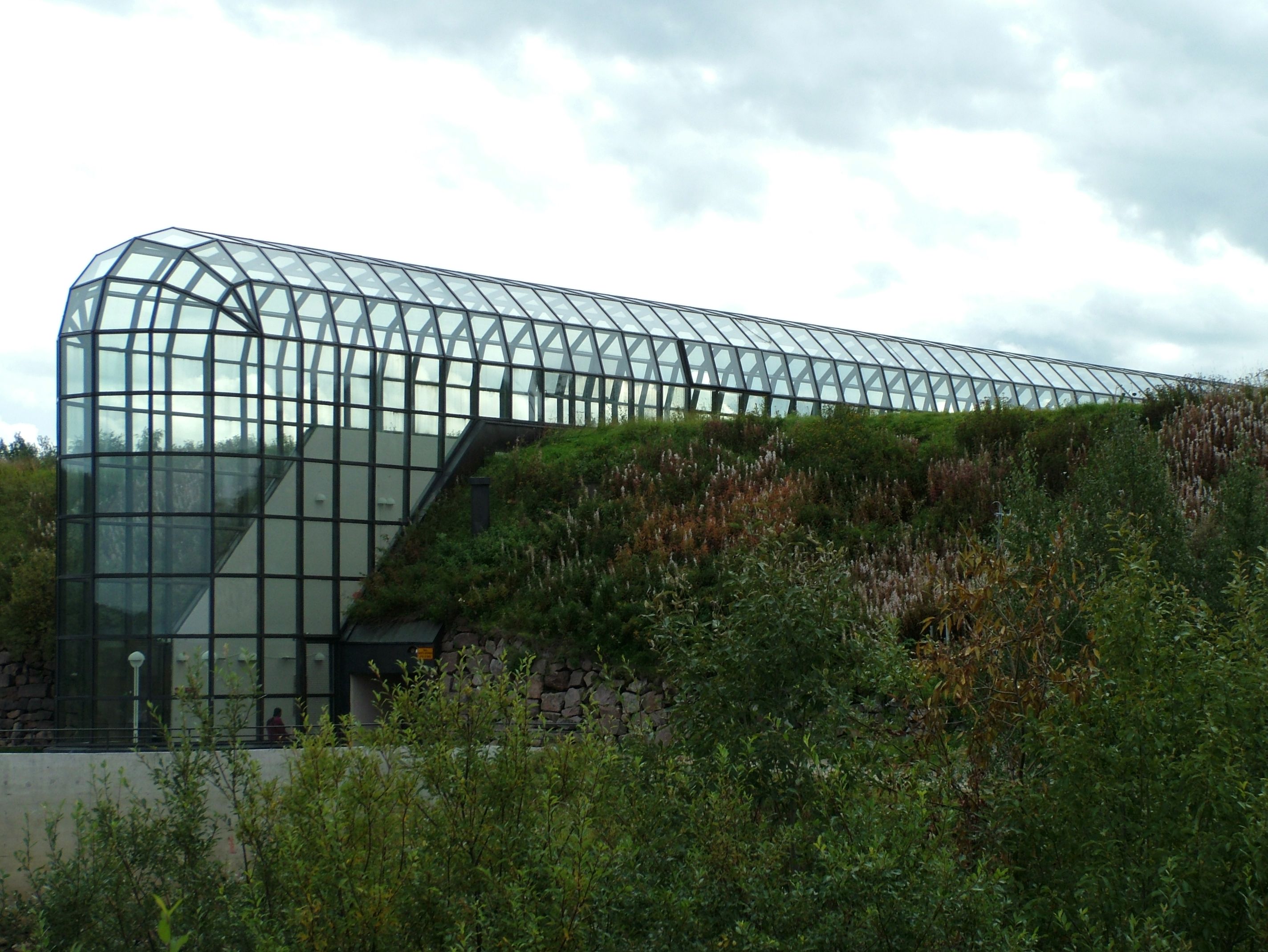
Arktikum
Walk into the Arktikum and you walk north. The building's 172-meter glass corridor is oriented on a precise north-south axis, its entrance at the southern end, so that every visitor who steps through the foyer is symbolically crossing into the Arctic. This is no accident of design. When Danish architects Birch-Bonderup and Thorup-Waade conceived this museum and science centre for Rovaniemi, Finland, they built it as a threshold -- the Gateway to the North, a place where the temperate world gives way to the Arctic one. It opened on 6 December 1992, the 75th anniversary of Finnish independence, and it has been drawing visitors into the polar story ever since.
Built Like the Land Itself
The architecture of the Arktikum is an argument about place. The exhibition spaces are sheltered below ground level, mimicking the way Arctic animals survive winter by burrowing beneath the snow. Above them, the glass corridor catches whatever light the high latitude offers -- which in summer means the endless glow of the midnight sun, and in winter means the eerie luminescence of the northern lights rippling above the transparent ceiling. The materials are stubbornly local: floors of Perttaus granite, the hardest variety available in Finland, and lime-washed Lapland pine. The chairs are birch and reindeer hide. Even the highway that bisects the glass tube -- the 30-meter-wide Kittila road passes straight through it -- feels like a statement about the inseparability of Arctic life and the infrastructure that sustains it.
Two Stories Under One Roof
Arktikum houses two distinct institutions. The Provincial Museum of Lapland, founded in 1975, traces the cultural history of Finnish Lapland and its indigenous Sami people. Its exhibitions explore how human communities have adapted to a landscape defined by extreme cold, polar darkness, and the brief explosion of summer. Alongside it, the Arctic Center -- part of the University of Lapland -- takes a scientific approach, examining modern life in the circumpolar world. Together, the two exhibitions cover everything from reindeer herding traditions to climate change research, from Inuit sculpture to the physics of aurora borealis. Temporary exhibitions rotate through regularly, ensuring the museum never tells quite the same story twice.
Rovaniemi's Phoenix Moment
The Arktikum's existence is itself a story of recovery. During World War II, retreating German forces burned Rovaniemi to the ground in October 1944 as part of the Lapland War, destroying virtually every building in the city. The reconstruction that followed was led in part by architect Alvar Aalto, who designed a new city plan and several landmark buildings. The Arktikum, completed nearly five decades after the destruction, represents a later chapter in that rebuilding -- a statement that Rovaniemi had not merely survived but had become the cultural capital of Finnish Lapland. A crescent-shaped annex designed by Claus Bonderup and Janne Lehtipalo was added in 1997, expanding the museum's capacity and reinforcing its role as the region's intellectual anchor.
Where the Northern Lights Come Indoors
Rovaniemi sits almost exactly on the Arctic Circle, and the Arktikum exploits this geography brilliantly. On clear winter nights, the northern lights are visible directly through the glass corridor, turning the building itself into a viewing platform. In summer, the midnight sun floods the interior with golden light that never quite fades. The museum has become one of Finland's top travel attractions -- ranked fourth nationally by Topworld International -- not because of any single exhibit, but because the building itself is an exhibit. It frames the Arctic not as a hostile frontier but as a living, complex, beautiful environment that humans have called home for millennia. Standing in that glass corridor at midnight in June, watching the sun hover above the horizon, you begin to understand why.
From the Air
Located at 66.51N, 25.73E in Rovaniemi, the capital of Finnish Lapland, almost exactly on the Arctic Circle. The 172-meter glass corridor is oriented north-south and may be visible from low altitude. Rovaniemi Airport (EFRO) is approximately 8 km to the northeast. The Ounasjoki and Kemijoki rivers converge at Rovaniemi, making the city identifiable from the air. Best viewed at 2,000-5,000 feet to spot the distinctive glass structure along the riverbank.