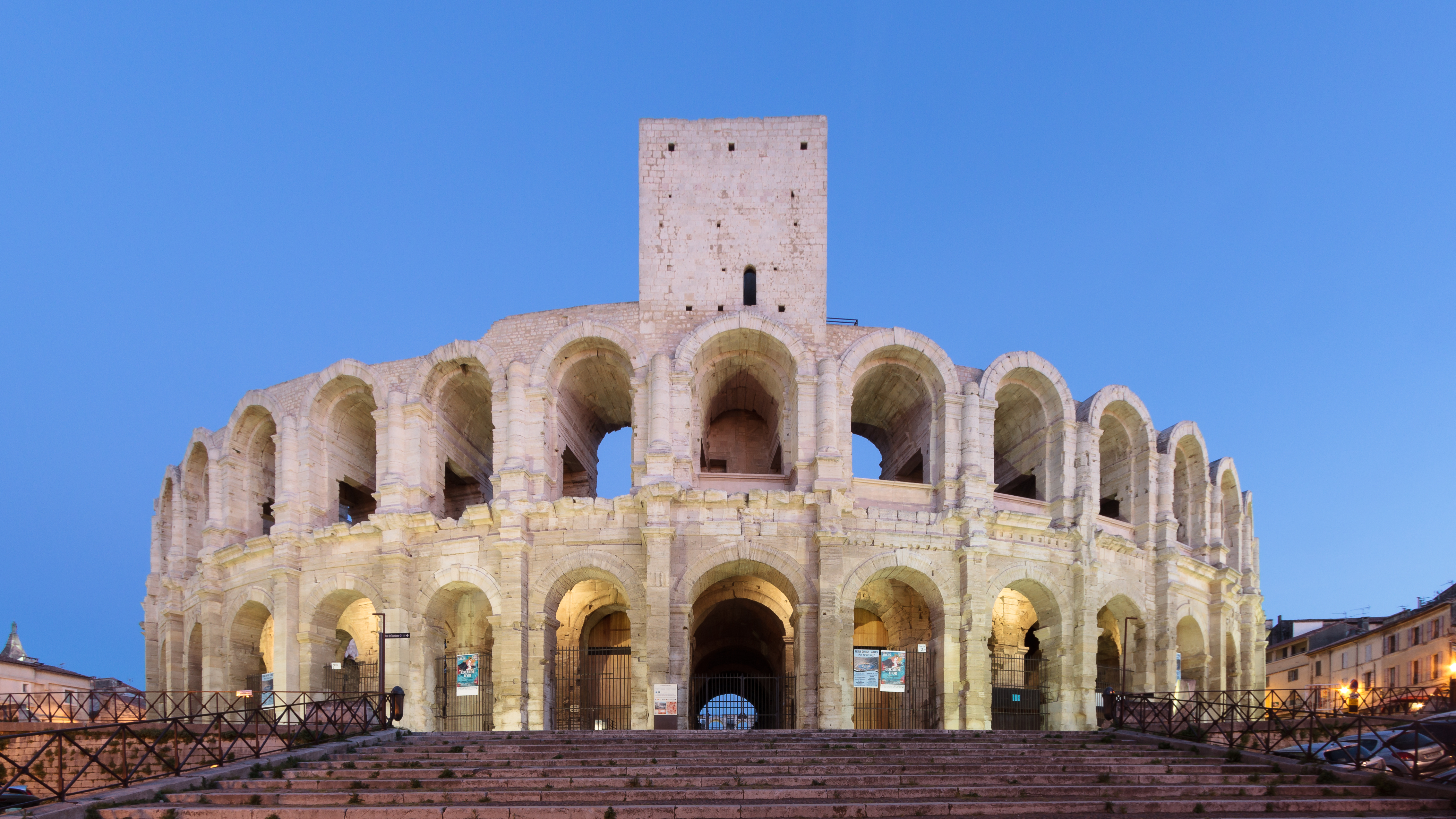
Arles Amphitheatre
Vincent van Gogh painted the crowd inside the Arles Amphitheatre in 1888, capturing the scene of spectators attending a bullfight in the same oval that had hosted gladiatorial combat eighteen centuries earlier. The painting, Les Arenes, shows what makes this place remarkable: not just that a Roman amphitheatre from 90 AD survives in southern France, but that people never stopped using it. Built a decade after the Colosseum, topped with medieval towers that the Romans never intended, the Arles Amphitheatre has been arena, fortress, town, and stage -- each era leaving its mark on walls that refuse to become ruins.
Colosseum of the Provinces
The amphitheatre measures 136 meters long and 109 meters wide, with 120 arches arranged across two tiers. It held over 20,000 spectators for chariot races and gladiatorial combat, seating them on terraces served by a sophisticated system of arcades, galleries, and staircases designed for rapid crowd movement. The architect worked in the Colosseum's shadow, both figuratively and literally: the building in Rome, completed between 72 and 80 AD, was the direct model. But the Arles arena was smaller, and the designer compensated by replacing the Colosseum's dual system of exterior galleries with a single annular gallery -- an adaptation dictated by the site's terrain. For over four centuries, this temple of entertainment hosted the bloody spectacles that defined Roman urban life.
Two Hundred Houses and Two Chapels
When the Western Roman Empire collapsed in the fifth century, the people of Arles did what people throughout the former empire did with amphitheatres: they moved in. Four towers were added to the structure, transforming it into a fortress. Within the oval walls, more than 200 houses eventually crowded together, forming a self-contained neighborhood with its own public square built on the arena floor and two chapels -- one at the center of the building, another at the base of the western tower. This was no temporary arrangement. The residential role continued for over a thousand years, through the medieval period and into the late eighteenth century, the amphitheatre's Roman engineering proving perfectly serviceable as the skeleton of a small town.
From Monument to Matador
The transformation began in 1825, when the writer Prosper Merimee championed the amphitheatre's conversion to a national historical monument. Expropriation of the interior houses started in 1826 and was complete by 1830, when the first event was staged in the cleared arena -- a bull race celebrating the French capture of Algiers. Bullfighting has remained central to the amphitheatre's identity ever since, with the annual Feria d'Arles drawing crowds to the ancient oval. In 1981, UNESCO inscribed the amphitheatre as part of the Arles, Roman and Romanesque Monuments World Heritage Site, recognizing its significance alongside the city's other ancient treasures.
Arena of Many Lives
The medieval towers still jut from the top of the Roman walls, a visual reminder that this building has never belonged to a single era. John Frankenheimer staged an action sequence inside the amphitheatre for his 1998 film Ronin. Van Gogh's painting of the bullfight crowd hangs in the Hermitage Museum. Summer brings plays and concerts to the arena floor, the acoustics of a Roman entertainment venue proving surprisingly well-suited to modern performance. The southern tower remains unrestored, a deliberate gap in the restoration that acknowledges the building's layered history. Two thousand years of continuous use have made the Arles Amphitheatre not a monument to the past but an argument that the best buildings outlive the purposes they were designed for.
From the Air
Located at 43.678N, 4.631E in the center of Arles. The oval amphitheatre with its medieval towers is clearly visible from altitude. Nimes-Ales-Camargue-Cevennes Airport (LFTW) lies 30 km northwest; Marseille-Provence (LFML) is 80 km east. The Camargue wetlands begin just south of the city. Best viewed from 2,000-4,000 ft AGL.