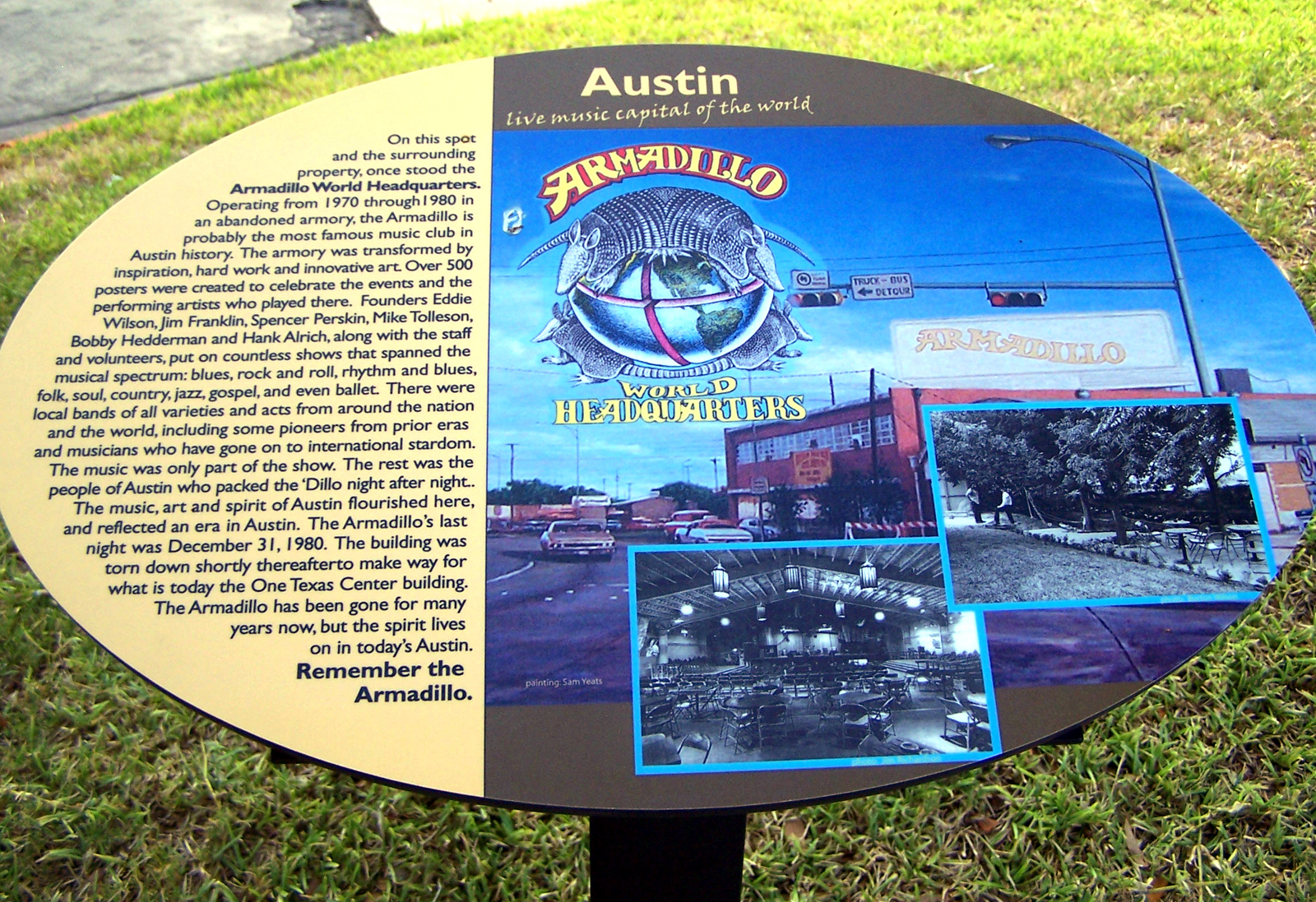
Armadillo World Headquarters
One night in 1970, Eddie Wilson stepped outside a nightclub on Barton Springs Road and noticed an old National Guard armory sitting dark and abandoned across the way. He found an unlocked garage door and drove his car up to the entrance, using the headlights to illuminate the cavernous interior. The building was ugly, uncomfortable, and had terrible acoustics. The rent was cheap. Within weeks, Wilson had transformed it into the Armadillo World Headquarters -- a ramshackle beer hall that would spend the next decade rewriting the rules of American music and earning Austin the reputation it still carries as the Live Music Capital of the World.
Armor and Armadillos
The name was pure wordplay layered with meaning. Wilson and his partners wanted an armored animal as mascot, since the building was an old armory. The nine-banded armadillo fit perfectly -- its shell looks like armor, the species has survived virtually unchanged for nearly 50 million years, and the creatures are nearly ubiquitous across Central Texas. Local poster artist Jim Franklin had already been using armadillos as a symbol in his artwork, giving the choice a visual lineage in Austin's counterculture. Wilson initially proposed calling it "International Headquarters" but settled on the grander "World Headquarters." The Armadillo officially opened on August 7, 1970, with Shiva's Headband, the Hub City Movers, and Whistler performing. Funding came from an unlikely coalition: Shiva's Headband founder's father Dan Perskin and Mad Dog, Inc., an Austin literati group that included writer Bud Shrake.
Where the Shit-Kickers Met the Hippies
The Armadillo caught fire with Austin's counterculture because admission was cheap and the management tolerated cannabis use openly enough that, as anecdotes suggest, police avoided raiding the place for fear of busting their own officers and local politicians. By 1974, Time magazine compared the Armadillo to San Francisco's Fillmore, declaring it the essential incubator for Austin's emerging sound. That sound had many names -- "The Austin Sound," "Redneck Rock," progressive country, "Cosmic Cowboy" -- but they all described the same unlikely fusion: country meeting rock and roll in a crumbling armory where the clientele mixed hippies, cowboys, and businessmen drinking lunch-hour Lone Star beer. At its peak, the Armadillo sold more Lone Star draft than any venue in Texas except the Houston Astrodome. Even Neiman Marcus offered a line of Armadillo-branded products. As musician Gary Nunn put it: "Our music was the catalyst that brought the shit-kickers and the hippies together at the Armadillo."
The Stage That Launched Legends
The roster of artists who played the Armadillo reads like an encyclopedia of American music. Willie Nelson and Waylon Jennings defined outlaw country from its stage. Stevie Ray Vaughan honed the blues guitar style that would make him a legend. ZZ Top, Ray Charles, and Frank Zappa all performed there. Frank Zappa and Captain Beefheart recorded the live album Bongo Fury at the Armadillo in May 1975, with Zappa thanking the kitchen staff in the liner notes. Commander Cody and His Lost Planet Airmen, Freddy Fender, Freddie King, and the Sir Douglas Quintet all cut live records inside those walls. Bruce Springsteen played five shows in 1974. AC/DC performed their very first American concert at the Armadillo in July 1977, sharing the bill with Canadian band Moxy. And on October 4, 1979, The Clash played with Joe Ely -- a photograph from that night appears on the cover of their landmark album London Calling.
Beautiful Wreckage
For all its cultural impact, the Armadillo was perpetually broke. The addition of a beer garden in 1972 and food service afterward were desperate bids to generate steady income, but the economics never quite worked: guaranteed payments to performers were large, ticket prices stayed deliberately cheap, and promotion was poor. Eddie Wilson later recalled the reality behind the legend: "People talk about the Armadillo like it was a huge success, but there were months where hardly anyone showed up. After the first night when no one really came I ended up crying myself to sleep up on stage." By late 1976 the club was laying off staff, and in 1977 it filed for Chapter 11 bankruptcy. The final nail was real estate. The Armadillo sat on prime development land in a rapidly growing Austin, and the landlord sold the property for an estimated $4 to $8 million. The last concert happened on New Year's Eve 1980 -- a sold-out show featuring Asleep at the Wheel and Commander Cody that some say ended at 4 a.m. and others swear lasted until dawn.
Ghost Notes on Barton Springs Road
The old armory was demolished in January 1981, its contents sold at auction and the building razed to make way for a 13-story office building. Today, standing at 525 1/2 Barton Springs Road, just south of the Colorado River and downtown Austin, there is no physical trace of the venue that Time magazine once called the heartbeat of the Austin music scene. But the Armadillo's legacy is everywhere in the city's DNA -- in the hundreds of live music venues that followed, in the annual South by Southwest festival that celebrates the same spirit of musical cross-pollination, and in Austin's enduring self-image as a place where unlikely sounds and unlikely people come together. The building is gone. The sound it helped create -- that unmistakable blend of country grit and rock rebellion -- still echoes across Texas and beyond.
From the Air
The Armadillo World Headquarters stood at approximately 30.258N, 97.75W, at 525 1/2 Barton Springs Road in Austin, Texas, just south of the Colorado River and Lady Bird Lake. The site is now occupied by a 13-story office building. Zilker Park and Barton Springs Pool are immediately to the west. Austin-Bergstrom International Airport (KAUS) is approximately 5 nm to the southeast. Best viewed at 2,000-3,000 feet AGL. The Lady Bird Lake / Colorado River corridor is the primary visual landmark for locating this area of South Austin.