Armagh Rail Disaster
The children had been looking forward to the seaside. On June 12, 1889, Armagh Methodist Sunday School organized a day trip to the resort of Warrenpoint, about twenty-four miles away on the coast of County Down. Nearly a thousand excursionists crowded aboard fifteen carriages, far more than the original plan of thirteen. The engine driver, Thomas McGrath, objected. He had never driven this route before and knew his locomotive might struggle on the steep gradients ahead. He was overruled.
Stalled on the Bank
The railway route from Armagh climbed steeply almost immediately, with gradients as severe as one in seventy-five. The overloaded train made progress at about ten miles per hour but stalled roughly two hundred yards short of the summit. McGrath applied the brakes, but the train's braking system was part of the problem. The carriages were fitted with non-automatic vacuum brakes -- the type that required active vacuum pressure to engage. The safer alternative, automatic continuous brakes that engaged whenever pressure was lost, had been recommended by the Board of Trade. The railway had not adopted them. With the train stuck and a scheduled service following twenty minutes behind, the chief clerk ordered the train divided: the front five carriages would proceed to the next station, then return for the rear ten.
The Runaway
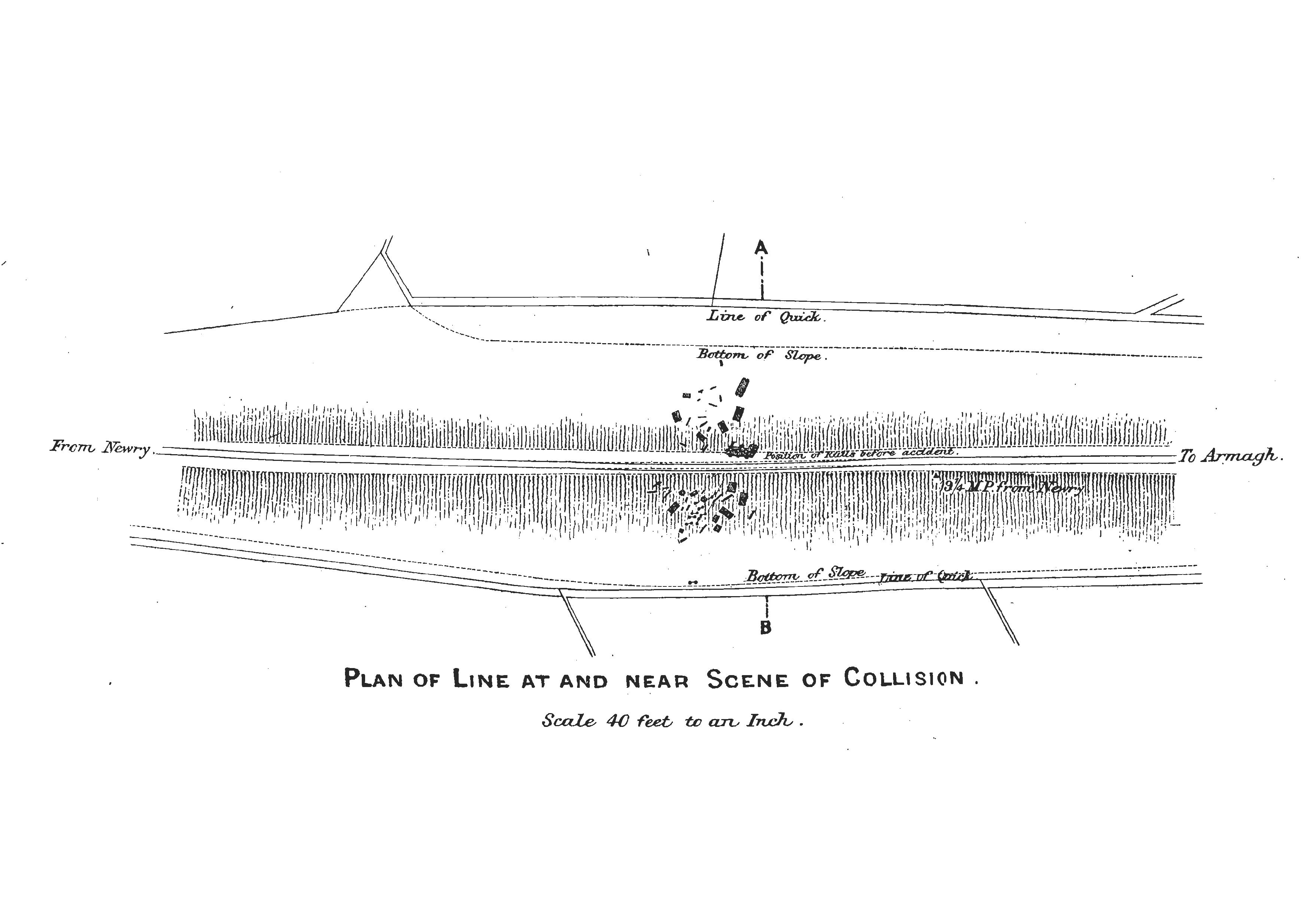
Splitting the train meant disconnecting the brake line. Once uncoupled, the rear ten carriages had only one handbrake in the rear guard's van and improvised stone wedges -- pieces of ballast shoved under the wheels -- to hold them on the gradient. When the front portion lurched forward, the jolt dislodged the stones. Eight carriages with no brakes at all rolled backward onto the two that were partially restrained, overwhelming the single handbrake. The entire rear portion began rolling downhill, gathering speed on the steep gradient back toward Armagh Station. The crew reversed the front portion and tried to catch and recouple it. They could not. The runaway carriages slammed into the oncoming scheduled service. The two rearmost carriages of the excursion train were utterly destroyed, and debris tumbled down a forty-five-foot embankment.
Eighty Lives, a Third of Them Children
Eighty people died and two hundred sixty were injured. About a third of the victims were children. Before the crash, passengers had been locked into their compartments -- standard practice to prevent ticketless boarding. Many could not escape the wreckage. It remains the worst railway disaster in Irish history and the fourth worst in the history of the United Kingdom. The Board of Trade investigation criticized the 'over-confidence' of the engine driver, the station master's decision to overload the train, and the chief clerk's failure to insist on assistance from the following train's locomotive.
The Law That Changed Everything
The Armagh disaster accomplished what years of recommendation and persuasion had not. Within two months, Parliament passed the Regulation of Railways Act 1889, which authorized the Board of Trade to require three things of all passenger railways: continuous automatic brakes, the block system of signalling, and the interlocking of points and signals. These were not suggestions. They were mandates. The Act is widely regarded as the beginning of the modern era in UK railway safety, the moment the British state moved from voluntarism to direct regulation of railway operations. The eighty people who died on that hillside outside Armagh -- families heading for a day at the beach -- became the reason no British train would ever again rely solely on a handbrake and a few rocks to hold it on a slope.
From the Air
The Armagh rail disaster occurred on the steep gradient just south of Armagh, at approximately 54.36N, 6.61W in County Armagh, Northern Ireland. The railway line climbed steeply out of Armagh station toward Hamilton's Bawn. Nearest airports: Belfast International (EGAA) about 25 nm northeast, Belfast City (EGAC) about 25 nm east. The terrain is hilly farmland. Best viewed below 3,000 ft AGL.