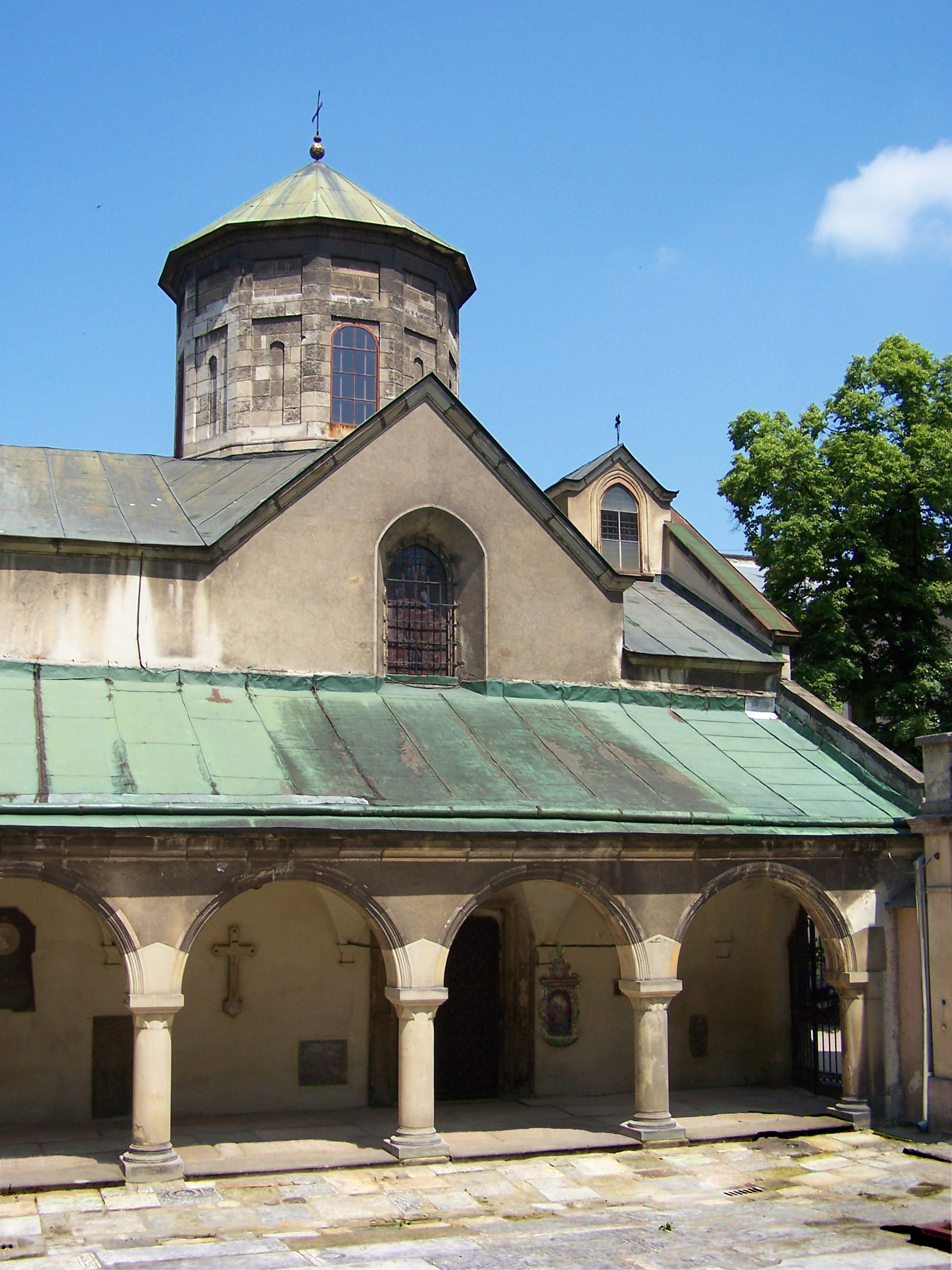
Armenian Cathedral of Lviv
An Armenian merchant from Caffa financed a church in 1363 in a city where he was, technically, a foreigner. That the cathedral he built still stands more than six centuries later -- through fires, occupations, forced closures, and the near-total erasure of its congregation -- says something about what stone and faith can endure when empires cannot. The Armenian Cathedral of the Assumption of Mary sits in Lviv's Old Town, just north of the market square, its modest exterior concealing one of the most layered histories of any religious building in Ukraine.
Modeled on a Lost Capital
The cathedral was modeled on the Cathedral of Ani, the ancient Armenian capital -- a city that by the 14th century was already in ruins. The choice was deliberate: a diaspora community building a spiritual anchor that pointed back to a homeland most of them would never see. Construction ran from 1363 to 1370, and the church was established as the mother church of an Armenian eparchy in Lviv. By 1437, an arcade gallery surrounded the building, its southern portion surviving to this day. A fire in 1527 damaged the structure, but the community rebuilt. A stone bell tower went up in 1571, and the main nave was extended in 1723. Each repair and addition reflected a community determined to hold its ground in a city where Poles, Jews, Ukrainians, Germans, and Armenians jostled for space and influence.
A Union Before Its Time
The cathedral's denominational history is tangled in ways that mirror the politics of its city. In 1630, Bishop Mikolaj Torosowicz united the Lviv Armenians with the Roman Catholic Church, and his successor Vartan Hunanyan continued the process in 1681 -- more than a century before the Armenian Catholic Church was formally established in 1742. For nearly three centuries afterward, the cathedral served the Armenian Catholic archdiocese of Lviv, a community that threaded its identity between East and West. Between 1908 and 1927, the cathedral underwent a thorough restoration, its interior transformed by the artists Jan Henryk Rosen and Jozef Mehoffer into something luminous and deeply contemplative.
Silenced by the Soviets
When the Soviet Union absorbed Lviv after World War II, the Armenian Catholic Archdiocese was abolished. Its administrator, Dionizy Kajetanowicz, was arrested. Almost the entire Polish-Armenian community was expelled westward to Poland, and the cathedral was shuttered, its sacred interior repurposed as a warehouse for plundered art. For decades, the building stood silent -- not destroyed, but emptied of everything that had given it meaning. The archdiocese technically still exists in canon law, but it has had no resident bishop since 1938, a vacancy that stretches across nearly a century.
A Contested Resurrection
After the Soviet collapse, two communities reached for the same building. Armenian Catholic families who had clung to their identity through decades of suppression sought to re-establish their parish. But Armenians from the Armenian Apostolic Church, who had settled in Lviv during Soviet times, also claimed the cathedral. Shortly before Pope John Paul II visited Lviv, Ukrainian authorities granted the building to the Armenian Apostolic Church, stipulating that both communities could worship there. On May 18, 2003, the Catholicos of All Armenians, Karekin II, re-consecrated the cathedral in a ceremony attended by dignitaries including singer Charles Aznavour and former Ukrainian president Leonid Kravchuk. Notably absent were Polish Armenians and Armenian Catholic clergy -- a pointed omission that underscored how much of the building's history remained contested.
What the Walls Hold
Step inside and the centuries press close. The interior owes much of its current beauty to the early 20th-century restoration by Rosen and Mehoffer, whose work blends devotional gravity with Art Nouveau grace. Two wonder-working icons -- one of St. Gregory the Illuminator, the other of the Mother of God -- were brought from Yazlovets in the 17th century and still watch over the nave. A small Benedictine convent lies just north, and to the south, adjoining the bell tower, stands the palace of the Armenian archbishops, both dating to the late 17th century. In 2009, the Polish Ministry of Culture began financing a new renovation, with Polish and Ukrainian specialists working side by side -- a collaboration that would have seemed impossible during most of the building's existence.
From the Air
Located at 49.843N, 24.031E in the heart of Lviv's UNESCO-listed Old Town. The cathedral sits just north of Rynok Square. The nearest major airport was Lviv Danylo Halytskyi International (UKLL), though Ukrainian airspace is currently closed to civil aviation. Visible from low altitude among the dense rooftops of the Old Town district. The bell tower, dating to 1571, is a distinctive vertical element amid the surrounding Renaissance and Baroque architecture.