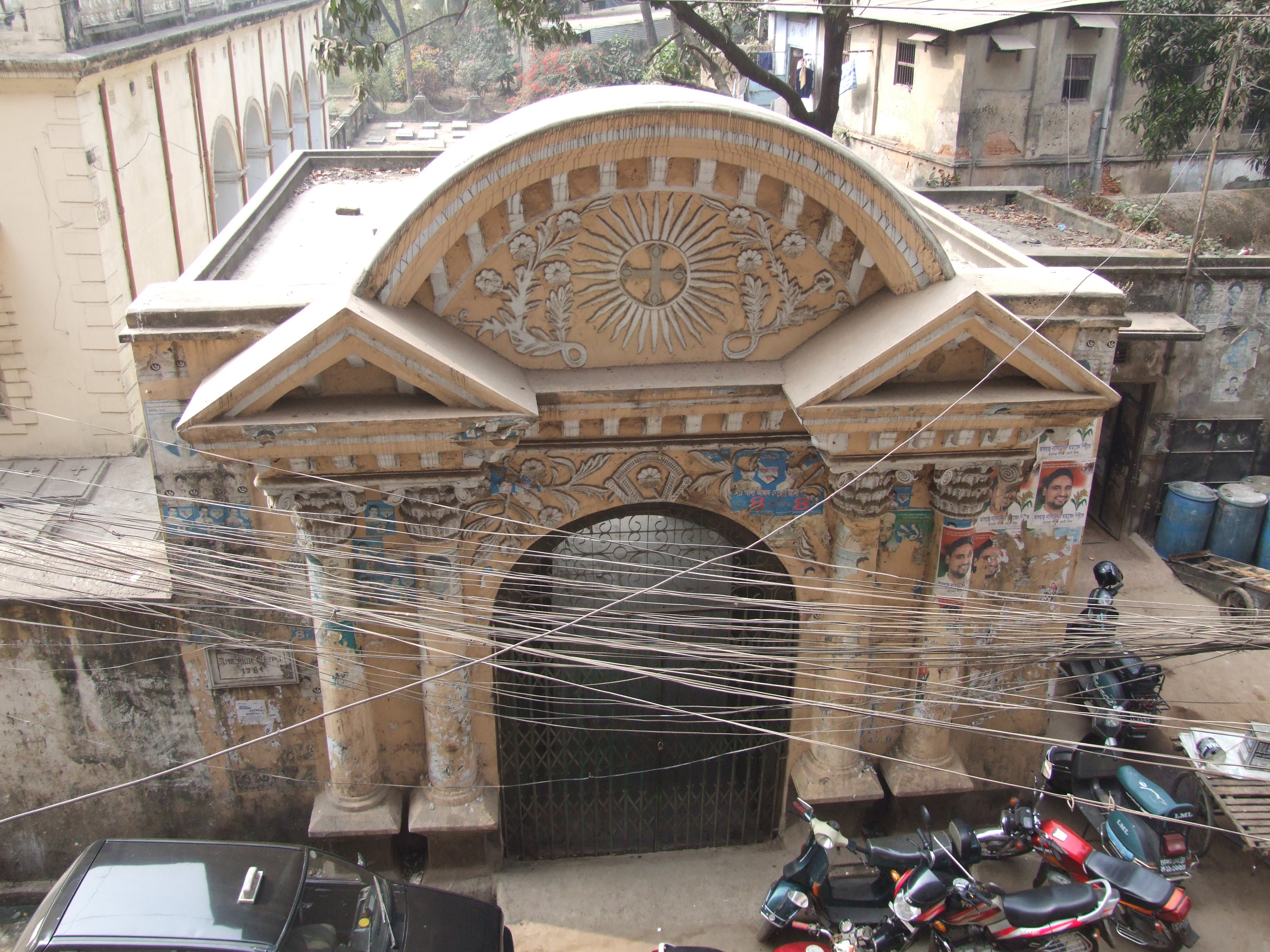
Armenian Church, Dhaka
Among the 350 graves in the churchyard, one tombstone bears a statue of a woman and the inscription "Best of Husband." It marks the resting place of Catchik Avatik Thomas, commemorated by a monument his family purchased in Kolkata and shipped to Dhaka. The grave belongs to a community that barely exists here anymore, yet the Armenian Apostolic Church of the Holy Resurrection still stands on Armenian Street in Armanitola, its arched windows and square tower intact after nearly 250 years. No Armenian congregation gathers for regular services. Six staff members maintain the building. Every Thursday, hundreds of local visitors arrive, not for worship but for the Michael Martin Food Assistance Program, which provides milk for babies and full meals for the needy.
Traders from a Distant Homeland
The Armenian presence in Dhaka dates to the 17th century, a consequence of the Safavid dynasty's domination of Armenia. Displaced by Persian rulers, Armenians were sent to the Bengal region for political and economic purposes. Those who arrived in Dhaka found a city hungry for trade, and they obliged. Armenian merchants dealt in jute and leather, two commodities that generated enough profit to convince some families to settle permanently. The neighborhood where they concentrated became known as Armanitola, a name that survives on modern maps even though the community that created it has vanished. By 1781, the Armenians had built their church on a site that had already served as their graveyard, and the tombstones that predate the building now serve as the most detailed chronicle of Armenian life in Bengal.
Arched Windows, Painted Walls
The church stretches 750 feet in length across two stories, with 4 doors and 27 arched windows. The floor plan centers on a main worship hall flanked by two rectangular wings that double as verandas and entrance passages. Inside, the main floor divides into three zones: a railed pulpit, a middle section with folding doors, and a seating area separated by a wooden fence. A spiral staircase leads to the second floor, where the rectangular wings open onto terraces. The square tower carries a shonkhonil, a type of minaret used in the Indian subcontinent as a mark of respect. Charles Port painted the works that still hang inside the church. Behind the pulpit, a baptism room holds a marble font sunk three feet deep. A watch house built by Johans Paru Piyete Sarkis once stood nearby, but the 1897 earthquake destroyed it.
One Man's Monumental Effort
By the 1980s, the church stood at the edge of oblivion. With no resident congregation and growing pressure on the property, the building seemed destined for absorption into the expanding city. Michael Martin, an Armenian with deep ties to Dhaka's vanishing community, mounted what amounted to a one-family campaign to preserve the church. He and his relatives made personal sacrifices that kept the doors open and the walls standing through years when the outcome was far from certain. Without his intervention, the physical record of Armenian life in Dhaka would likely have been erased. Martin died in Canada on 10 April 2020, but his legacy persists in the food program that bears his name and in the simple fact that the church still exists at all.
A Living Archive
The church's survival attracted attention beyond Dhaka. BBC and AFP produced documentaries about the building before the Bangladesh government declared it a religious and historical heritage site, placing it under the Department of Archaeology within the Ministry of Cultural Affairs. The government of Armenia expressed interest in cooperating with the restoration effort. In 2023, an Armenian resident priest was approved to serve at the church, splitting time between Dhaka and the Armenian communities of Singapore and Myanmar. Mother Teresa stayed in the church compound during a 1996 visit to the city. Today the site is open to daytime visitors, who sign a guestbook on their way in. The church serves the Church of Bangladesh for regular services, and visiting Armenian priests conduct occasional Armenian rites. What began as a merchant community's place of worship has become something rarer: a monument to a people who left, maintained by those who stayed.
From the Air
Located at 23.712°N, 90.402°E in the Armanitola district of Old Dhaka. The church compound with its square tower is nestled in dense urban fabric and best spotted from low altitude. Nearest major airport is Hazrat Shahjalal International Airport (VGHS), approximately 12 km north. The Buriganga River runs roughly 500 meters to the south, providing a useful navigation reference.