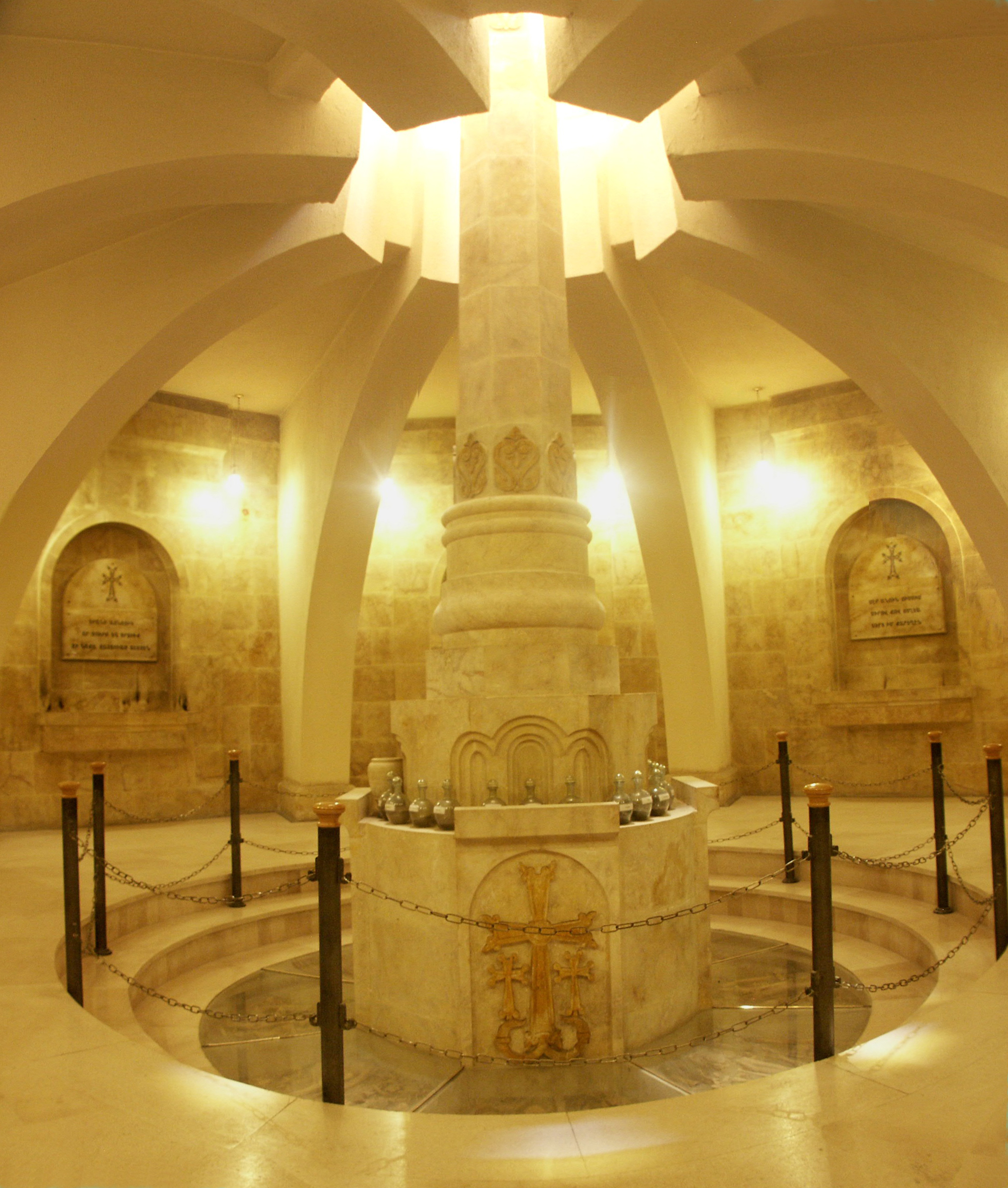
Armenian Genocide Memorial Church, Der Zor
Deir ez-Zor was where the marches ended. During the Armenian genocide of 1915-1923, the Ottoman government drove hundreds of thousands of Armenians from their ancestral lands on forced death marches into the Syrian desert. Deir ez-Zor, a dusty city on the Euphrates, was designated as their final destination -- not because anyone expected them to arrive alive, but because the surrounding desert would finish what the marches began. The killing centers around Deir ez-Zor became among the most lethal sites of the genocide. For Armenians, this stretch of desert is sacred ground, soaked in the suffering of their grandparents and great-grandparents. On that ground, they built a memorial.
Bones Beneath the Column
The memorial complex rose on land that had served as a burial site, concentration camp, and execution ground during the genocide. The Armenian community in Deir ez-Zor had first built a small chapel dedicated to Saint Hripsime on the spot. By 1985, the Armenian Apostolic Church's Diocese of Aleppo initiated a more ambitious project. Construction of the Martyrs' Memorial began in December 1989 and was completed in November 1990. Catholicos Karekin II of the Armenian Catholicosate of Cilicia consecrated it on May 4, 1991. The complex served simultaneously as church, museum, monument, archive center, and exhibition space. Its most powerful element was the Column of Resurrection, a massive pillar rising from the basement hall through the center of the church. Around the column's base, arranged as witnesses, lay the bones of genocide victims -- remains dug from the Syrian desert, placed there so that no visitor could forget what had happened in this place.
Architecture as Testimony
Every element of the complex carried meaning. The entrance stairs symbolized the catastrophes endured by the Armenian nation -- suffering climbed but never surrendered. The facade was decorated with pigeons and crosses, representing the struggle and sacrifice required to achieve peace. To the right of the courtyard stood the Wall of Friendship, inscribed with both Arabesque and Armenian motifs, acknowledging the bond between the two peoples. Two continuously flowing springs on this wall signified inexhaustible life. Opposite the entrance, a monument bore a khachkar -- an Armenian cross-stone brought from Armenia itself -- with an eternal flame burning before it. Five replicas of Armenian genocide monuments from around the world flanked the memorial. The church pointed upward, built to embrace the sky. Beneath it, the basement museum held books, documentary photographs, and publications narrating the genocide's history. Every April 24, Armenian Genocide Remembrance Day, tens of thousands of Armenian pilgrims traveled from across the globe to gather at Deir ez-Zor and commemorate the dead.
Destroyed a Second Time
On September 21, 2014, the memorial complex was blown up. Most reports attributed the destruction to militants of the Islamic State, which controlled Deir ez-Zor at the time. But Shahan Sarkisian, the Armenian Prelate of Aleppo, noted that the perpetrators' identity was never verified and that, unlike other ISIL demolitions, no footage of the act was disseminated. Journalist Robert Fisk reported that fighters from Jabhat al-Nusra appeared to be responsible. Analyst Sam Hardy pointed out that former al-Nusra fighters may have carried out the act while serving under the ISIL banner. The timing was pointed: the destruction came just months before the centennial of the genocide, and on the 23rd anniversary of Armenia's independence. Catholicos Aram I called it "an act of barbarism" -- a specifically planned crime targeting both the church and the memory it preserved.
Memory That Outlasts Stone
The destruction of the Deir ez-Zor memorial struck the Armenian diaspora with particular force because of what the site represented. This was not merely a church or a museum. It was a place of pilgrimage built on the very ground where their ancestors had been killed, a place where bones recovered from the desert served as physical testimony. Destroying the memorial did not erase the history it commemorated -- if anything, it added another chapter to the long story of violence directed at Armenian memory. The genocide itself was followed by decades of denial. Memorials like Deir ez-Zor existed precisely to counter that silence, to insist that the dead be acknowledged. The complex joined a global network of Armenian genocide memorials, from Yerevan's Tsitsernakaberd to monuments across the diaspora, each one a refusal to let the world forget. The bones beneath the Column of Resurrection are scattered now, but what they testified to remains.
From the Air
Located at 35.20N, 40.08E in Deir ez-Zor, Syria, on the Euphrates River in the eastern Syrian desert. The memorial site was in the city itself; the surrounding terrain is flat, arid desert. Nearest airport is Deir ez-Zor Airport (OSDZ). The Euphrates River is the dominant visual landmark, cutting through brown desert terrain. The memorial complex was destroyed in 2014; only ruins remain.