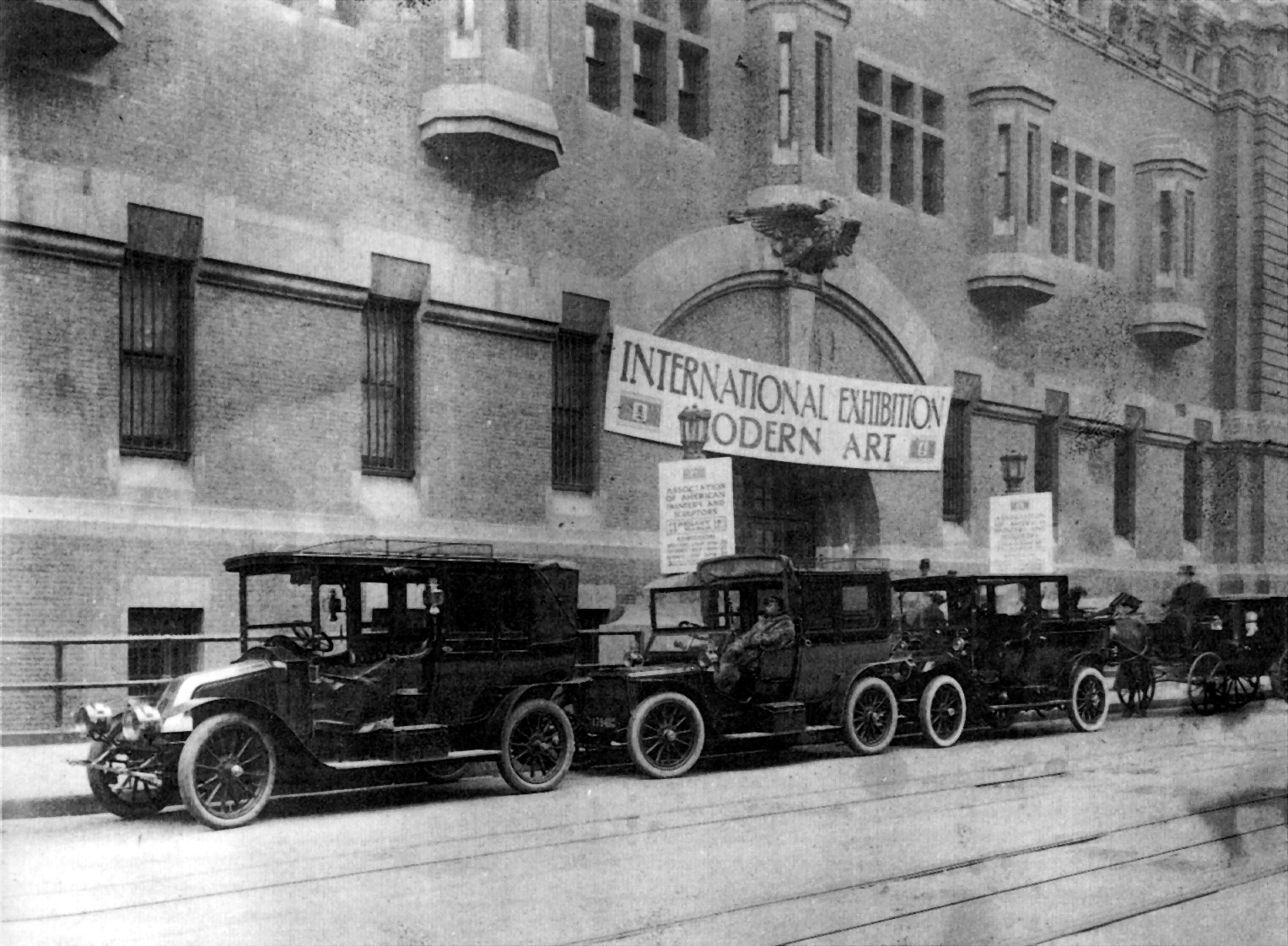
The Armory Show: The Night America Saw Modern Art
One painting changed everything, and it was not even particularly large. Marcel Duchamp's "Nude Descending a Staircase, No. 2" occupied a modest stretch of wall inside the 69th Regiment Armory on Lexington Avenue between 25th and 26th Streets. A critic for the New York Evening Sun described it as "an explosion in a shingle factory." That single dismissive line guaranteed that every curious New Yorker who read the morning papers would come see for themselves. They did -- roughly 87,000 of them in New York alone, between February 17 and March 15, 1913. What they encountered was the International Exhibition of Modern Art, organized by the Association of American Painters and Sculptors, and it was unlike anything America had ever seen.
Three Men and a Pine Tree Flag
The show was the brainchild of three artists: Arthur B. Davies, the association's president, whose own work was a mild form of Symbolism; Walt Kuhn, who traveled to Europe in the fall of 1912, visiting studios and galleries to select works; and Walter Pach, an American painter living in Paris who served as the critical European liaison. Pach opened doors to the studios of Duchamp, Brancusi, and the Cubists. The trio chose the pine tree flag of the American Revolution as the exhibition's emblem, a deliberate signal that this show was meant as an act of artistic independence. Their ambition was to present the full arc of modern art, from Ingres and Delacroix through the Impressionists, Post-Impressionists, and Fauves, all the way to the Cubists who were terrifying critics in Paris.
Eighteen Octagonal Rooms
The armory's vast drill hall was divided into eighteen octagonal galleries, each draped in burlap and decorated with potted pine trees. Roughly 1,300 works by approximately 300 artists filled the space. The American section was the largest -- galleries A through F and L through N -- but the European works drew the crowds and the fury. Cezanne, Gauguin, Van Gogh, Matisse, Picasso, Braque, and Kandinsky hung alongside American painters like Edward Hopper, Stuart Davis, and Joseph Stella, many of whom were exhibiting for the first time beside the European avant-garde. About a fifth of the exhibiting artists were women, a fact that later generations have only recently begun to rediscover. The admission price was modest, the catalog cheap, and the public showed up in enormous numbers.
The Volcano of Outrage
The reaction was volcanic. Former President Theodore Roosevelt visited the show and pronounced the Cubists "lunatics." The New York Times called Duchamp's nude "an orderly heap of broken violins." When the exhibition traveled to Chicago's Art Institute, students burned Matisse in effigy. Brancusi's abstract sculptures baffled viewers accustomed to heroic bronzes. Critics who could parse a Sargent portrait found themselves speechless before a Kandinsky improvisation. And yet the controversy itself was the engine of success: people came to be outraged, and many left converted. The show's attendance across its three cities -- New York, Chicago, and Boston -- exceeded 300,000. Art dealers who had shown no interest in European modernism before 1913 suddenly could not acquire it fast enough.
The Aftershock
The Armory Show did not just introduce modern art to America. It rewired the country's cultural infrastructure. In the years that followed, the collections assembled by patrons who were galvanized by the exhibition -- people like Walter Arensberg, Lillie P. Bliss, and John Quinn -- became the seed collections of institutions that define American art today. Bliss's holdings helped establish the Museum of Modern Art in 1929. The Whitney Museum of American Art, founded in 1931, grew directly from the impulse the show created to take American modernism seriously. Before 1913, New York's art world looked primarily to the academies of Europe for validation. After 1913, it began to look at itself.
Lexington Avenue, Still Standing
The 69th Regiment Armory still stands at 68 Lexington Avenue, a massive Beaux-Arts brick fortress. It hosts events, exhibitions, and the annual art fair that bears the original show's name, now held at the Javits Center. In 2013, the centennial was marked by exhibitions at the New-York Historical Society and the Montclair Art Museum, the latter opening on February 17, exactly one hundred years to the day from the original. The Smithsonian's Archives of American Art created a digital timeline of primary source documents from the show. Walking past the armory today, it is easy to forget that inside these walls, over a few weeks in the winter of 1913, American culture cracked open and let the twentieth century in.
From the Air
The 69th Regiment Armory is located at 68 Lexington Avenue, Manhattan (40.7412N, 73.9835W), between 25th and 26th Streets. The large Beaux-Arts building is identifiable from low altitude as a substantial brick structure in the Kips Bay/Gramercy area. Nearby airports: KJFK (John F. Kennedy, 24km SE), KLGA (LaGuardia, 13km NE), KEWR (Newark Liberty, 15km W). Best viewed at 2,000-4,000 feet AGL approaching from the East River.