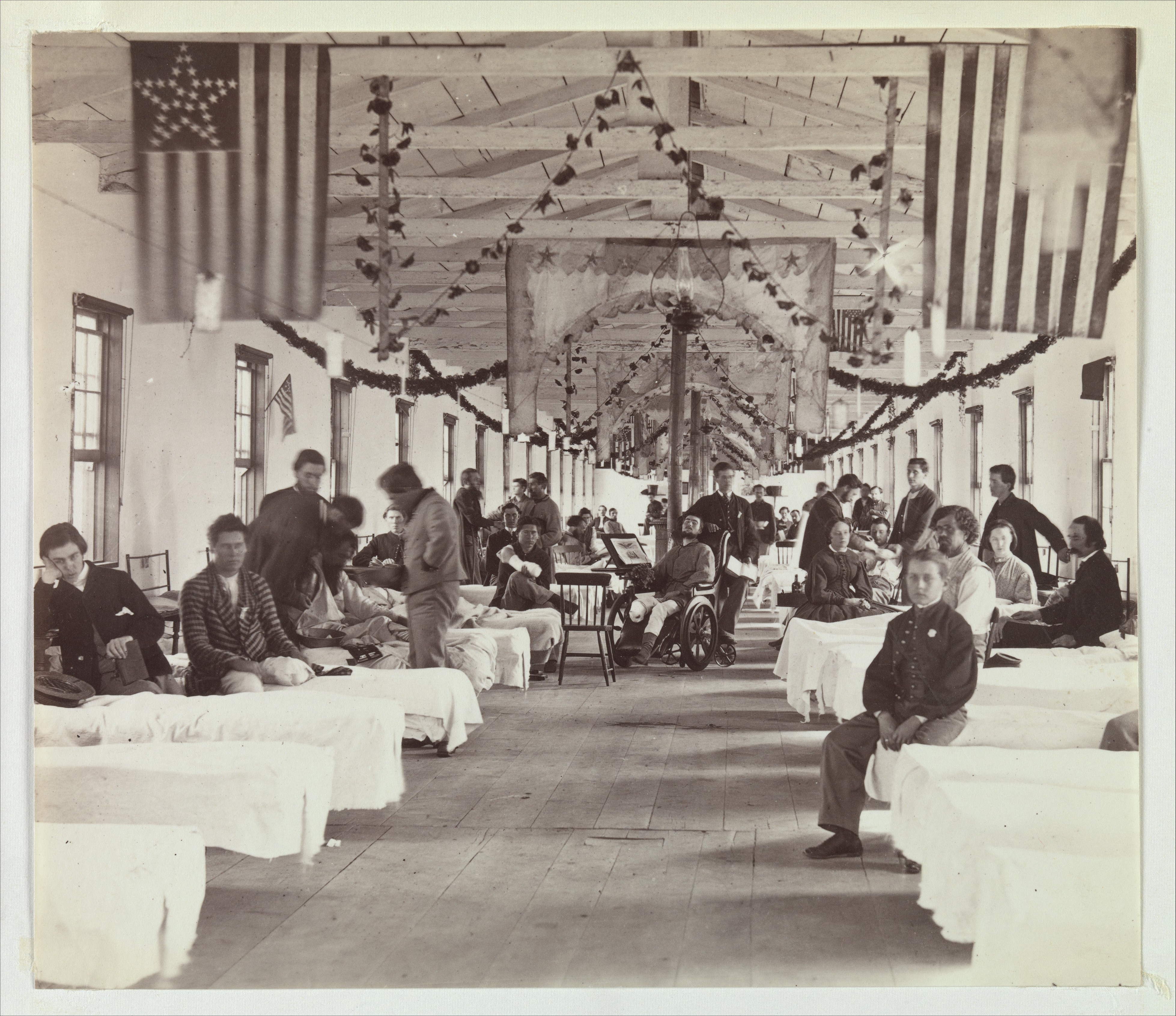
Armory Square Hospital
"I devote myself much to Armory-square hospital because it contains by far the worst cases, most repulsive wounds, has the most suffering and most need of consolation. I go every day without fail, and often at night -- sometimes stay very late." Walt Whitman wrote those words about a place that no longer exists. Where the National Air and Space Museum now stands, between the Smithsonian Castle and the Capitol, twelve wooden ward buildings once stretched across the National Mall, holding a thousand beds filled with the broken bodies of Union soldiers. Armory Square Hospital operated from 1862 to 1865, and its proximity to the Potomac River wharves meant it received the casualties no other hospital wanted -- the ones too gravely wounded to be moved any farther from the war.
The Worst Cases
The hospital rose on land that President Franklin Pierce had designated in 1856 for a District of Columbia armory -- a site chosen at the intersection of 6th Street SW and B Street SW (now Independence Avenue) because it was centrally located on level, firm ground. When the Civil War overwhelmed Washington's existing medical facilities, the Armory's surroundings became something far different from a parade ground. Twelve ward barracks went up in 1862, along with quarters for officers, service facilities, and a chapel. Overflow tents accommodated the surges. Wounded soldiers arrived by steamboat at the city wharves in southwest Washington and across the Long Bridge at the end of Maryland Avenue SW. Because Armory Square was the closest hospital to these arrival points, it became the destination for the gravest casualties -- men receiving end-of-life care, undergoing additional surgeries, or waiting until they were stable enough to be transferred farther from the front lines.
The Poet in the Wards
Walt Whitman arrived in Washington from New York after reading that his brother George had been wounded. Finding George's injury minor, Whitman might have returned home. Instead, he stayed. The suffering he witnessed in the city's hospitals -- and at Armory Square in particular -- compelled him to volunteer through the Christian Commission, visiting wounded soldiers daily, developing close relationships with many of them, and raising money for their provisions. The experience reshaped him. His collection The Wound Dresser emerged from those bedside hours, transforming personal grief and wartime anguish into some of the most powerful American poetry ever written. Whitman did not merely observe; he sat with dying men, wrote letters for those who could not hold a pen, and became a constant, comforting presence in wards filled with unimaginable suffering.
Lincoln Among the Beds
President Abraham Lincoln visited Armory Square Hospital in 1863. Nurse Amanda Akin Stearns recorded the scene in her memoir, The Lady Nurse of Ward E, published in 1909: "It was pathetic to see him pass from bed to bed and give each occupant the warm, honest grasp for which he is noted." Stearns wrote that Lincoln took a special interest in the hospital, suggesting flower beds be planted between the wards using plants from the government gardens -- a project that Dr. Bliss, the hospital superintendent, carried out. Stearns confessed that Lincoln's "homely face with such sad eyes and ungainly figure did not fill my youthful idea of a President of the United States," but she recognized the power of his presence to lift the spirits of the wounded soldiers in her care.
Farewell to Armory Square
The hospital published its own newspaper, the Gazette, which ran for several months providing reading material and news to patients while recognizing staff service. After the Surrender at Appomattox on April 9, 1865, the flow of wounded slowed and military leaders determined the hospital was no longer needed. The final edition of the Gazette, published on August 21, 1865, offered a remarkable reflection: "One cannot conceive of a gun-shot wound that has not been treated here. Of nearly every disease in the catalogue we have had examples." The writers added a prayer: "God grant that the stern emergency of a bloody civil war, which rendered so many asylums for our wounded and sick soldiers a necessity, may never again arise to curse with its mildew blights our native land." They bid farewell with measured grief: "Within its walls we have learned many a lesson of wisdom, of patience under suffering -- of the keenest grief -- of faith, forgiveness, of true manhood."
From Hospital to History
The hospital buildings began coming down in 1867, though the original Armory building survived. By 1873, landscaping reclaimed the Armory Square portion of the National Mall. The Armory itself served as storage until the Smithsonian Arts and Industries Building was constructed, then housed the United States Fish Commission headquarters from 1881 to 1932. Temporary buildings crowded around it starting in 1918. Finally, in January 1964, the Armory was demolished to make way for the National Air and Space Museum. Today, millions of visitors walk through that museum each year, most unaware that beneath their feet lies ground where a thousand soldiers once lay in wooden wards, where Whitman read poetry to dying men, and where Lincoln walked between the beds offering the only comfort a president could give -- his presence.
From the Air
Located at 38.89N, 77.02W on the National Mall in Washington, D.C. The hospital site is now occupied by the National Air and Space Museum, identifiable from the air between the Smithsonian Castle (to the west) and the U.S. Capitol (to the east). The National Mall stretches as a long green rectangle through the heart of the city. Nearby airports: Ronald Reagan Washington National (KDCA) 2nm south across the Potomac, Washington Dulles International (KIAD) 25nm west. The Potomac River wharves where wounded soldiers arrived are visible along the southwest waterfront.