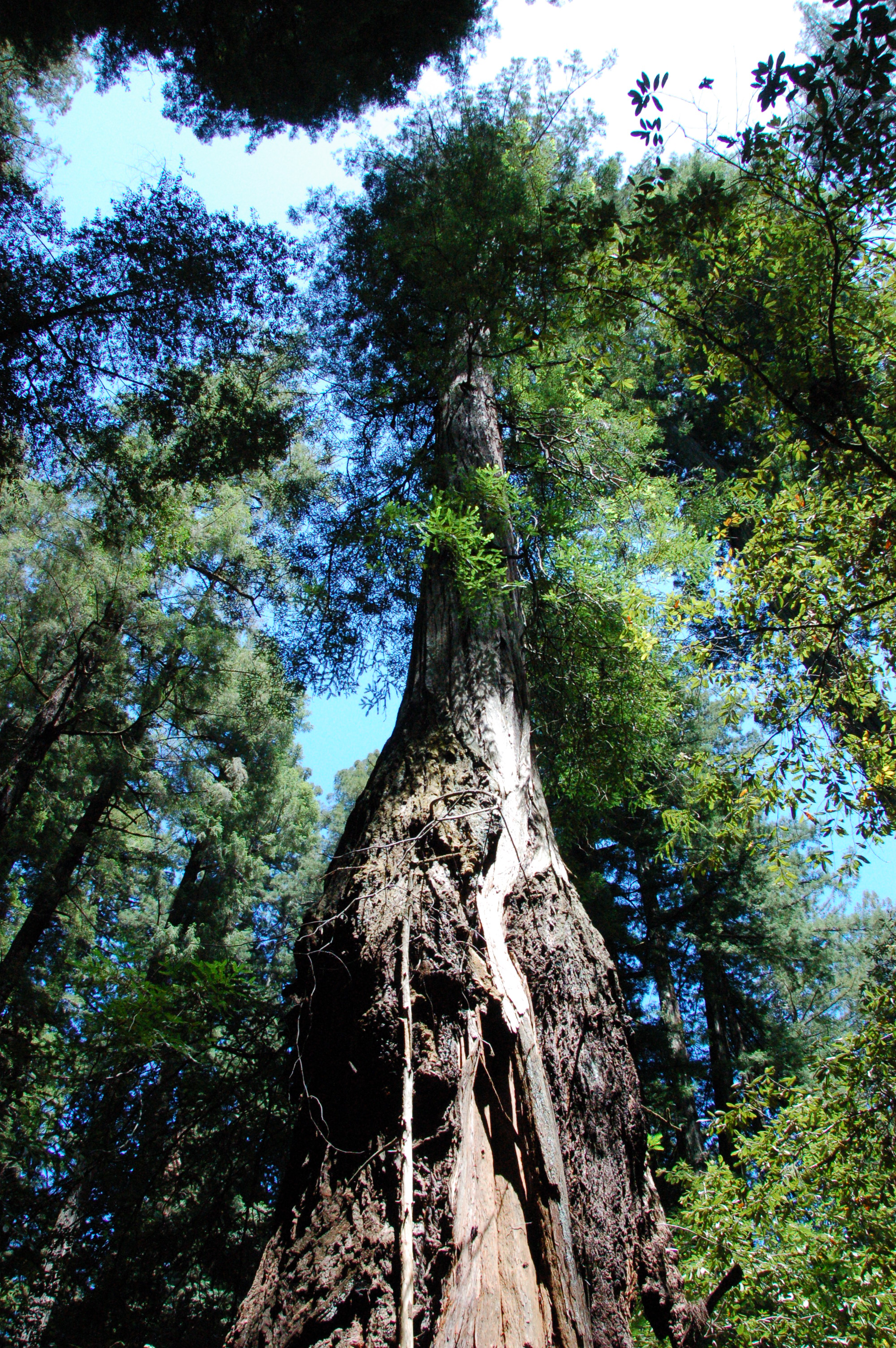
The Colonel's Last Stand
The Colonel Armstrong Tree was already six hundred years old when the Magna Carta was signed. It has stood in this canyon north of Guerneville for more than 1,400 years, long enough to have been a sapling when the Roman Empire still held together and a mature giant before Columbus crossed the Atlantic. Yet the remarkable thing about Armstrong Redwoods State Natural Reserve is not that this tree survived those centuries of history. It is that it survived the nineteenth century, when every other old-growth redwood forest in Sonoma County was cut down around it.
A Forest That Breathes Fog
The reserve protects 805 acres of coast redwoods in a narrow canyon that functions as a temperate rainforest. Fifty-five inches of rain fall here each year, almost all of it between September and June, but it is the summer fog that truly sustains the grove. Marine air pushes inland from the Pacific, threading through the Russian River corridor and condensing on the redwood canopy. The trees drink from the air itself, their needles combing moisture from the fog and dripping it down to their roots. Without this fog, the redwoods would struggle to survive the dry California summers. With it, they build trunks wide enough to drive a car through and push toward heights that test the physical limits of how far water can travel upward through living wood. The Parson Jones Tree, the tallest in the grove, reaches more than 310 feet into the canopy, a biological skyscraper visible from the park entrance.
Colonel Armstrong's Gamble
During the 1870s, when Sonoma County's lumber industry was reducing ancient forests to stumps and board feet at industrial speed, Colonel James Armstrong looked at the redwood grove on his property and made an unconventional decision. Instead of selling the timber, he set the land aside as a natural park and botanical garden. It was an act that cost him potential profit and must have baffled his neighbors, who were busy converting similar forests into fortunes. Armstrong died before he could see his vision secured permanently, but his daughter and the Le Baron family refused to let the grove slip away. They mounted a relentless public campaign of meetings, rallies, and automobile caravans designed to shame the county into action. In 1917, Sonoma County voters responded, approving an initiative to purchase the property for $80,000, an investment that preserved what their campaign rightly called the last remnant of the once mighty redwood forest.
Mysteries in the Bark
Beyond the headline trees, the grove holds quieter curiosities. The Icicle Tree displays the bizarre burl formations that grow on many redwoods, knobby outgrowths that can weigh several tons and appear hundreds of feet above the forest floor. Why these growths form remains a genuine botanical mystery. Scientists know that burls contain dormant bud tissue capable of sprouting new growth, and they may serve as a kind of biological insurance policy for the tree, but the mechanism that triggers their formation is still poorly understood. Walking the trails, you pass through an ecosystem layered with such puzzles. Ferns carpet the canyon floor in green so deep it borders on black in the shadows. Banana slugs navigate the duff. The air smells of tannin and damp earth and something older than any of it, a quality that visitors struggle to name but never forget.
A Park That Nearly Disappeared Twice
Sonoma County managed the grove until 1934, when the state of California assumed control. Two years later it opened to the public as Armstrong Redwoods State Park. In 1964, growing awareness of the grove's ecological significance prompted the state to reclassify it as a natural reserve, affording stricter protections against development and resource extraction. The adjacent Austin Creek State Recreation Area, accessible through the same entrance, offers a striking contrast: rolling hills of open grassland, oaks, and conifers where the dense canopy gives way to sunlight and sky. Today the reserve includes wheelchair-accessible trails with interpretive panels in Braille, an outdoor amphitheater nestled among the trunks, and tree-hugging platforms that let visitors wrap their arms around bark that was old before their country existed. The Colonel Armstrong Tree stands at the heart of it all, still growing, still breathing fog, still proving that one stubborn landowner's refusal to reach for the saw was worth more than anyone in the 1870s could have imagined.
From the Air
Coordinates: 38.5381°N, 123.01°W. The reserve sits in a redwood canyon just north of Guerneville along the Russian River in western Sonoma County. From the air at 3,000-4,000 feet AGL, the dense old-growth canopy is strikingly darker than the surrounding mixed forests and grasslands. The Russian River corridor provides a clear visual guide running east-west through the area. Nearest airports: KSTS (Charles M. Schulz-Sonoma County Airport, 18 nm east), E16 (South County Airport of Santa Clara County, distant). Watch for summer fog banks pushing inland from the coast, which can obscure the canyon entirely below 1,500 feet.