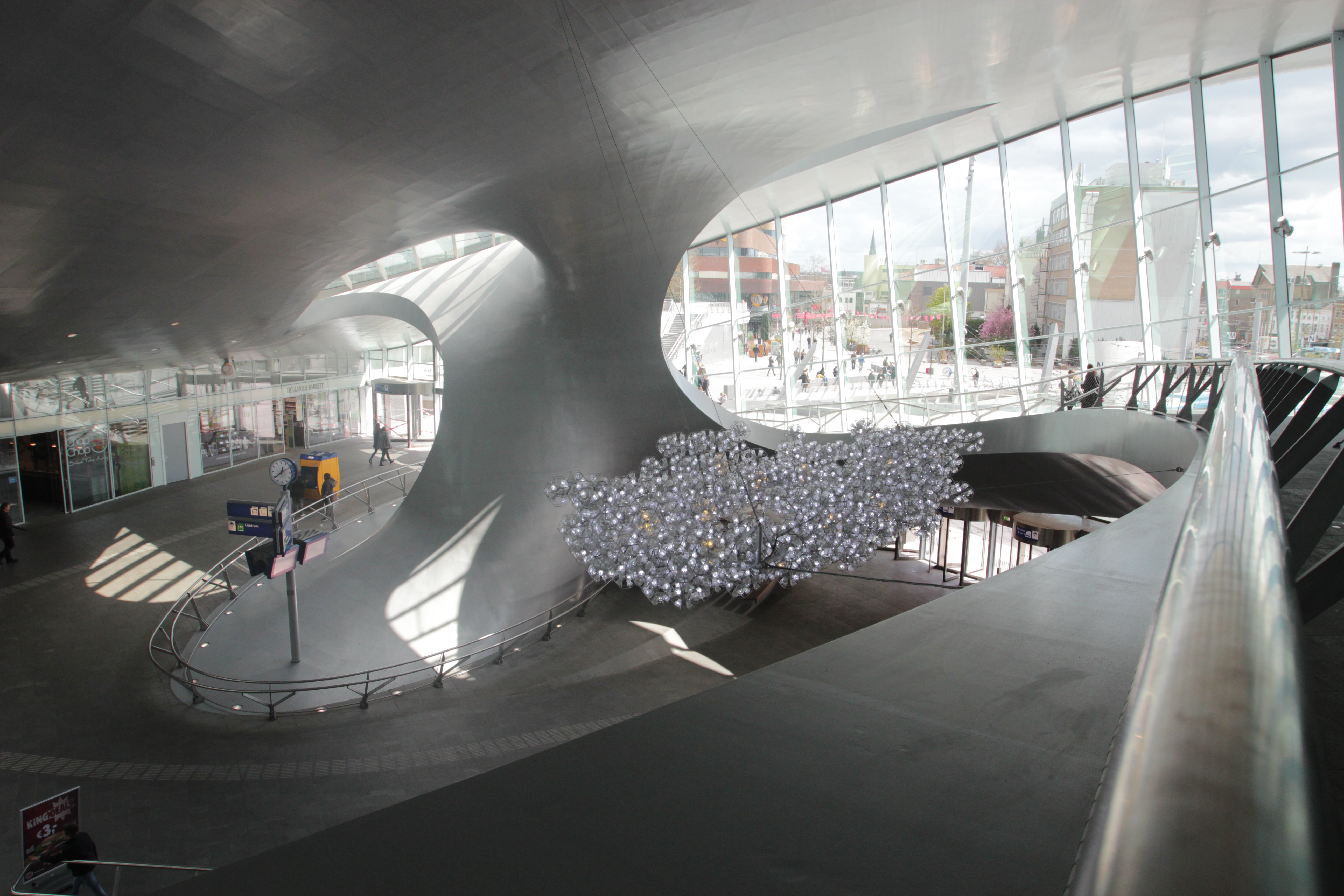
Arnhem Centraal railway station
Walk through the front entrance of Arnhem Centraal and the ceiling does something ceilings are not supposed to do. It twists. It folds in on itself. White concrete sweeps overhead in a single continuous surface that seems to have been poured by someone trying to capture motion in a substance famous for refusing to move. Designed by Amsterdam's UNStudio in collaboration with the engineer Cecil Balmond, the terminal that opened on 19 November 2015 took nearly two decades to finish and won the Dutch Nationale Staalprijs for steelwork that disappears entirely into its sculpted shell.
A Station That Refuses Right Angles
Most train halls are honest about their structure. Columns hold things up; beams cross overhead; the geometry announces itself. Arnhem Centraal does the opposite. The 18,000-square-meter main hall has almost no straight lines. Floor curves into wall, wall curves into ceiling, and the whole interior reads as one continuous surface bending around the travelers beneath it. UNStudio borrowed the form from a Klein bottle, a mathematical object with no inside or outside, and translated it into pre-stressed concrete and steel ribs hidden beneath the white skin. Stand still for a moment, look up, and the geometry is genuinely disorienting in the way good architecture sometimes should be.
Twenty Years of Patience
The project began in 1996, when Arnhem agreed that its old station could no longer cope with the traffic flowing through Gelderland's capital. Reconstruction broke ground in 2006. A temporary entrance accessible only by three flights of stairs served passengers while the existing station was demolished around them. A new tunnel under the platforms opened in 2011. That same summer, a dive-under was excavated west of the station so that Nijmegen and Utrecht trains could pass beneath the main tracks without crossing them; all western traffic was suspended for five weeks while crews dug. The completed station finally reopened on 19 November 2015, and on that day the station was rechristened Arnhem Centraal, dropping the simple Arnhem it had carried since 1845.
Where the Lines Converge
Arnhem is a junction in the truest sense. The station sits at the crossing of three historic railways, the Amsterdam-Arnhem line opened in 1845, the Arnhem-Leeuwarden line, and the Arnhem-Nijmegen line. Trains heading east continue across the German border on the Oberhausen route, picking up the Intercity-Express that carries passengers through Cologne to Frankfurt and on to Basel. About 40,000 people pass through the station every day, making it the ninth-busiest in the Netherlands. The covered bus station tucked beneath the Essent towers handles dense city service, including Arnhem's distinctive trolleybus network, the last of its kind in the country, with overhead wires running into the surrounding neighborhoods.
A Building That Reads Differently from Above
From the air, the station roof reveals what is harder to grasp from inside. The white form crests and dips like a frozen wave, surrounded by the office towers and shopping arcades that filled in around it during the long construction. The 76,000-cubic-meter volume of the main hall, designed to handle up to 110,000 transfers per day, looks improbably small beside the larger civic gesture it makes, a deliberate landmark for a Dutch city whose 20th-century skyline was largely rebuilt after the war that came through here. For Arnhem, a place that has had to start over more than once, the choice to build something this ambitious in the first decade of the new century was not accidental.
From the Air
Located at 51.985 degrees north, 5.901 degrees east, in the Dutch city of Arnhem near the German border. The nearest airport for general aviation is Teuge International (EHTE), about 35 km north. Schiphol (EHAM) lies 95 km west, Eindhoven (EHEH) 75 km south, and Düsseldorf (EDDL) about 90 km southeast across the German border. Recommended viewing altitude 2,500-4,000 feet AGL on a clear day, the white sculpted roof stands out against the urban grid just north of the John Frost Bridge over the Nederrijn.