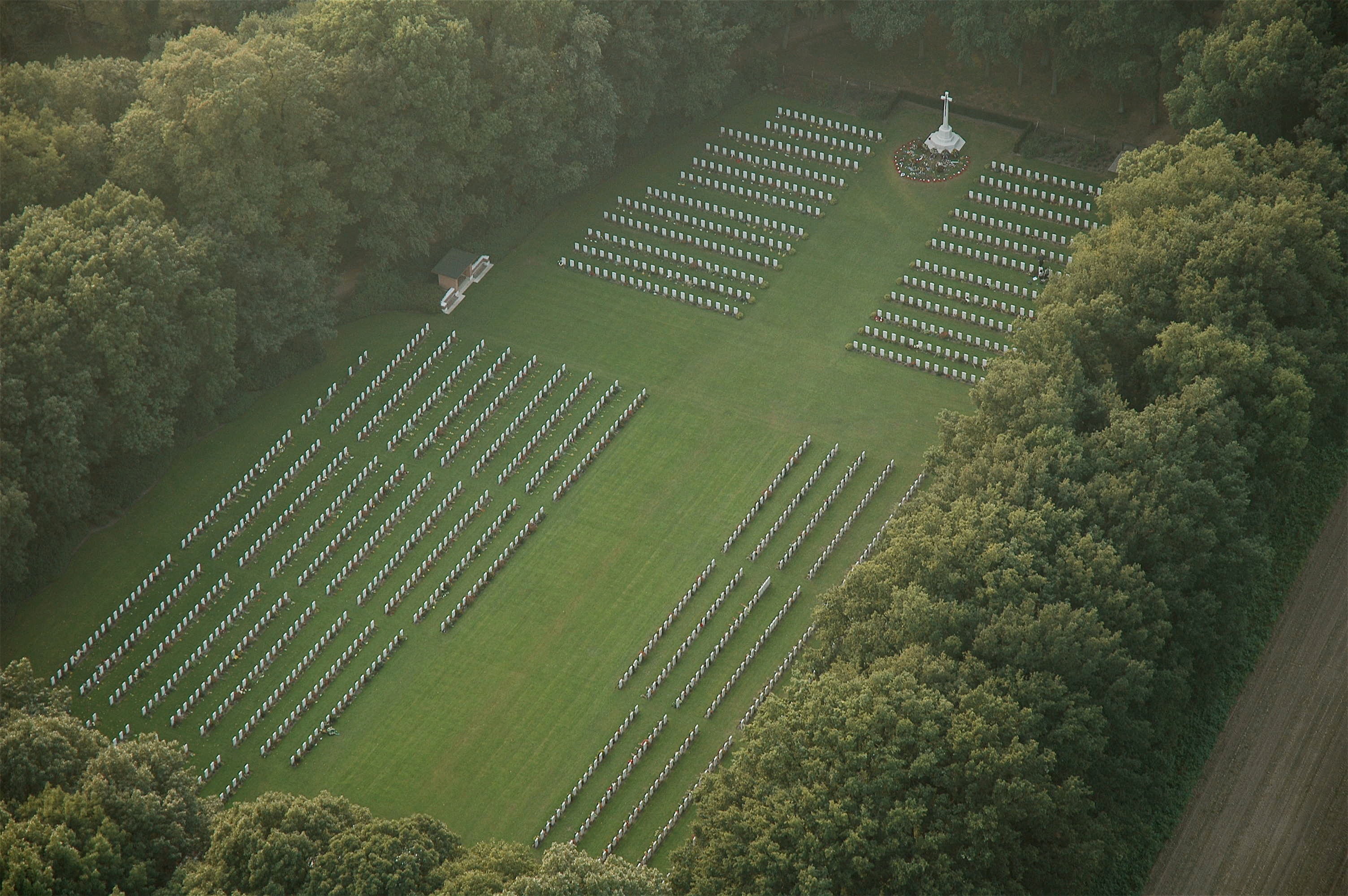
Arnhem Oosterbeek War Cemetery
On the first weekend of every September, more than a thousand Dutch schoolchildren walk into a small field north of Oosterbeek carrying flowers. Each child stops at a Commonwealth War Graves Commission headstone, reads the name carved on the white Portland stone, and places a bouquet at its base. The youngest of them are seven or eight years old. The graves they tend belong mostly to soldiers who died in September 1944, in the failed Allied attempt to seize the bridge at Arnhem, and to whose families the children have written letters in advance.
Why the Cemetery Exists
When the British 1st Airborne Division was withdrawn across the Rhine on 25 September 1944, after nine days of fighting, the dead had to be left behind. Almost 2,000 Allied soldiers had been killed: more than 1,174 men of the British 1st Airborne Division, 219 from the Glider Pilot Regiment, 92 from the Polish 1st Independent Parachute Brigade, 368 RAF aircrew, dispatchers of the Royal Army Service Corps, men of XXX Corps, and US troop carrier crews. They were buried where they fell, sometimes in their own slit trenches, sometimes in mass graves dug by the Germans. Kate Ter Horst, whose Oosterbeek house had served as a regimental aid post during the battle, returned after the war to find 57 graves in her garden. When Arnhem was liberated in April 1945, British grave registration teams began the work of finding and identifying the rest.
A Field on Perpetual Loan
In June 1945, the Dutch government offered a small field north of Oosterbeek to the Imperial War Graves Commission on perpetual loan, and the Allied dead were reburied there. As of 2023 the commission records 1,759 graves in the cemetery: 1,684 are Commonwealth, including British, Canadian, Australian and New Zealand servicemen. Seventy-three are Polish, many of them exhumed and moved from Driel to the lasting disappointment of that village's residents, who had cared for the graves themselves. Eight are Dutch civilians, some killed in the fighting, some former commission staff. Two hundred and forty-three of the headstones bear no name. Three of the five Victoria Crosses awarded for the battle mark graves here; all three were awarded posthumously. Bodies are still found in the woods and farmland around Arnhem in the 21st century, identified where possible by Dutch grave registration staff, and reinterred in this small field.
The Ceremony That Would Not End
The flower ceremony began at the first commemoration after the war and has been held every year since. By 1969, the 25th anniversary, the Parachute Regiment quietly approached the Dutch organizers to suggest that the time had come to let the battle pass into history. The Dutch refused, vehemently and emotionally. The ceremony was theirs as much as anyone's; the men buried here had died trying to liberate their country, and Dutch families had spent a generation grieving alongside British ones. The commemoration continues on the first weekend of September each year. Children write to the families of the soldiers whose graves they have been assigned. Some correspondences last decades. Some carry on now into a second or third generation of letter-writers on both sides.
What the Stones Do Not Show
Three hundred more Allied dead from the Battle of Arnhem lie elsewhere, in civilian cemeteries across the Netherlands, Belgium, Britain and the United States. Sixty are buried in Germany, where they died as prisoners of war after the battle. The German dead, at least 1,300 of them, were originally buried at the SS Heroes Cemetery near Arnhem and were later reinterred at Ysselsteyn. Some 453 Dutch civilians killed during Market Garden are commemorated separately. The men still missing, 138 of them as of 2003, are named on the Groesbeek Memorial nearby. The numbers tell one part of the story. The other part is told by a child who is too young to remember the war, who has nonetheless been entrusted with a name and a bouquet, and who will return next September to do it again.
From the Air
Located at 51.994 degrees north, 5.849 degrees east, in Oosterbeek, a village just west of Arnhem in the Netherlands. The cemetery is a rectangular field of white headstones surrounded by woodland, visible from low altitude. The nearest airfield is Teuge International (EHTE) about 35 km north; Schiphol (EHAM) lies 95 km west, Eindhoven (EHEH) 70 km south. Recommended viewing altitude 1,500-3,000 feet AGL. The rebuilt John Frost Bridge over the Nederrijn lies about 8 km east, a useful navigation reference for understanding the geography of the 1944 battle.