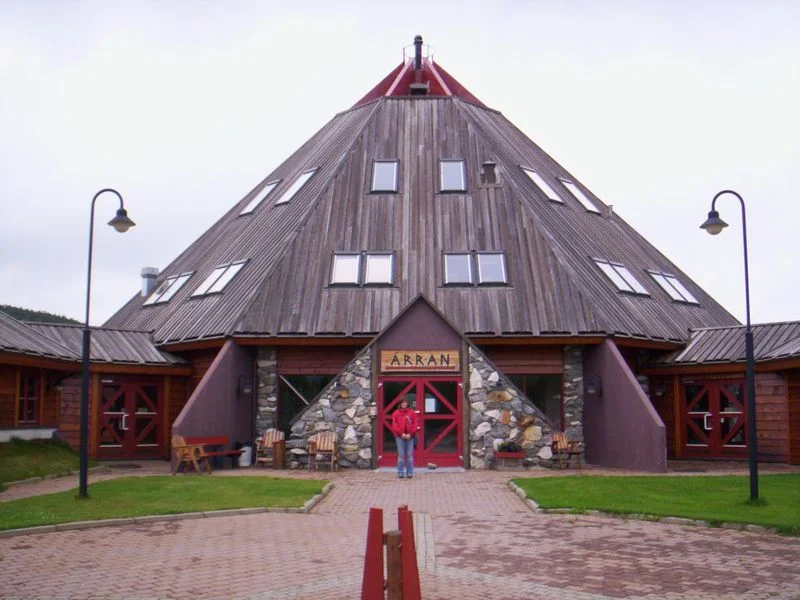

Árran Lule Sámi Centre
Drag is the kind of place that doesn't really announce itself. It sits on the narrow shore of Tysfjord in Hamarøy Municipality, in Norway's Nordland county - a village of a few hundred people, with mountains rising sharp behind it and the long fjord stretching east. But Drag is the heart of a culture: the home of the Lule Sámi, one of the smallest of the Sámi language groups, with perhaps 2,000 speakers across Norway and Sweden combined. At the centre of Drag stands Árran - a museum, a school, a publishing house, a kindergarten, a research office - all packaged into a single institution whose job is to keep a language and a people from disappearing. Árran means hearth in Lule Sámi. The name fits.
The Smallest of the Sámi Tongues
The Sámi peoples - indigenous to the northern reaches of Norway, Sweden, Finland and Russia - speak not one language but a family of related ones, spread along a 1,500-kilometre arc across the top of Europe. The Northern Sámi language has tens of thousands of speakers; the smaller varieties - Southern Sámi, Pite Sámi, Ume Sámi, Skolt Sámi - have only hundreds. Lule Sámi sits in the middle, with perhaps 2,000 speakers concentrated around Tysfjord on the Norwegian side and around the Luleå river drainage in northern Sweden. It is the language of a particular landscape: high mountain plateaus, deep fjords, long inland lakes, summer pastures and winter reindeer grounds. It is the language of generations whose lives were shaped by reindeer herding, fishing, and the seasonal migrations that the borders of modern Norway and Sweden eventually cut in half.
Founding the Hearth
Árran was established in 1994 - relatively late in the history of Sámi cultural institutions, but at a moment when Norway was finally beginning to reckon with its long history of forced assimilation. For most of the 20th century, the Norwegian state had pursued a policy of Norwegianisation: Sámi children were sent to boarding schools, forbidden to speak their own language, taught that their parents' culture was backward. The damage was deep and generational. Some Lule Sámi families simply stopped speaking the language at home, hoping to protect their children from the institutional pressure. By the 1990s, when the language nearly disappeared in some villages, the need for an institution like Árran was urgent. The centre opened with a museum, a kindergarten teaching Lule Sámi to the youngest children, and a publishing programme. It now offers on-site and video-conference language courses to learners across Scandinavia.
Books, Journals, and a Dictionary
Since 1999, Árran has published the popular-scientific journal Bårjås, written primarily in Lule Sámi and Norwegian, with article summaries in the Lule Sámi language. For a small community, Bårjås is an extraordinary undertaking - peer-reviewed pieces on archaeology, linguistics, history, and contemporary culture, published in a language that has no commercial market. Árran has also worked on the Sámasta online language course, has published children's books and reference works, and has been developing a Norwegian-Lule Sámi dictionary. Each project is an act of survival. Each new book published means another generation has access to its own language in print. Director Lars Magne Andreassen has led the institution since 2011.
The Mikal Urheim Archive
In 2017 Árran received a major archive donation from Mikal Urheim, one of the most important figures in modern Lule Sámi culture. Urheim was a teacher, language activist, and tradition-bearer whose materials - personal papers, recordings, photographs, ethnographic notes - constitute a substantial portion of the surviving documentation of mid-20th-century Lule Sámi life. The archive went to the Árran museum, where it joins material the centre has been collecting since its founding: traditional clothing (gákti), tools, photographs of reindeer-herding families, recordings of joiks - the traditional vocal music in which a person, place, or animal is given voice rather than described.
Drag, Tysfjord, and the Future
From Árran you can step outside and look across Tysfjord to mountains that rise nearly vertically from the water. The fjord is one of the deepest in Norway. The Hellemobotn pass behind it was once a crucial reindeer migration route. This is not abstract heritage: the families connected to Árran still herd reindeer, still fish, still live in a Lule Sámi landscape - even if Norwegian is now usually the language of the shop and the workplace. The centre exists at the intersection of two stories. One is the recovery: a language coming back into schools, books published, children learning words their grandparents were punished for using. The other is the loss: only 2,000 speakers, a language officially classed as severely endangered, and a long road still ahead. Árran is the hearth that keeps both stories warm - and the institution that, year by year, decides what the next generation of Lule Sámi will inherit.
From the Air
Árran is at 68.05°N, 16.08°E, in the village of Drag on the shore of Tysfjord, Hamarøy Municipality, Nordland - well above the Arctic Circle. Cruising altitude FL080-FL130 over this part of northern Norway offers astonishing views: the deep cleft of Tysfjord, the Hellemo mountains, the long ribbon of E6 highway, and on clear days the white peaks of the Lofoten chain to the west. The light here is the famous Arctic light - midnight sun from late May to mid-July, polar night through December and early January, and the aurora visible on most clear winter nights. Nearest airports: Narvik/Harstad-Evenes (ENEV) about 75 km north, Bodø (ENBO) about 200 km southwest. Weather changes rapidly along these fjords; sudden katabatic winds off the mountain plateaus can produce severe turbulence in the valleys.
Nearby Stories
- Kvitbjorn Disaster 6 km away
- HMS Curlew (D42) 20 km away
- Skrova Lighthouse 34 km away
- HMS Hardy (H87) 42 km away
- Rago National Park 47 km away
- Laponia 73 km away
- Saltstraumen 78 km away
- Convoy PQ 15 365 km away