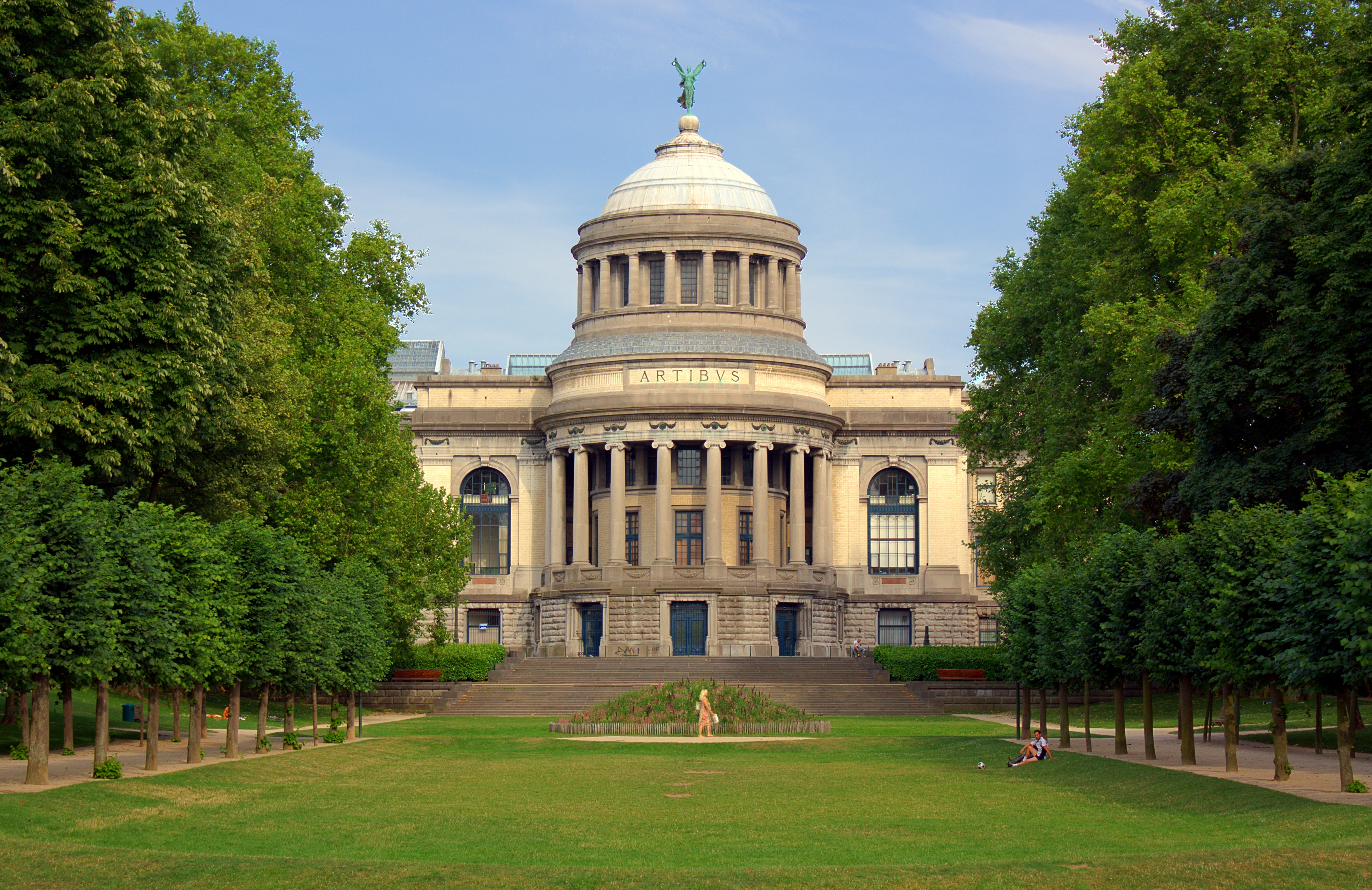
Art & History Museum
In 1935, a Belgian training ship called the Mercator returned from Easter Island with an oddly specific passenger: Pou Hakanononga, the god of tuna, carved in stone, colossal, and very heavy. The Rapa Nui had once carried him to the shoreline to bless their fishing. The Mercator carried him to Brussels, where he now sits in a gallery of the Art and History Museum, several thousand miles from any tuna. He is one of more than a hundred thousand objects in this museum, and his journey is not unusual. Egyptian sarcophagi, Roman colonnades from Syria, Aztec figurines, a Tibetan goddess, a Native American totem pole — all converged here, in a glass-and-iron palace on a 19th-century parade ground.
A Parade Ground for Empire
The Cinquantenaire was originally just that: a parade ground, flat and wide, where the Belgian army marched in formation under King Leopold II. In 1880, Belgium decided to celebrate fifty years of independence with a National Exhibition, and the army's drilling field acquired a vast iron-and-glass palace, full of light and engineering swagger. The military took the north wing. The eclectic mess of antiquities the young Kingdom of Belgium had inherited — Burgundian and Habsburg treasures stored uncomfortably inside the medieval Halle Gate — needed a home. By 1889 they were here, settling into rooms designed for trophies of a different kind. The museum has been growing into the building ever since, while the building itself has been growing into the city around it. Outside, traffic now thrums around the Schuman roundabout and the European Quarter. Inside, the lights are low and the cases are full.
Eleven Thousand Pieces of Egypt
The Egyptian collection alone numbers more than 11,000 pieces, much of it gathered by the prodigious Belgian Egyptologist Jean Capart in the early 20th century. There is the Lady of Brussels, a serene limestone bust whose half-smile has survived three thousand years of weather and wandering. There is a relief of Queen Tiye, mother of Akhenaten and grandmother of Tutankhamun, her royal features still sharp under the gallery lights. A colossal Ptolemaic pharaoh's head looms above visitors who suddenly feel very small. Mummies rest in painted sarcophagi, their wrapped feet pointed toward a Brussels exit they will never use. The mastaba — an entire reconstructed tomb facade — invites you to step into a place built for the dead and emerge again.
The Colonnade from Apamea
In a hall sized to hold it, fragments of the Great Colonnade of Apamea rise from the floor — fluted columns that once lined a Roman avenue in what is now Syria. In front of them stands a bronze statue of Septimius Severus, the African-born emperor who restored Apamea after an earthquake. Belgian archaeologists excavated here in the 1930s, and what they found includes a stunning fifth-century mosaic of a hunting scene that once paved the palace of a Roman governor of Syria Secunda. Children visiting this gallery sometimes lie on the floor to look up the columns, which is exactly the right thing to do. Nearby, a 20th-century French architect's scale model of fourth-century Rome lets you hover, godlike, above the imperial city at its peak.
Mosan Gold and Horta's Shop
The European decorative arts wing tells the story of the Low Countries through the things their craftsmen made beautifully. The Treasure Room is staged like a medieval crypt: dim, hushed, the goldwork of the Mosan masters from the Meuse River valley glowing in their cases. A gilt copper candlestick from Dinant shows Samson wrestling a lion. An ivory plaque from Genoelselderen, late eighth century, carries Christ triumphing over evil. Walk on, through the Gothic cloister and the Flemish tapestries and the polychrome altarpieces, and you eventually arrive at something stranger: Victor Horta's actual Wolfers jewellery shop, dismantled from its original site and rebuilt inside the museum. Art Nouveau cases curve under Horta's own ironwork. In the park outside, his small Temple of Human Passions still shelters Jef Lambeaux's marble of writhing bodies, a sculpture too scandalous for its own time.
The Museum That Renamed Itself
Until 2018, this was the Cinquantenaire Museum, named for the park. The new name — Art and History Museum, one of the constituent parts of the Royal Museums of Art and History — is less poetic, but it's honest about the breadth: prehistoric Belgian tools, Greek vases, Coptic textiles, Khmer sculpture, Chola bronzes from Tanjore, Wayang masks from Java, pre-classic clay figurines that Mexican archaeologists nicknamed Pretty Ladies, headdresses of the Kayapo people of Brazil. The collections were gathered in an era when European museums took what they could; some pieces here are now the subject of restitution conversations that did not exist when they arrived. The Heart Museum room, a small obsession bequeathed by a Brussels cardiologist named Boyadjian, displays hundreds of objects depicting hearts — lockets, reliquaries, anatomical drawings, jewellery. The whole museum has something of that quality: a magpie's hoard, gathered across centuries, asking visitors to make sense of it themselves.
From the Air
The museum sits at 50.839 N, 4.392 E, in the Cinquantenaire Park beside the Schuman roundabout in Brussels' European Quarter. From altitude, look for the long iron-and-glass palace flanking a triumphal arch — the arch is the unmistakable centrepiece of the park. Nearest airport: Brussels Airport (EBBR), about 12 km northeast. Brussels is busy controlled airspace; expect EBBR Class C and frequent vectors. Best viewing on clear summer days when the glass roof of the palace glints from above.