Art Institute of Chicago
The museum purchased Edward Hopper's Nighthawks in 1942 for $3,000. Today, that painting is considered an icon of American culture, one of the most recognizable images in the country's artistic canon - and it hangs in a building that was never supposed to be a museum at all. The Art Institute of Chicago sits in Grant Park at 111 South Michigan Avenue, a Beaux-Arts palace originally designed to host meetings during the 1893 World's Columbian Exposition. The plan was always for the Art Institute to move in after the fair closed, but the building's grandeur exceeded what anyone expected for a young museum founded just fourteen years earlier by artists fleeing a bankrupt academy. That museum now holds nearly 300,000 works across 11 curatorial departments, spanning 5,000 years of human expression. It is the second-largest art museum in the United States, surpassed only by the Metropolitan Museum of Art in New York.
From Fire to Fine Art
The Art Institute's origin story is tangled with disaster. In 1866, a group of 35 artists founded the Chicago Academy of Design on Dearborn Street. They built a five-story stone school on West Adams Street, which opened in November 1870. The Great Chicago Fire destroyed it the following year. The academy limped along in rented spaces, hemorrhaging money, until it went bankrupt in 1879. That same year, a breakaway group founded the Chicago Academy of Fine Arts and bought the old academy's assets at auction. In 1882, they renamed it the Art Institute of Chicago and elected banker Charles L. Hutchinson as president. Hutchinson is considered the single most important figure in the museum's history. He held the presidency until his death in 1924, transforming a scrappy local institution into a world-class museum. The building itself was designed by Boston firm Shepley, Rutan and Coolidge, and its Michigan Avenue entrance is guarded by two bronze lions, each weighing more than two tons, sculpted by Edward Kemeys and unveiled in 1894.
Masterworks Behind the Lions
The collection reads like a greatest-hits album of Western art. Grant Wood's American Gothic has been here since 1930, when Wood entered it in a contest at the museum. It won a medal, and the painting depicting what has been called 'the most famous couple in the world' never left. Georges Seurat's Sunday Afternoon on the Island of La Grande Jatte - the pointillist masterpiece that inspired a Stephen Sondheim musical and mesmerized Cameron in Ferris Bueller's Day Off - hangs prominently in the galleries. Picasso's The Old Guitarist, painted during his Blue Period in 1903, anchors the Modern Wing. The Impressionist and Post-Impressionist collection is widely regarded as the finest outside France: more than 30 Monets, including six Haystacks, alongside Renoir's Two Sisters (On the Terrace), Caillebotte's Paris Street; Rainy Day, and van Gogh's Bedroom in Arles. The collection also stretches far beyond painting - 35,000 Asian objects, a mummy named Paankhenamun, 140,000 architectural works, the 68 Thorne Miniature Rooms at 1:12 scale, and three copies of Hokusai's Great Wave off Kanagawa.
The Modern Wing and a Million Square Feet
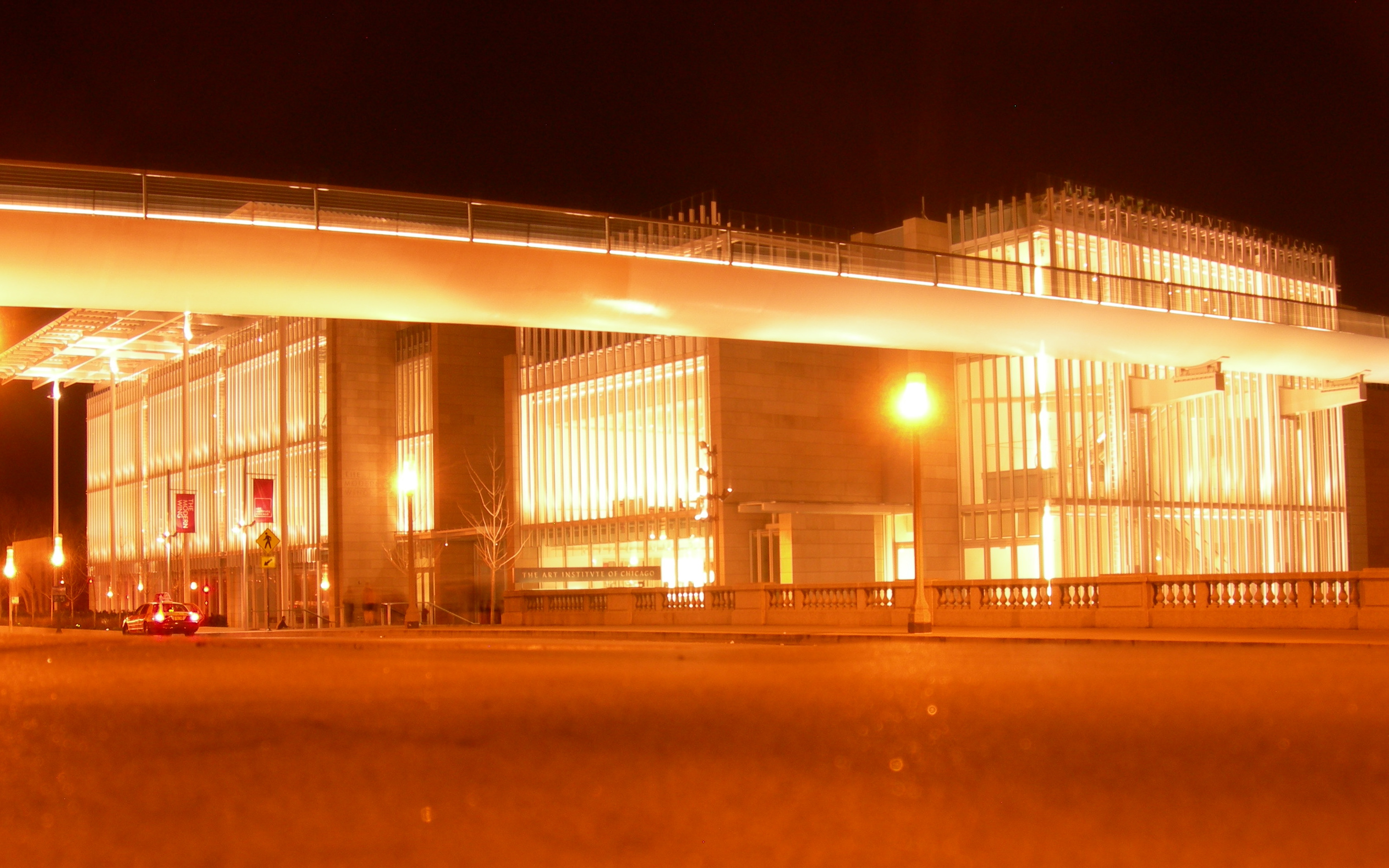
When Renzo Piano's Modern Wing opened on May 16, 2009, it added enough space to make the Art Institute the second-largest art museum in the country. The $294 million addition - the culmination of a $385 million fundraising campaign - houses 20th and 21st century art, contemporary galleries, photography, and architecture and design collections including original renderings by Frank Lloyd Wright and Mies van der Rohe. The Nichols Bridgeway connects a rooftop sculpture garden to Millennium Park. In 2015, collectors Stefan Edlis and Gael Neeson donated what has been called one of the world's greatest groups of postwar Pop art: works by Warhol, Johns, Twombly, Koons, Sherman, Lichtenstein, and Richter, with the museum agreeing to keep them on display for at least 50 years. Attendance surged to 2 million in 2009, a 33 percent increase. Tripadvisor named it the world's best museum in 2014.
A Building That Straddles Trains
The Art Institute has one of the most unusual floor plans of any major museum: it straddles open-air railroad tracks. Two stories of gallery space connect the east and west buildings while Metra Electric and South Shore Line trains rumble below. The east entrance features the reconstructed stone arch from the old Chicago Stock Exchange, designed by Louis Sullivan in 1894 and demolished in 1972 - salvaged portions of the original trading room were painstakingly rebuilt inside the museum. The lions at the Michigan Avenue entrance have their own tradition: when a Chicago sports team reaches a championship, the lions get dressed in that team's uniform. During Christmas, evergreen wreaths hang around their necks. The building sits on land publicly owned by the city and administered by the Chicago Park District, a reminder that this institution belongs, in a fundamental way, to Chicago itself.
Hollywood's Favorite Museum
In Ferris Bueller's Day Off, director John Hughes - a Chicago native - staged a wordless sequence that has become one of the most celebrated museum scenes in cinema. Set to The Dream Academy's cover of a Smiths song, Ferris and Sloane share a moment in front of Chagall's America Windows while Cameron stares into Seurat's pointillist dots, the camera zooming closer and closer until the image dissolves into pure color. Hughes called it a love letter to the museum. The 1970 Parker Brothers board game Masterpiece used reproductions of the Art Institute's paintings, introducing millions of players to Seurat, van Gogh, and Wood. In 2009, the facades along Lincoln Park were redressed to their 1934 appearance for the film Public Enemies. The museum has also embraced the digital age: in 2018, it released images of over 52,000 public-domain works under a Creative Commons Zero license, making masterpieces freely available to anyone.
From the Air
Located at 41.88°N, 87.62°W in Chicago's Grant Park, directly along the Lake Michigan shoreline. The Beaux-Arts building and Modern Wing are visible from altitude as part of the museum campus south of Millennium Park. The Chicago River is visible to the north. Nearby airports include Chicago O'Hare International (KORD, 14 nm northwest) and Chicago Midway International (KMDW, 8 nm southwest). Best viewed at 3,000-5,000 feet AGL on approach from the lake, where the museum's position between Grant Park's green space and the downtown skyline is striking.