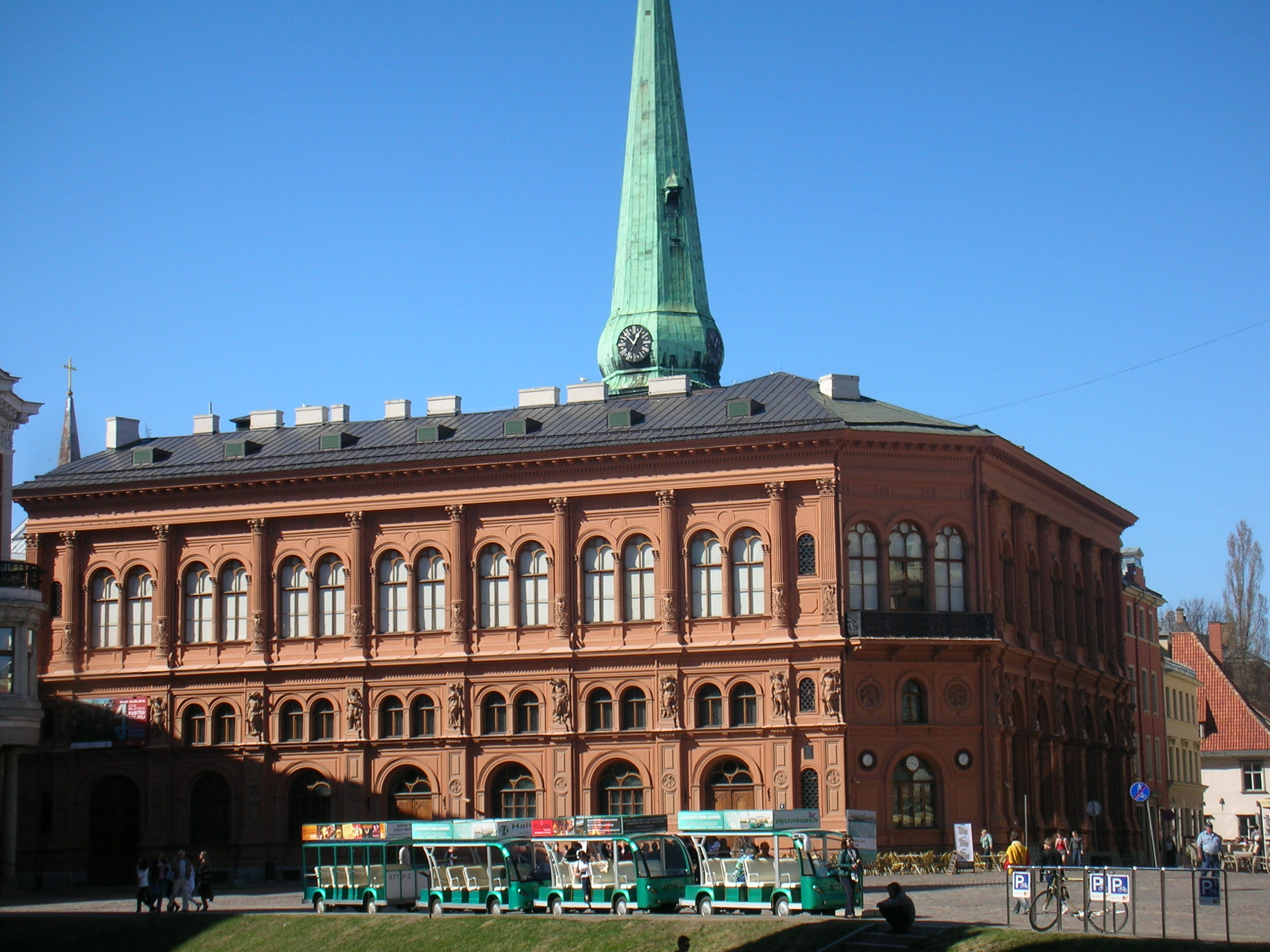
Art Museum Riga Bourse
Tsar Alexander II of Russia opened the Riga Stock Exchange in person on 26 May 1856. The merchants of Riga had been waiting nearly a decade for the building, and the architect they hired had given them something extraordinary: a Venetian Renaissance palazzo dropped onto a corner of medieval Old Riga, complete with a terracotta facade carved with allegorical figures. Atlas held up the sky on one side; Mercury, god of commerce, watched the trading floor from above. For ninety years the building was where Riga did business. Then a war, an occupation, a fire, and a long restoration turned it into something else entirely. Today the same halls where merchants haggled over Russian timber and English textiles hold a Monet, a Rodin, an Egyptian mummy, and 22,000 other works of art.
A Palazzo for Trade
By the 1840s Riga's commerce had outgrown the City Hall. The merchants' Stock Exchange Committee was meeting in shared rooms, and in 1847 the Great Guild decided to build a single new home for the Guild itself, the exchange, and a city theater. The architect they chose was Harald Julius von Bosse, a Baltic German nobleman who had built a successful career in St. Petersburg. Bosse insisted the building belong to the Old Town, fitting itself to the irregular medieval streets. The theater idea was dropped over fire risk. Construction began on 25 March 1852 on the corner of Pils, Šķūņu, and Jēkaba streets. Bosse modeled it on the Venetian Renaissance palazzo style, deliberately reaching for an architectural language that had once meant Mediterranean trading wealth. The Danish sculptor David Jensen, also working in St. Petersburg, modeled the terracotta gods who would watch over the bourse for the next century and a half.
What the Building Has Lived Through
The exchange survived the First World War and the founding of independent Latvia, but the Second World War was harder. The Soviet annexation in 1940 emptied the building of its function — there was no longer a stock market in Riga to hold a stock exchange — and after 1945 it was repurposed as the House of Science and Technology Propaganda. The terracotta facade was painted over in pale pink and brown. Then on 24 January 1980 a fire broke out on the upper floors. The damage scarred the building so badly that scars are still visible today. Reconstruction began, then stalled in 1982. For more than two decades the bourse stood half-fixed in the heart of Riga's Old Town. Real restoration only began in 2008 and finished in 2011, when the building reopened as the home of Latvia's foreign art collection.
The Collectors
The art that fills the building was assembled by Riga merchants and physicians over two centuries. The first private collection given to the city belonged to Nikolaus von Himsel, a Baltic German doctor who died in 1764 and left behind a Kunstkammer stuffed with oriental objects he had bought on his travels. Domenico de' Robbiani, an Italian merchant who settled in Riga, donated his Dutch, German, and French paintings. Reinhold Schilling gave thirty paintings; Mayor Ludwig Wilhelm Kerkovius added twenty-six. The largest single gift came from Friedrich Wilhelm Brederlo, who handed over 201 paintings, seventy of them by Dutch masters. By the time the museum was formally established in 1920, Latvia had inherited a collection that ran from antiquity to the nineteenth century, made not by aristocrats but by businessmen and doctors with a habit of sending money toward art.
Walking the Halls
The collection now numbers more than 22,000 works dating from the fourth millennium BC to the twenty-first century. There is Claude Monet's Winter Landscape (Sandviken), painted in Norway in 1895, all blue snow and cold light. There is a workshop version of Anton van Dyck's portrait of William II of Orange, painted in 1632 when the prince was barely a child. There is a Rooster Fight by Melchior d'Hondecoeter, a Society of Musicians by Niccolò Renieri, a Hubert Robert view of the Roman Augustus Temple at Nîmes. The sculpture rooms hold an Antonio Canova bust of the goddess Hebe, a Carpeaux Bacchante, a François Pompon Bear, and a bronze cast of Rodin's The Kiss. The decorative arts include Sèvres porcelain, Meissen vases, a Fabergé bird carafe, and an Indonesian wayang shadow puppet. It is not a focused collection — it is a collection of collections, layered like the city itself.
Old Town's Quiet Anchor
Stand in Doms laukums, the Dome Square that was created in 1937 by demolishing a row of older buildings, and the bourse is the long pale facade on your right. The cathedral closes the square at the far end. Behind both buildings the streets get narrower and crookeder, tipping toward the Daugava River and the city's seven centuries of trade. The bourse is the youngest of the major buildings on the square, and the only one originally built for money rather than God or government. The merchants who paid for it could not have predicted that their trading floor would end up holding ancient Egyptian artifacts and a Monet. But they would have understood the impulse: bring beautiful things from elsewhere, gather them in Riga, and put them on display.
From the Air
The Art Museum Riga Bourse sits at 56.95°N, 24.11°E on Doms laukums (Dome Square) in Riga's Old Town, on the right bank of the Daugava River. Best viewed at 1,500 to 2,500 feet AGL with the cathedral spire and the river bend serving as primary references. Riga International Airport (EVRA) is 8 kilometers southwest. The Old Town's compact UNESCO-listed core is unmistakable from the air, with the bourse forming part of the Cathedral Square ensemble. Light haze can dim the terracotta facade, so morning or late afternoon offers the best contrast.