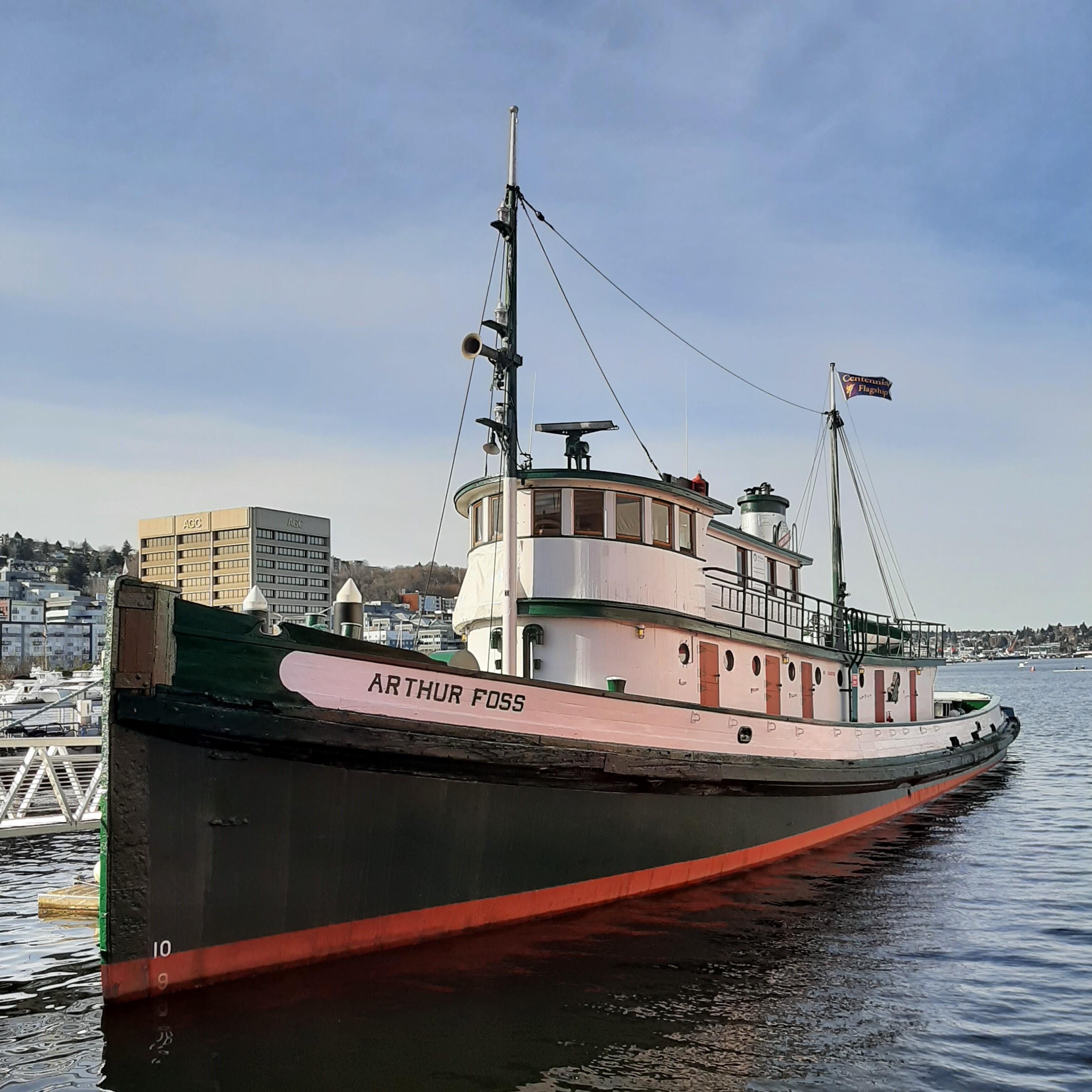
Arthur Foss
On the morning of December 8, 1941, a wooden tugboat painted white and green was crawling across the open Pacific at barely more than walking speed, towing two barges away from Wake Island. Twelve hours out, the radio crackled with the news: Pearl Harbor had been attacked. Japanese planes were simultaneously bombing Wake. The crew of the Arthur Foss mixed every can of white paint on board with engine grease and frantically repainted their vessel dark gray to blend with the ocean. They blacked out all lights and went radio silent. No one knew if they had enough fuel to reach Hawaii, or whether they would find the enemy waiting when they arrived. The tug they were trying to save was already fifty-two years old.
A Cape Cod Captain and the Columbia Bar
The tug was built in 1889 at Portland, Oregon, and christened Wallowa. Her first captain, R.E. Howes, was born in 1846 on Cape Cod, Massachusetts, and had spent years towing sailing ships across the Columbia River bar, one of the most treacherous stretches of water on the Pacific coast. On September 23, 1889, Howes took Wallowa on her maiden inspection trip across the bar, departing Astoria at three in the morning with Oregon Railroad & Navigation Company officials aboard. The tug performed flawlessly and spent the next nine years in this dangerous service, guiding tall ships through the breaking swells where river current collides with ocean tide.
Gold Rush and Gales
When the Klondike Gold Rush ignited a shipping frenzy in 1898, Wallowa was leased to the White Star Line to tow the sidewheeler Yosemite up the Inside Passage to St. Michael, Alaska, a gateway to the Yukon River goldfields. The work was punishing. On a return voyage from Skagway in November 1898, a powerful gale drove Wallowa ashore near Mary Island on the southeast Alaska coast. The tug refloated undamaged on the next high tide, though the bark Columbia she was towing was not so lucky -- it stranded at the mouth of Portland Canal and became a total loss. Wallowa's stout wooden hull kept her working Alaskan waters for years, hauling supply barges and construction materials to mining camps, and carrying mail and supplies between Juneau, Haines, Skagway, and Seattle.
Movie Star and Bridge Builder
Foss Launch & Tug Company purchased Wallowa in late 1929 and, to help cover the cost, leased her to MGM Studios in 1931 for filming the 1933 hit Tugboat Annie -- the first major motion picture filmed in Washington state. After her Hollywood turn, Foss rebuilt the tug in 1934 at Tacoma, installing a powerful Washington Iron Works diesel engine that made her the most muscular tug on the West Coast. Renamed Arthur Foss in honor of the company founder's eldest son, she became the Foss fleet's flagship. Under the skilled Captain Martin Guchee, Arthur Foss hauled a giant barge from San Francisco that had been used to build the Golden Gate Bridge, delivering it north for the ill-fated Tacoma Narrows Bridge. In 1938, Guchee drove Arthur Foss at full speed around an experimental barge on Lake Washington, generating four-foot waves to stress-test the pontoon design for the Lacey V. Murrow Memorial Bridge -- the world's first floating highway bridge, completed in 1940.
War in the Pacific
In February 1941, Arthur Foss departed Tacoma to deliver a drydock gate to Pearl Harbor, then continued to Wake Island to deliver construction barges. Captain Rolstad and his crew were at Wake when the war warnings began. On the morning of the attack, Rolstad decided to skip refueling and run for the open sea. The crew's desperate camouflage job and the decision to follow original orders to Honolulu at reduced speed saved them. The Navy commissioned Arthur Foss in early 1942, renaming her Dohasan and assigning her to tow supply barges between Hawaiian bases. She even ventured to French Frigate Shoals to help build an emergency airstrip. After the war, the worn-out tug was placed in a floating drydock for the voyage home, but rough seas knocked her off her keel blocks and heavily damaged the hull. Foss spent until August 1948 rebuilding her.
The Oldest Survivor
Arthur Foss returned to work towing bundled log rafts in the Strait of Juan de Fuca for twenty years, setting the record for the longest uninterrupted towing service in the Straits. She retired in July 1968 after seventy-nine years of commercial service. In 1970, Henry Foss -- the last surviving son of company founder Thea Foss -- presided over her donation to Northwest Seaport. Volunteers painstakingly refurbished the main engine piece by piece, achieving the first startup as a museum ship in 1980. Declared a National Historic Landmark in 1989, the same year both tug and Washington State celebrated their hundredth birthdays, Arthur Foss now rests at the Historic Ships Wharf at Lake Union Park in Seattle. She is likely the oldest wooden tugboat still afloat anywhere in the world.
From the Air
Arthur Foss is docked at the Historic Ships Wharf at Lake Union Park, located at 47.63N, 122.34W on the south shore of Lake Union in Seattle. The ship is small but identifiable among the cluster of historic vessels at the wharf. Look for the park's green lawns and the MOHAI museum building nearby. Best viewed below 2,000 feet AGL. Nearest airports: Boeing Field/King County International (KBFI) 5nm south, Renton Municipal (KRNT) 8nm southeast, Seattle-Tacoma International (KSEA) 12nm south.