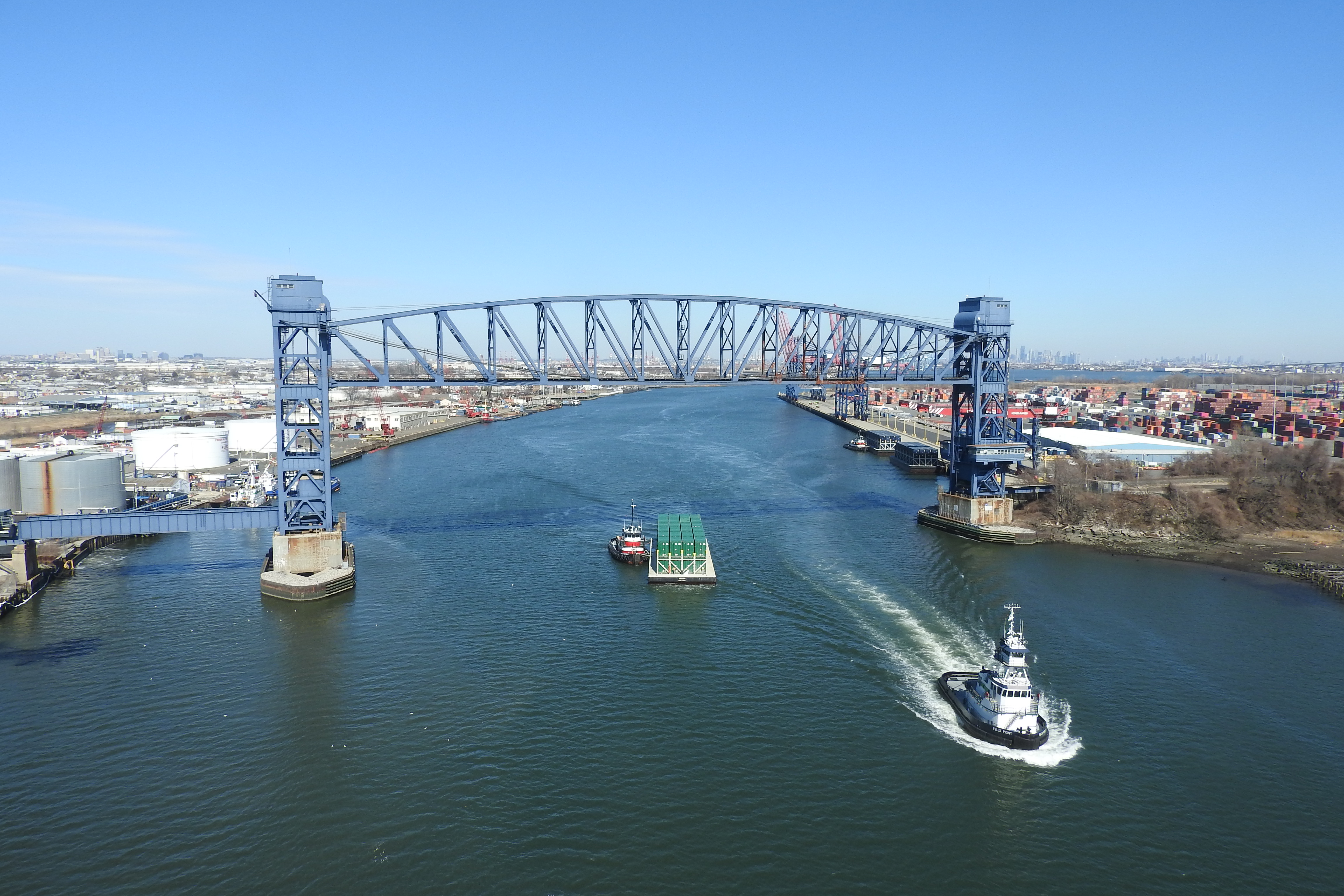
Arthur Kill Vertical Lift Bridge
Most bridges aspire to grandeur. The Arthur Kill Vertical Lift Bridge aspires to something less poetic: getting trash off Staten Island. With the longest lift span of any vertical-lift bridge in the world -- a 558-foot truss held between two 215-foot steel towers -- it connects Elizabethport, New Jersey, to the Howland Hook Marine Terminal on the western shore of Staten Island. A single railroad track runs across it. On most days, exactly one train crosses. That train is typically loaded with containerized garbage bound for waste-to-energy plants on the mainland. It is, by almost any measure, one of the most remarkable bridges in America that almost nobody has heard of.
Born of the Baltimore and Ohio
The bridge opened in 1959, built by the Baltimore and Ohio Railroad to replace the Arthur Kill Bridge, a swing bridge that had served the crossing since 1890. Its engineering was ambitious from the start: the lift span allows a 500-foot navigation channel on the Arthur Kill waterway, clearing mean high water by 31 feet when closed and 135 feet when fully raised. The bridge parallels the Goethals Bridge, which carries Interstate 278 and motor vehicle traffic between the two states. But where the Goethals handles thousands of cars per hour, the Arthur Kill lift bridge belongs to the slower, heavier world of freight rail.
Sixteen Years of Silence
By the late 1980s, rail traffic on Staten Island had dwindled to nothing, and the bridge fell dormant. For sixteen years, no train crossed it. The structure sat over the waterway, its mechanisms rusting, a relic of an industrial era that seemed to have moved on. In 1994, the New York City Economic Development Corporation purchased the bridge and the North Shore rail branch from CSX, but a decade passed before anything happened. Finally, in December 2004, the NYCEDC and the Port Authority of New York and New Jersey announced a $72 million rehabilitation project to bring the bridge back to life.
Painted Royal Blue
The restoration was completed in June 2006, and the bridge was painted royal blue -- an homage to the Baltimore and Ohio Railroad's historic color scheme. On October 4, 2006, a single locomotive crossed the Arthur Kill for the first time in 16 years, taking on switching duties at the New York Container Terminal at Howland Hook. The moment was quiet, industrial, and unremarkable to anyone not paying attention. But it marked the return of freight rail to Staten Island, a development with significant implications for the borough's infrastructure and the roads surrounding it.
The Trash Train and Beyond
Normal garbage operations began on April 2, 2007, diverting an estimated 90,000 annual truck loads from the congested Goethals Bridge. In October 2007, the New York Container Terminal launched on-dock rail service called ExpressRail, with regular runs by Conrail, CSX, and Norfolk Southern. The bridge had become what urban planners love and commuters never notice: critical freight infrastructure that quietly reduces highway congestion. As of 2018, U.S. Coast Guard regulations limit the bridge to two 15-minute lowering windows per day, with restrictions during high tide. Conrail, which services Staten Island with a single daily train, has noted this is adequate for current traffic -- though it could become a bottleneck if rail demand grows.
From the Air
Located at 40.638N, 74.195W spanning the Arthur Kill waterway between Elizabethport, NJ and Staten Island, NY. The bridge is clearly visible from the air as a distinctive vertical-lift structure with two tall towers, running parallel to the Goethals Bridge immediately to its south. The New York Container Terminal at Howland Hook is visible on the Staten Island side. Nearest airports: Newark Liberty International (KEWR) approximately 5 nm north, Linden Airport (KLDJ) 4 nm southwest. Best viewed at 1,500-2,500 feet AGL to see the lift mechanism and surrounding industrial waterfront.