Arti et Amicitiae
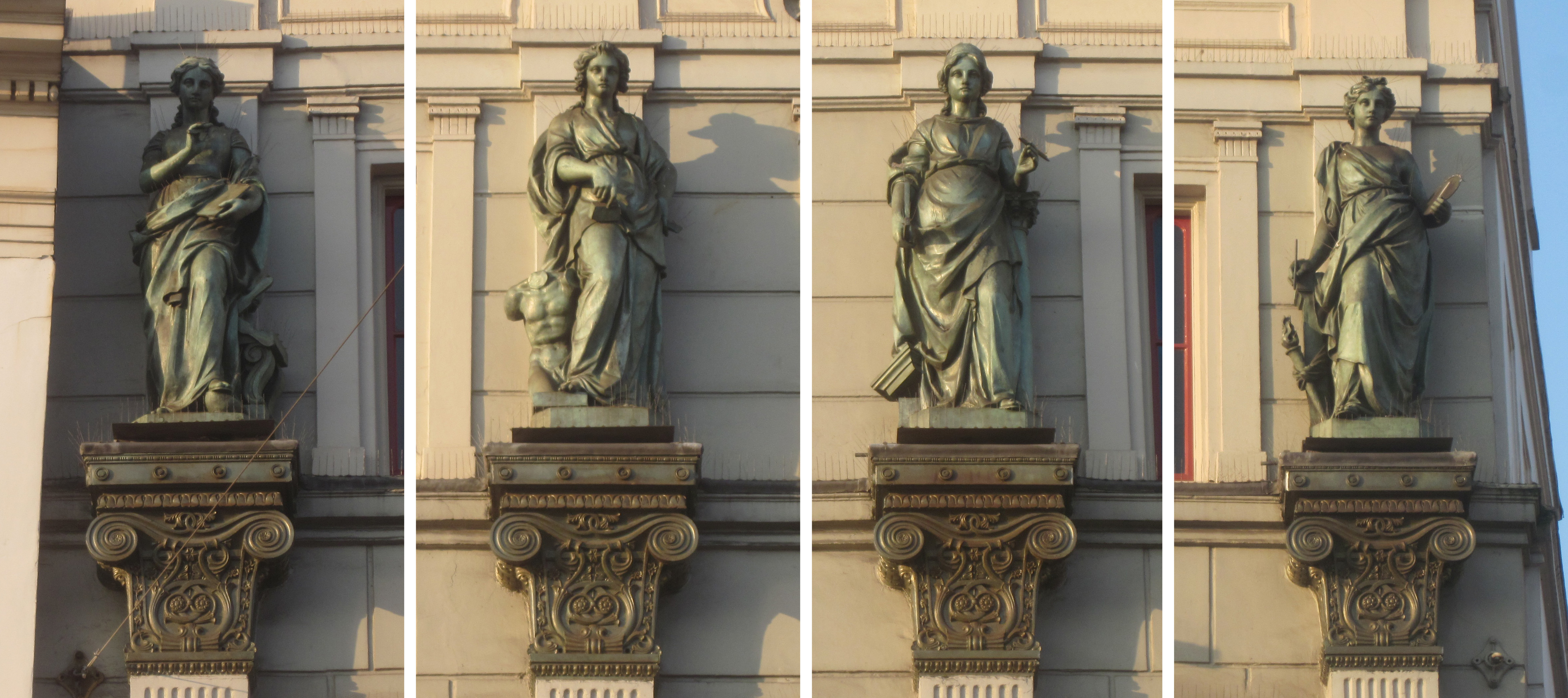
For Art and Friendship — that is what the Latin name promises. Arti et Amicitiae has held to the promise for nearly two centuries. Founded in 1839, the year George Hendrik Breitner was learning to walk and Vincent van Gogh had not yet been born, Arti is a private artists' society on the Rokin in central Amsterdam that survived the fall of the painters' guilds, the rise and fall of the Hague School, two World Wars, and the chaos of postwar Dutch modernism — and it is still open, still showing exhibitions, still running a widows' and orphans' fund of the sort the medieval guilds used to keep. The clubhouse at Rokin 112 hides behind a white neoclassical facade that looks unremarkable until you notice the four sculptures along the parapet: Architecture, Sculpture, Painting, Engraving, the four arts the building has held under one roof since 1855.
A Society Born from a Vacuum
In 1794, the French occupation under Napoleon dissolved the last of Amsterdam's medieval painters' guilds — the local descendants of the old Guild of Saint Luke that had once governed every painter, gilder, and engraver in the city. For half a century afterward Dutch artists had no formal institution of their own. Various drawing societies and informal clubs filled the gap, but nothing with weight or continuity. In 1839 four artists in Amsterdam decided to do something about it and founded the Sociëteit Arti et Amicitiae. A year later they bought, at auction, a building at Rokin 3 called the Grand Salon Dupond. It became Arti's permanent home. By 1841 King William II had been made an honorary member, and the architect Marinus van Elven Geradur Tetar — professor at the Royal Academy of Fine Arts — had designed a new exhibition salon on the first floor, with a steel-framed continuous band of windows and a glass roof that flooded the long hall with even daylight. It is the same hall, with the same trick of light, that exhibitions hang in today.
Independence from the State
Napoleon had also decreed that the art world should be operated and directed by the rulers — at the Art Academy of Delft, non-artists set art policy. Arti was built as the opposite of that idea. Its central principle, held since 1839 and never relinquished, was the sovereignty of artists over their own affairs, including their own finances. One of the society's first big initiatives was a public subscription for a monument to the city's most famous painter, Rembrandt van Rijn. The founding member Louis Royer sculpted the statue, and on 27 May 1852 King William III unveiled it on what later became Rembrandtplein. A historical gallery of 103 scenes from Dutch national history followed. For members, Arti operated a widows' and orphans' fund modeled on the old guild benefits, supported by entrance fees from exhibiting artists, sales of exhibition catalogs, dues from honorary members, and revenue from the historical collection.
The Building and Its Allegories
The clubhouse you see today was assembled by merging two adjacent houses and dressing them in 1855 with a single white neoclassical facade by J. H. Leliman. Four allegorical figures by the sculptor Franz Stracke crown the parapet — Architecture, Sculpture, Engraving, and Painting, the four arts the building unites. A carved hand serves as the building's identifying gable stone, alongside an ox, the patron animal of the old Saint Luke guild whose tradition Arti claimed. Inside, the great architect Hendrik Petrus Berlage — better known for the Beurs and for the master plan of Nieuw-Zuid — designed the interiors: showrooms, board rooms, a private club room paneled in dark wood. The first major rebuilding, in 1893-94, moved the main entrance to the Spui side and renewed the staircase and hallway under Berlage's direction. The 1962-64 restoration moved the entrance back to the Rokin. In 2009 the adjacent building at number 114 was bought to expand the premises. The precious woodwork and original furniture have, remarkably, survived all of it largely intact.
Who Walked Up the Staircase
Climb Arti's staircase today and you climb past portraits of the painters of the second Dutch Golden Age — the artists who shaped Dutch painting between the Hague School and the early modernists. Some names: Jozef Israëls and his son Isaac. The brothers Jacob, Willem, and Matthijs Maris. George Hendrik Breitner, the great Amsterdam street painter. Anton Mauve, Vincent van Gogh's cousin by marriage and first teacher. Jan Toorop. Lourens Alma-Tadema, before he left for London and a knighthood. Hendrik Willem Mesdag. Lizzy Ansingh, Coba Ritsema, Thérèse Schwartze. Piet Mondriaan, before he became Mondrian. Even non-members exhibited here: Marc Chagall, Max Liebermann, and Vincent van Gogh among them. The full membership list runs to dozens of names that any Dutch museum catalog would recognize at a glance.
Prizes and the Long Continuity
In 1878 the patron Wilhelm Ferdinand Willink van Collen left thirty thousand guilders in his will to Arti specifically to support young Dutch artists during their studies. The Willink van Collenprijs was awarded from 1880 with interruptions until 1950, first modeled on the tiered prize structure of the Paris Salon, then narrowed to a single first prize from 1890 onward. A separate Prize of the Sociëtait was given alongside it. Today the society counts roughly 550 artists and 1,100 supporting members, and the historical archive remains in the building, while the valuable historical library has been transferred to the Van Gogh Museum for safekeeping. Arti still runs exhibitions, hosts the occasional outside event — the seventeenth edition of the Sonic Acts Festival used the building as one of its venues — and continues, quietly, the work for which it was founded: making sure Dutch artists have somewhere of their own.
From the Air
Arti et Amicitiae stands at Rokin 112, in the heart of central Amsterdam at approximately 52.369°N, 4.892°E — about two blocks south of Dam Square, on the broad inner canal that links Dam to Muntplein. Schiphol Airport (EHAM) is 12 km southwest. Best aerial perspective at 1,500-3,000 ft AGL, with the Rokin running as a clear north-south line through the canal grid; the building's white neoclassical facade is hard to spot at altitude but the roofline of the long exhibition hall, set behind, gives a distinctive horizontal break against the surrounding tall canal houses.