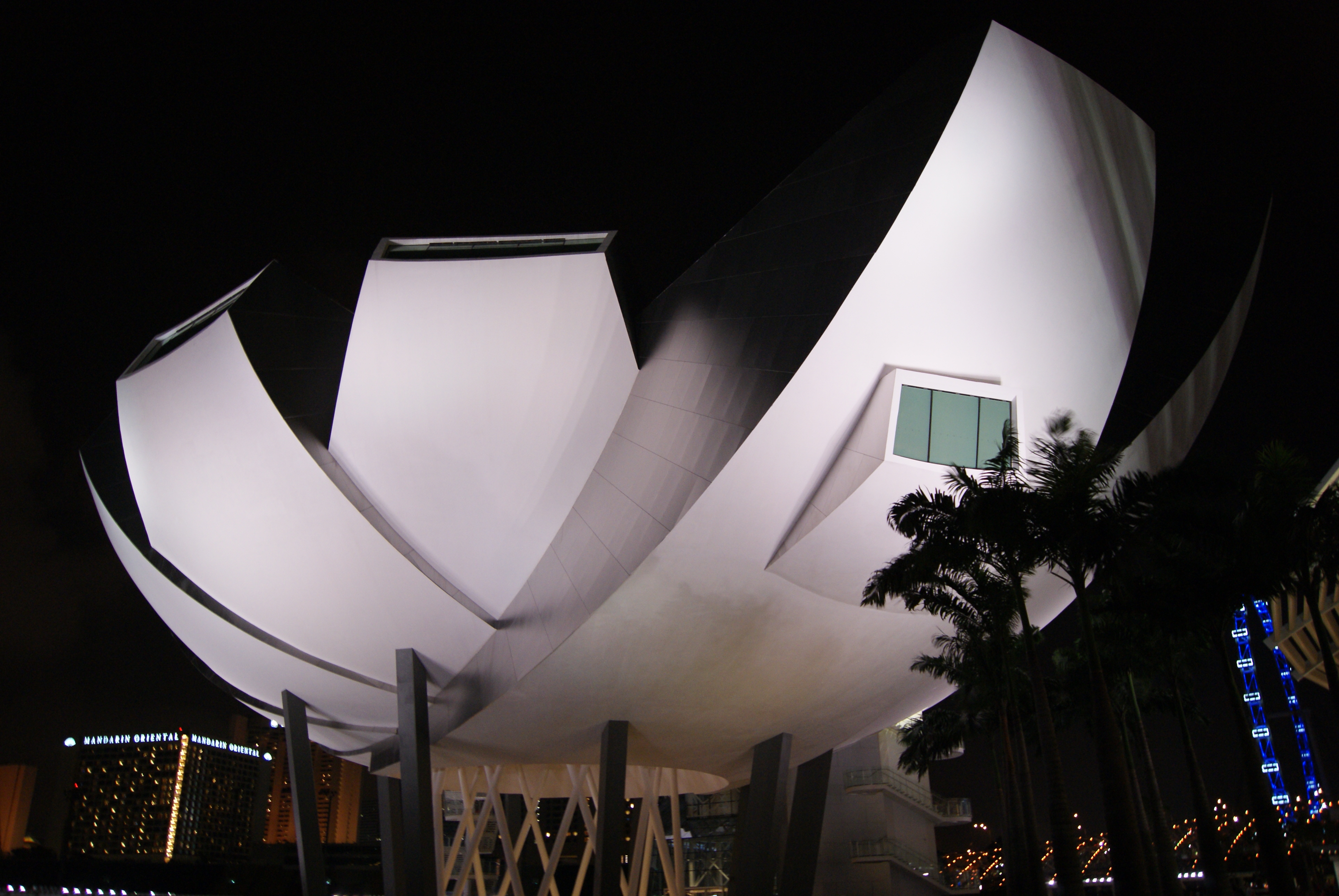
ArtScience Museum
Ten fiberglass petals reach skyward from Singapore's waterfront, cupping the tropical rain and funneling it into a waterfall that cascades through the building's core. The ArtScience Museum at Marina Bay Sands looks like nothing else on Earth, and that is precisely the point. Designed by Israeli-Canadian architect Moshe Safdie and opened on 17 February 2011 by Prime Minister Lee Hsien Loong, the building was conceived not merely as a gallery but as a statement: that art and science are not opposites but collaborators, and that the building housing their conversation should embody that fusion in every structural detail.
A Hand Extended Over the Bay
Las Vegas Sands chairman Sheldon Adelson called it "The Welcoming Hand of Singapore," and from above, the resemblance is unmistakable. The museum's round base anchors ten curved extensions that the architects call "fingers," each one a distinct gallery space with a skylight at the tip that floods the curved interior walls with natural light. The exterior is fibre-reinforced plastic stretched over a steel lattice, creating organic forms that would be impossible in concrete or stone. Walk beneath the structure and the scale becomes disorienting -- the underside curves overhead like a wave frozen mid-break. The building houses 21 gallery spaces spanning 6,000 square metres, enough room for blockbuster exhibitions that have ranged from Van Gogh immersive experiences to Titanic artifacts to Harry Potter memorabilia.
Where the Rain Falls Inward
Singapore receives more than two metres of rainfall annually, and Safdie turned that fact into a design feature rather than a problem. Rainwater striking the lotus-shaped roof is channeled down through the building's hollow centre, cascading into a reflecting pond at the lowest level. The collected water is then recycled for use in the museum's restrooms. It is a building that drinks its own environment -- an act of sustainability wrapped in spectacle. The effect during a monsoon downpour is particularly striking: the interior waterfall becomes a roaring column of water that visitors can see from multiple levels, transforming weather from inconvenience into exhibit.
Treasures from the Deep
The museum's opening exhibition set an ambitious tone. In 1998, diver Tilman Walterfang and his team discovered the Belitung shipwreck in the Gaspar Strait -- a large 9th-century Arabian dhow that had sunk around 830 AD while carrying the single largest consignment of Tang dynasty export goods ever found. The cargo spent six years being desalinated and conserved in New Zealand before eventually being purchased for around US$32 million. Among the finds: some of the oldest cobalt-blue-and-white ceramics made in China, gold items bearing Arabic designs, jars packed with spices and incense resins, bronze mirrors, thousands of glazed bowls, and a small cache of intricately tooled gold and silver vessels that remain unparalleled from the period. The Sultanate of Oman presented Singapore with a faithful reproduction of the original dhow, named the Jewel of Muscat, underscoring the shipwreck's significance as evidence of ancient maritime trade routes connecting China, Southeast Asia, and the Middle East.
The Space Between Disciplines
What distinguishes the ArtScience Museum from a conventional gallery is its insistence on collision. Permanent objects on display have included a reproduction of Leonardo da Vinci's Flying Machine alongside a Kongming Lantern and a high-tech robotic fish -- artifacts and inventions spanning centuries and continents, united by the thread of human ingenuity. The touring exhibitions have been equally eclectic: Egyptian mummies, Dali surrealism, Warhol pop art, National Geographic photography, and dinosaur paleontology have all cycled through the galleries. In 2025, the museum announced a partnership with PGLang's creative agency Project 3 for an ambitious rebrand, signaling that the institution continues to push toward new intersections of creativity and technology. The building itself remains the most permanent exhibit -- a structure where natural light, collected rainwater, and engineered curves work together as a living demonstration of the ideas the galleries explore.
From the Air
Located at 1.286°N, 103.859°E on the southern shore of Marina Bay, adjacent to the three towers of Marina Bay Sands. The museum's distinctive lotus shape is clearly recognizable from above at altitudes of 2,000-5,000 feet. Singapore Changi Airport (WSSS) lies approximately 15 km to the east. Seletar Airport (WSSL) is 14 km to the north. Expect warm, humid conditions year-round with frequent afternoon thunderstorms.