Arusha National Park
Most visitors to northeast Tanzania are heading to the Serengeti or Ngorongoro, and they drive straight past the turnoff without a second glance. That is Arusha National Park's quiet advantage. At just a fraction of the size of Tanzania's headline parks, it packs an improbable range of landscapes into a space you can explore in a single day: crater lakes rimmed with flamingos, montane forest dense with primates, and the towering volcanic cone of Mount Meru, which at 4,566 meters is Tanzania's second-highest peak and a serious mountaineering objective in its own right.
Meru's Long Shadow
Mount Meru dominates everything here. Its summit crater, breached on one side by a catastrophic ancient eruption, creates a dramatic amphitheater of cliffs visible from across the park. Climbing it takes four days along a route that passes through every vegetation zone the park contains: lowland savanna gives way to montane forest, then heather and moorland, and finally the barren alpine desert near the summit. You climb with a compulsory armed ranger, a regulation born from the occasional presence of Cape buffalo and elephants on the lower trails. Reaching the summit at sunrise, with Kilimanjaro floating above the clouds to the east, is one of those moments that justifies every hour of altitude-induced headache on the way up.
The Forest Canopy
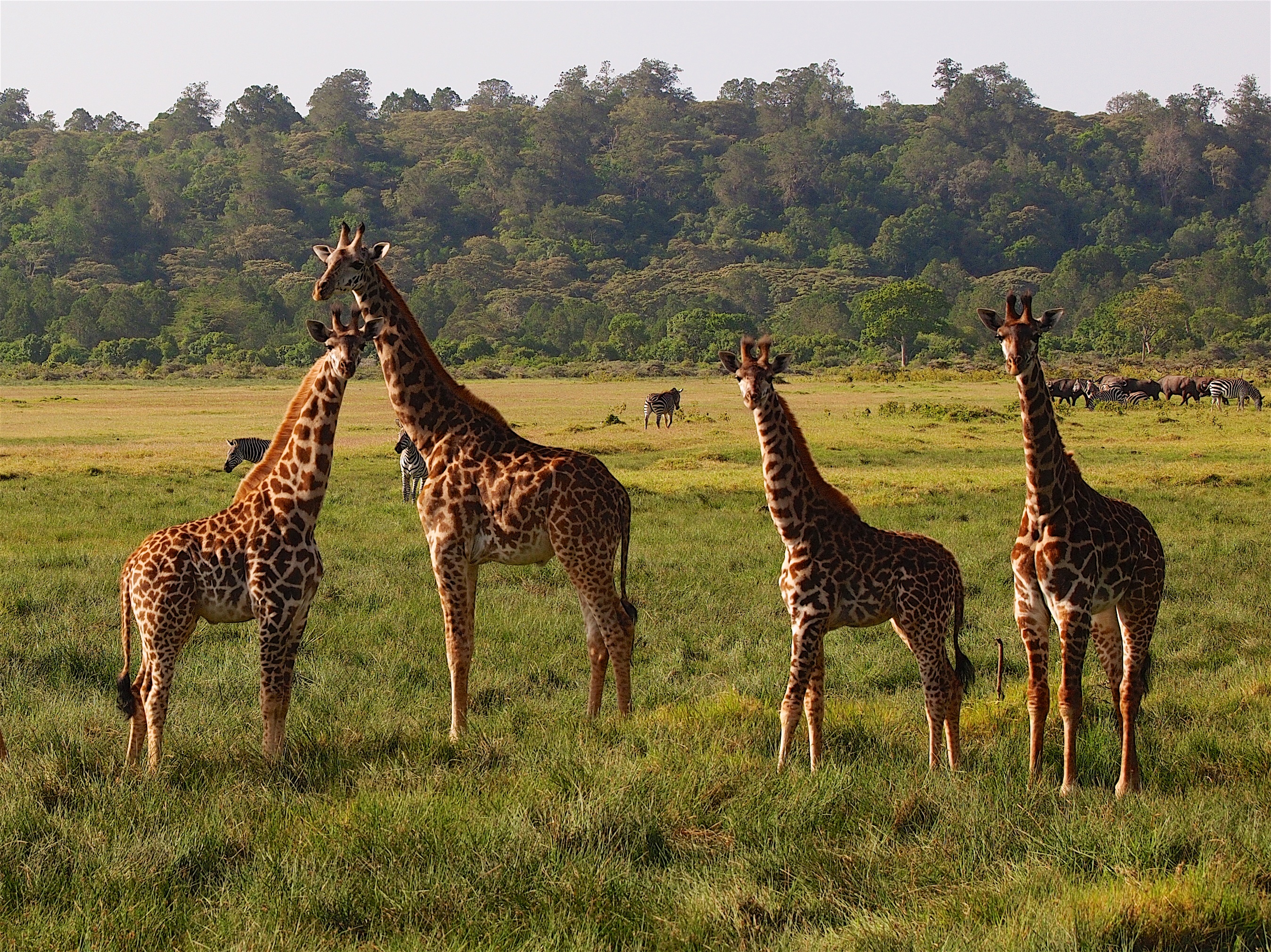
Below the moorland, Arusha's montane forest is where the park reveals its richest life. Black-and-white colobus monkeys move through the canopy in troops, their long white tail plumes trailing behind them like banners. Blue monkeys forage lower in the understory, shyer but no less present. The birdlife is prolific, and birders come here specifically for species that are difficult to find elsewhere on the northern Tanzanian tourist circuit. Narina trogons flash crimson and green in the filtered light, while bar-tailed trogons perch in the middle canopy. Even the starlings are worth pausing for, their iridescent plumage catching the equatorial sun in unexpected ways. Giraffes, zebras, and warthogs populate the more open areas, and leopards haunt the forest, though seeing one requires more luck than most visitors carry.
Crater Lakes and Flamingos
The Momella Lakes are a string of shallow, alkaline lakes at the park's eastern edge, each a slightly different color depending on its mineral content and the algae blooming within it. Flamingos congregate here in concentrations that turn the shorelines pink, feeding on the microscopic organisms that thrive in the alkaline water. Cape buffalo graze the lake margins, and the open terrain around the lakes provides some of the park's best general wildlife viewing. It is a different world from the dense forest a few kilometers away, and the transition happens abruptly, as if someone drew a line between two ecosystems and dared them to coexist.
The Overlooked Neighbor
Arusha National Park sits less than 40 kilometers from the city of Arusha, the gateway to Tanzania's northern safari circuit. That proximity makes it accessible in a way that the Serengeti, a full day's drive away, never will be. Visitors with a morning to spare between flights or safari legs can drive in, loop through the park, and still make it back for lunch. But the park rewards more than a quick pass. Walking safaris are possible here, a rarity in Tanzania, and the Mount Meru climb offers a less crowded, more technically interesting alternative to Kilimanjaro. The park does not promise the vast herds or big-cat drama of the Serengeti. What it offers instead is intimacy, the sense of being close enough to the forest and its inhabitants to hear the colobus monkeys calling before you see them.
From the Air
Located at 3.25S, 36.83E in northeast Tanzania, immediately northeast of Arusha city. Mount Meru (4,566 m) is the park's dominant feature, clearly visible from high altitude. Kilimanjaro International Airport (HTKJ) is approximately 50 km to the east. Arusha Airport (HTAR) is closer, about 10 km to the west. Best viewed at 8,000-12,000 ft AGL to appreciate the volcanic crater and lake system. Mount Kilimanjaro is visible 70 km to the east-northeast.