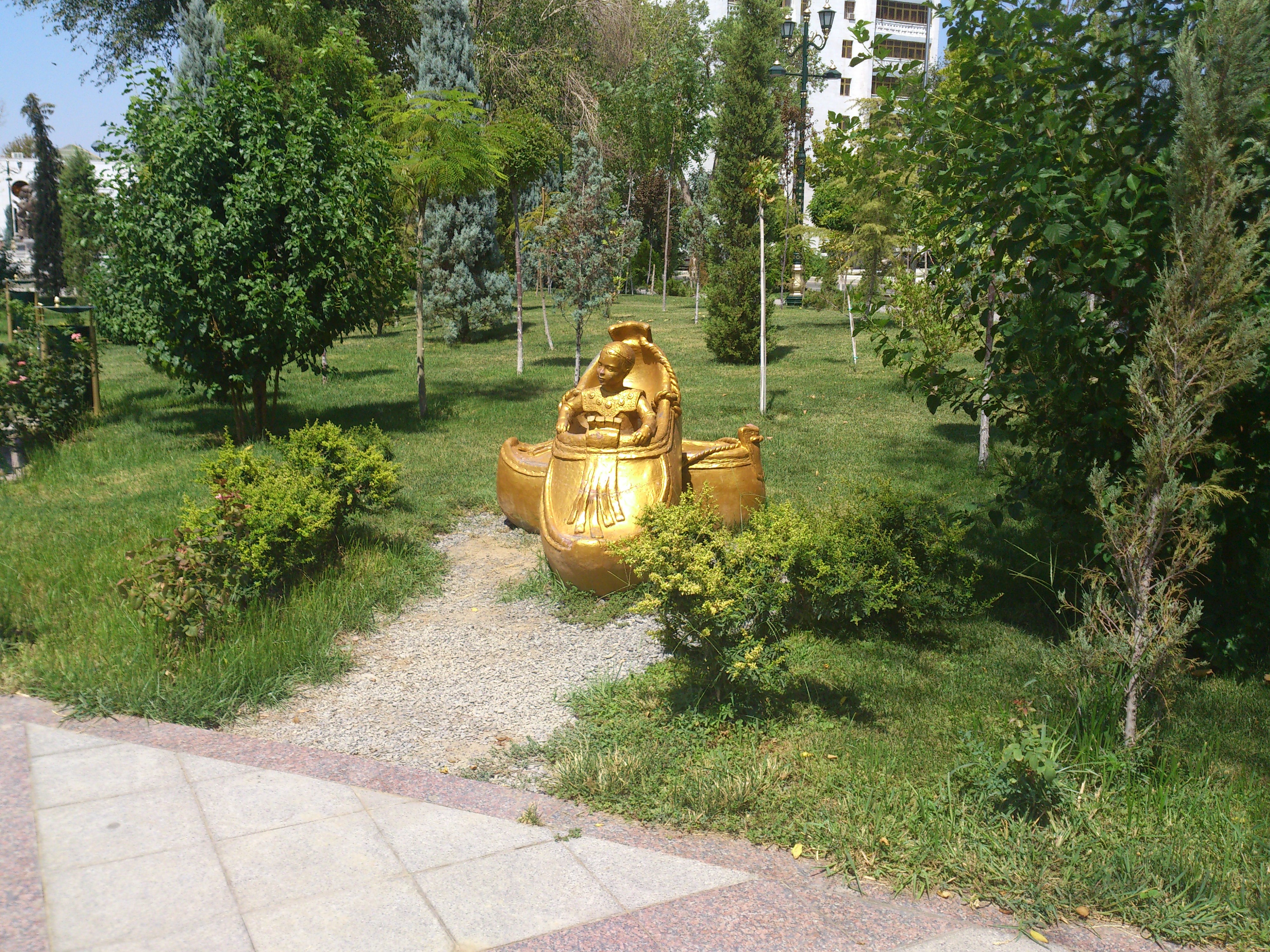
Ashgabat: The White Marble Mirage
Every building is white. Not off-white, not cream - white marble, gleaming under the Central Asian sun, block after block after block. Ashgabat holds the Guinness World Record for the highest density of white marble-clad buildings in the world: 543 of them packed into 22 square kilometers, their surfaces totaling more than 4.5 million square meters of imported stone. The effect is disorienting. Wide boulevards stretch between identical facades. Golden domes catch the light. Monumental government buildings carry symbolism so heavy it borders on parody. This is what happens when a capital city becomes one man's architectural vision - and then his successor's.
One Man's City
Saparmurat Niyazov ruled Turkmenistan from 1985 until his death in 2006, first as Communist Party boss, then as self-proclaimed "Turkmenbashi" - Father of All Turkmen. He transformed Ashgabat from a drab Soviet capital into a showcase of white marble and golden statuary. Niyazov renamed months of the year after himself and his mother. He banned opera, ballet, and recorded music. He wrote a spiritual guide called the Ruhnama and required it to be studied in schools and workplaces. But his most lasting legacy was physical: the wholesale reconstruction of Ashgabat into a city of marble monuments. His successor, Gurbanguly Berdimuhamedov, who took power in 2007, continued the building program with equal enthusiasm. The marble kept coming. Ashgabat today is the product of two presidencies unified by a single architectural obsession.
Built on Rubble
The marble city sits on a fault line. On October 6, 1948, at 1:12 in the morning, a magnitude 7.3 earthquake struck Ashgabat. The shaking lasted ten seconds. When it stopped, roughly 80 percent of the city's buildings had collapsed. Estimates of the dead range from 70,000 to 176,000 - as much as ten percent of the entire Turkmen Soviet Republic's population. The Soviet government suppressed news of the disaster; sealed archives were not opened until 1973, twenty-five years later. Ashgabat was rebuilt as a standard Soviet city of concrete apartment blocks and administrative buildings. Then Niyazov tore that city down and built his marble vision on top of it. The Ashgabat that visitors see today is the third iteration of a city that has been destroyed and rebuilt twice in living memory.
A Capital of Contrasts
The historical nickname for Ashgabat is "The City of Love." No one uses it anymore. "The City of White Marble" has replaced it entirely. The comparison most often drawn is to Pyongyang - another capital redesigned according to a single leader's vision, another city where monumental architecture serves ideology more than inhabitants. The Ministry of World Affairs building is a perfect example: its design carries the kind of heavy-handed symbolism that makes visitors uncertain whether to admire the ambition or laugh at the excess. But Ashgabat is not entirely artifice. The Tolkuchka Bazaar, eight kilometers north of the city center, erupts on Saturdays and Sundays with carpets, sheepskin telpeks, striped khalat robes, and the raw commerce of Central Asian market culture. Here the marble gives way to dust and haggling, and the city feels alive.
Getting Around the Ghost City
Ashgabat's streets are wide, clean, and often empty. The city has an extensive bus system running from the Teke Bazaar hub, with air-conditioned stops displaying detailed route maps. But the preferred method of transport is what locals call a "taxi" - which actually means hitchhiking. Hold your arm at a downward angle with two fingers extended. A car, usually a Lada, will stop. State your destination. If the driver nods, climb in; if not, wait for the next one. The fare is roughly two dollars. Everyone does this. It is an entirely ordinary form of transit in a city where very little else feels ordinary. Official taxis exist near the airport and railway station but cost more. The incongruity is pure Ashgabat: marble boulevards navigated by improvised rides in aging Soviet sedans.
Beyond the Marble
The surrounding landscape offers what the city itself cannot: age and authenticity. Nissa, 15 kilometers to the west, holds the ruins of a Parthian settlement dating to the 2nd century BC. Geok Depe, 50 kilometers out, marks the site of the final battle between Turkmen forces and the Russian Imperial Army in the 1880s. Bakharden offers a cave with the Kow Ata Lake, a subterranean thermal pool that smells of sulfur and serves as a weekend escape for Ashgabat residents. The ancient site of Altyn Depe preserves a Bronze Age settlement with potter's quarters, differentiated housing, and a monumental cult complex where archaeologists found small golden heads of a wolf and a bull. From Ashgabat, travelers can also arrange the overland trip to Darvaza - the famous gas crater that has burned in the Karakum Desert since 1971. The marble city is a starting point. The real Turkmenistan lies beyond it.
From the Air
Located at 37.95°N, 58.38°E at the foot of the Kopet Dag mountains in southern Turkmenistan. From altitude, Ashgabat is immediately recognizable: a grid of white structures gleaming against the brown desert and mountain backdrop. The city sits in an arid valley between the Kopet Dag range to the south (marking the Iranian border) and the Karakum Desert to the north. Ashgabat International Airport (ASB) serves domestic and limited international flights. The Trans-Caspian Railway connects to Mary (350 km east), Turkmenabat (590 km east), and Turkmenbashi (on the Caspian coast). Mashhad, Iran is 270 km to the southeast.