Asian Pacific Thematic Historic District
The abalone divers came first. In the 1860s, Chinese fishermen established camps along San Diego Bay, harvesting shellfish and building the foundations of what would become one of Southern California's most significant Asian communities. Within decades, these eight blocks adjacent to the Gaslamp Quarter bustled with the life of Chinatown, a neighborhood of restaurants, laundries, meeting halls, and family associations. Today, the Asian Pacific Thematic Historic District preserves twenty-two buildings from that era, though the thriving community that built them has long since dispersed. The Dr. Sun Yat-Sen Memorial Gate marks the entrance to this historic quarter, a monument to persistence and change.
Harvests from the Bay
San Diego's Chinatown did not emerge from the railroad work that established Chinese communities across the West. Here, the sea provided the catalyst. Abalone divers and fishermen arrived in the 1860s, drawn by the rich marine life of San Diego Bay and the Pacific waters beyond. They established themselves in an area bounded by what are now Market Street, Second Avenue, Sixth Avenue, and J Street, building a commercial district that served both the Chinese community and the broader city. By the turn of the century, this eight-block neighborhood had become a thriving enclave, its streets lined with businesses that bore signs in Chinese characters alongside English.
The Shared Streets
The Chinese community did not occupy these blocks alone. Japanese immigrants established businesses and residences alongside their Chinese neighbors, and Filipino families joined the mix as the twentieth century progressed. This multiethnic character distinguished San Diego's Asian quarter from the more homogeneous Chinatowns of San Francisco and Los Angeles. The buildings that survive reflect this diversity, their architectural details and historical associations connecting to all three communities. The twenty-two contributing structures date from 1883 to 1930, representing nearly fifty years of continuous Asian-American presence in downtown San Diego.
Dispersion and Memory
World War II accelerated changes already underway. Chinese-Americans who served in the military returned to find new opportunities in neighborhoods that had previously excluded them. The old Chinatown began to empty. By the time San Diego designated the area a historic district in 1987, most Chinese-owned businesses had closed and the residential population had scattered to suburbs across the county. The district's official recognition came during the redevelopment of the adjacent Gaslamp Quarter in the 1980s and 1990s, a period when historic preservation competed with demolition throughout downtown. These eight blocks survived because enough people remembered what had stood here.
What Remains
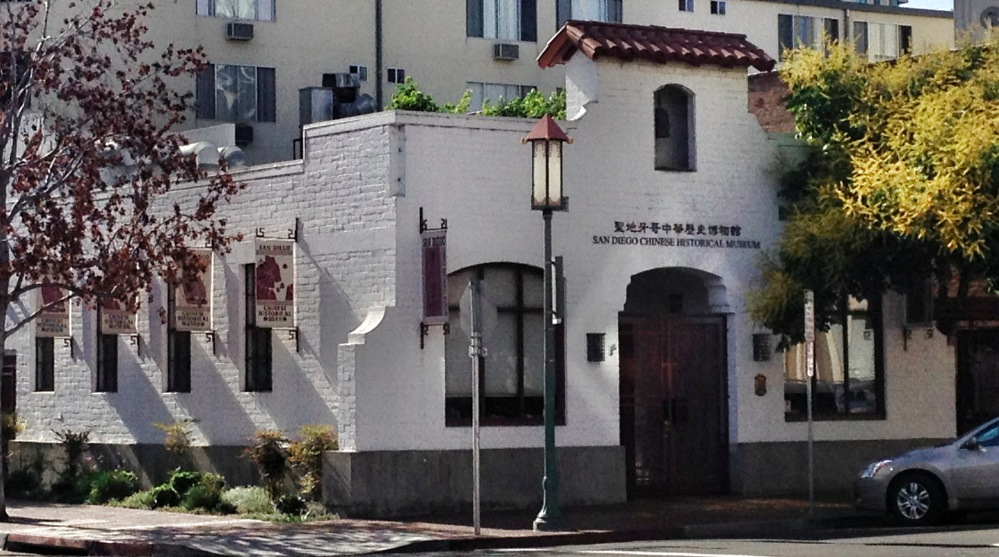
The San Diego Chinese Historical Museum anchors the district today. The building began life in 1927 as the Chinese Mission, constructed elsewhere in the city and moved to its present location in 1996. Inside, artifacts and photographs document the history that these streets witnessed. The Chinese Consolidated Benevolent Association building still stands, a reminder of the mutual aid societies that helped immigrants navigate a sometimes hostile new country. Walking through the district, visitors encounter architecture from the Victorian and early twentieth-century commercial periods, buildings that served Chinese herbalists and Japanese grocers, Filipino barbers and American landlords. The living community is gone, but the physical record endures, preserved in weathered brick and cast iron.
From the Air
Located at 32.71N, 117.16W in downtown San Diego, the Asian Pacific Thematic Historic District covers eight blocks adjacent to the Gaslamp Quarter. The district is not easily distinguished from the air, as it integrates with surrounding downtown development. The Dr. Sun Yat-Sen Memorial Gate provides a ground-level landmark. Nearby airports: San Diego International (KSAN) 2nm northwest. The district lies beneath the final approach path to Runway 27.