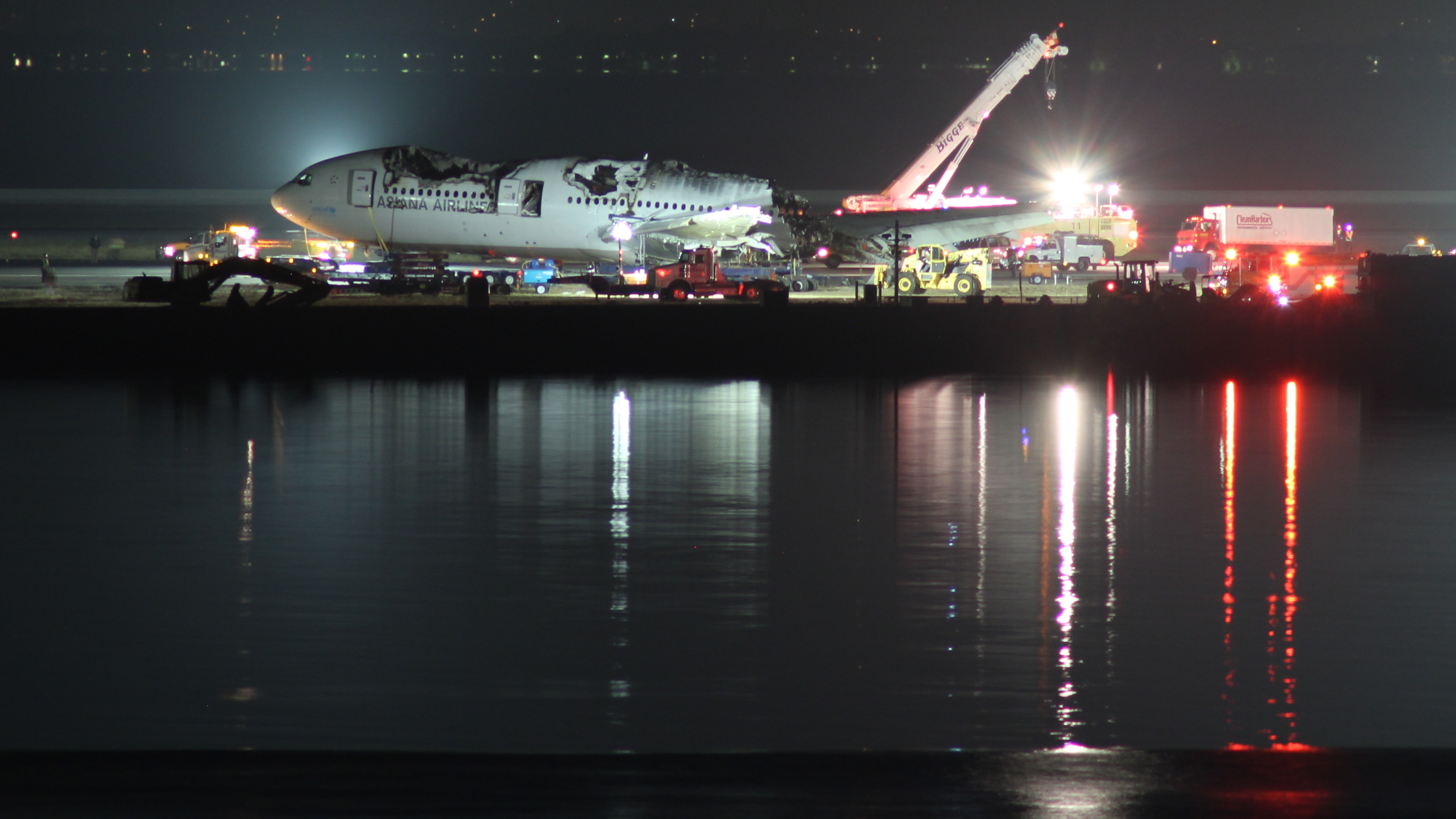
Asiana Airlines Flight 214
Seventy Chinese students and teachers were on board, heading to summer camp in America. The flight from Seoul had been uneventful for its entire duration. It was only in the final seconds, on a clear Saturday morning in July 2013, that Asiana Airlines Flight 214 became a catastrophe. The Boeing 777-200ER, approaching too slowly and too low, struck the seawall just before the threshold of Runway 28L at San Francisco International Airport. The tail snapped off. The main landing gear and left engine separated. The fuselage slid down the runway, spinning and catching fire. Of the 307 people on board, 304 survived. Three did not. All three were teenage girls from Jiangshan High School in China's Zhejiang Province.
A Training Flight Gone Wrong
Captain Lee Kang-kook, 45, was in the left seat -- the captain's position -- but he was the one being trained. He had 9,793 total flight hours but only 43 in a Boeing 777, accumulated over just nine flights. Beside him in the right seat sat Captain Lee Jeong-min, 49, serving as instructor for the first time. He had 12,387 hours of experience and 3,220 in the 777. The instrument landing system's glide slope on Runway 28L had been out of service since June 1, meaning a precision ILS approach was not available. The crew was cleared for a visual approach, hand-flying the aircraft without the electronic vertical guidance that would have kept them on the correct descent path.
Below the Glide Path
Cockpit voice recordings captured the crew's deteriorating awareness. First, they noted they were above the glide path. Then on it. Then below it. The aircraft's airspeed decayed well below the target approach speed as the throttles sat at idle. By the time the crew recognized the severity of their situation and advanced the thrust levers, there was not enough time or altitude to recover. At impact, the airspeed had dropped to 106 knots. The NTSB investigation concluded that the accident was caused by the flight crew's mismanagement of the final approach, with deficiencies in Boeing's documentation of the aircraft's complex autothrottle system and Asiana's pilot training cited as contributing factors.
Summer Camp, Interrupted
Among the 141 Chinese passengers, more than 90 had connected through Incheon from Shanghai. Many were students: 29 from Jiangshan High School in Zhejiang, 22 from Taiyuan Number Five Secondary School in Shanxi, and others from the Taiyuan Foreign Language School. They were bound for a West Valley Christian School summer camp. The three who died -- all from the Jiangshan group -- were teenagers whose families had sent them across the Pacific for what should have been a formative summer experience. One, Liu Yipeng, survived the crash itself but died of her injuries six days later at San Francisco General Hospital. She had been wearing her seatbelt, seated in the last row, when the crash rotated her seat backward and the aircraft's rear door struck her.
What Survived
Four flight attendants seated at the rear were ejected when the tail section broke off. All four survived. Of the 307 people aboard, 182 were admitted to nine area hospitals. The crew's decision to execute an evacuation after the aircraft came to rest, despite fire engulfing portions of the fuselage, saved hundreds of lives. The accident led to revisions in how airline pilots are trained to manage automated systems during approach, and it renewed debate about the risks of over-reliance on technology in the cockpit. The seawall at the threshold of 28L, where the aircraft's tail struck, remains one of the most recognizable features of the SFO approach -- a concrete line between safe arrival and the unforgiving waters of San Francisco Bay.
From the Air
The crash occurred at the threshold of Runway 28L at KSFO (37.613°N, 122.365°W). The seawall is immediately before the runway threshold on the bay side. Pilots should note that the ILS glide slope on 28L was unavailable at the time due to construction. Visual approaches to 28L/28R require careful speed management due to the proximity of the bay. SFO elevation is 13 ft MSL.