Askari Monument
There is a roundabout at the junction of Samora Avenue, Maktaba Street, and Azikiwe Street that reportedly marks the exact center of downtown Dar es Salaam. In 1911, a statue stood there of Hermann Wissmann, a German explorer and army major who had governed German East Africa in the late nineteenth century. The bronze depicted Wissmann with one hand on his hip and the other on his sword, gazing toward the harbor, while at his feet an African soldier draped a dead lion with a German flag. When British forces entered Dar es Salaam in 1916, they removed Wissmann, along with statues of Karl Peters and Otto von Bismarck. In 1927, something very different took the same spot.
The Soldier on the Pedestal
The Askari Monument -- formally the Dar es Salaam African Memorial -- honors the askari, the African soldiers who fought for the British in the East African campaign of World War I. The word askari comes from Arabic, meaning soldier, and the men it commemorates served in the King's African Rifles and the Carrier Corps, units that bore the physical burden of a conflict fought largely by European powers on African soil. The monument's central feature is a bronze sculpture of a single African soldier, rifle with bayonet pointed toward Dar es Salaam harbour. It was created in London by a British sculptor working for Westminster's Morris Bronze Founders, who signed the piece with his pseudonym, "Myrander." Before it was shipped to East Africa, the statue was exhibited at the Royal Academy, where it received critical praise -- a detail that speaks to the strange colonial dynamic of a sculpture honoring African sacrifice being first admired by London art critics.
Words in Three Scripts
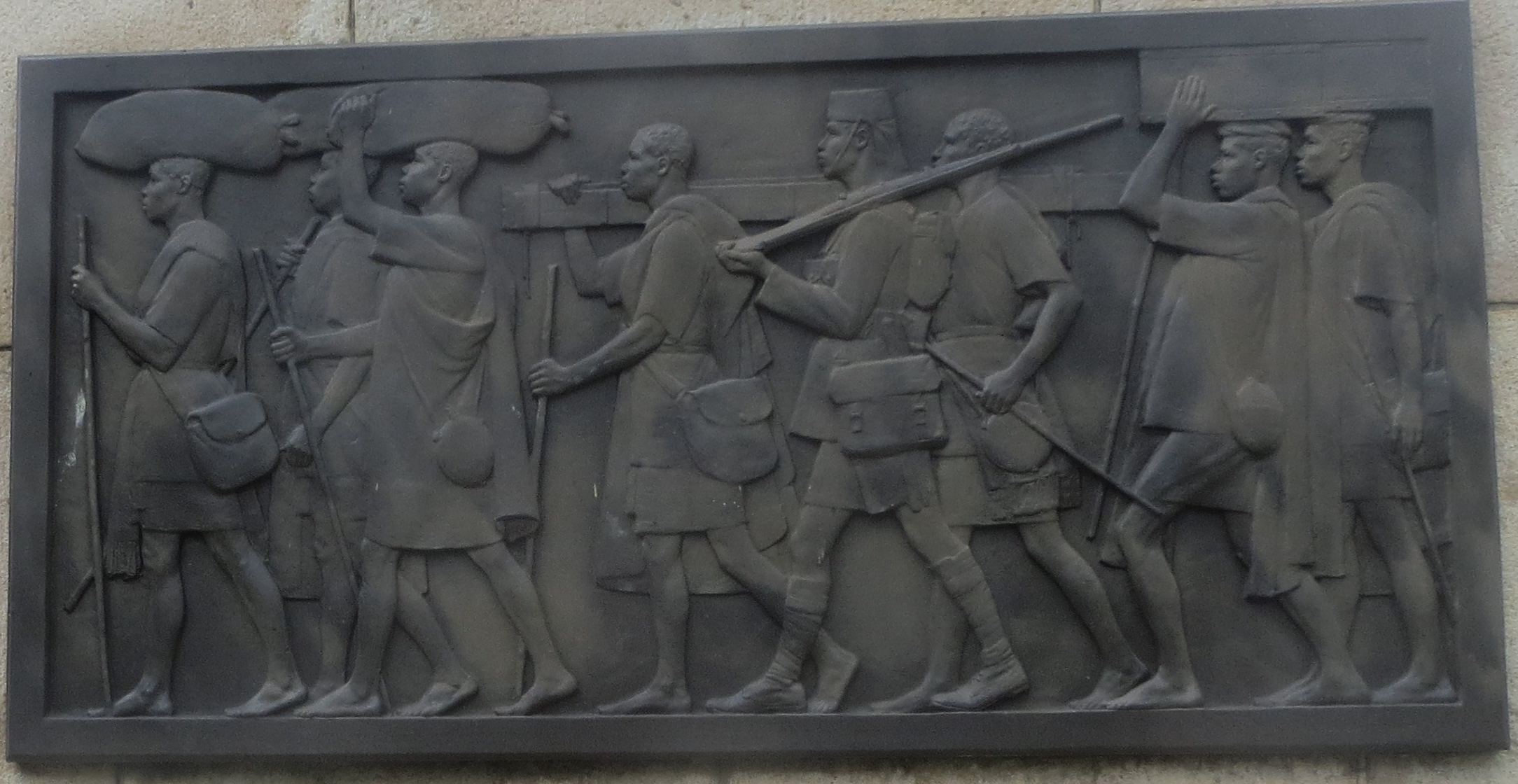
The stone pedestal carries inscriptions that reflect the cultural complexity of the place. On the narrow sides are plaques with dedications in Swahili, written in both Arabic and Latin script, and in English. The English inscription includes a line attributed to Rudyard Kipling: "If you fight for your country even if you die your sons will remember your name." On the wider sides, two pictorial bronze plaques depict the monument's honorees in action -- one showing eight African soldiers in combat, the other depicting the Carrier Corps, the porters who transported supplies through terrain no vehicle could cross. The inscriptions in three scripts acknowledge what the monument's European commissioners perhaps did not fully intend: that the soldiers' own language and cultural traditions existed independently of the empire they had served.
A Statue Replacing a Statue
The layered history of this single roundabout tells the story of colonial East Africa in miniature. Wissmann's statue, with its imagery of a European standing tall while an African crouched at his feet, embodied one version of power. Its removal in 1916 marked the end of German rule. The Askari Monument that replaced it in 1927 was a British creation -- still colonial, still framing African sacrifice through a European lens, but acknowledging that it was African bodies that had fought and died. The monument belongs to a set of three identical askari memorials unveiled the same year across what was then British East Africa. The other two stand in Mombasa and Nairobi. Together, they form a triangular memorial network honoring soldiers who fought under a flag not their own, in a war not of their making, on a continent that would spend the next four decades fighting to govern itself.
The Wider Reckoning
A separate memorial stands nearby in Dar es Salaam War Cemetery: the British and Indian Memorial, which commemorates by name more than 1,500 British and Indian officers and men who died in East Africa during and after January 1917 and who have no known grave. The existence of both memorials in the same city underscores a painful arithmetic -- that the East African campaign consumed soldiers from three continents in a war that originated in the assassination of an Austrian archduke in Sarajevo. The askari who are memorialized in bronze were a fraction of those who served. The Carrier Corps alone numbered in the hundreds of thousands across East Africa, and their mortality rate from disease and exhaustion was staggering. The monument at the center of Dar es Salaam's busiest intersection cannot capture all of that loss. But the bronze soldier still stands, bayonet fixed, facing the harbor through which so many colonial powers arrived and from which, eventually, they all departed.
From the Air
Located at 6.82S, 39.29E in central Dar es Salaam, Tanzania, at a prominent roundabout on Samora Avenue. The monument is too small to identify from altitude, but the junction is at the heart of the city's grid, near the harbor waterfront. Julius Nyerere International Airport (HTDA) lies approximately 10 km to the west. The harbor and the distinctive peninsula of Dar es Salaam are clearly visible landmarks from cruising altitude.