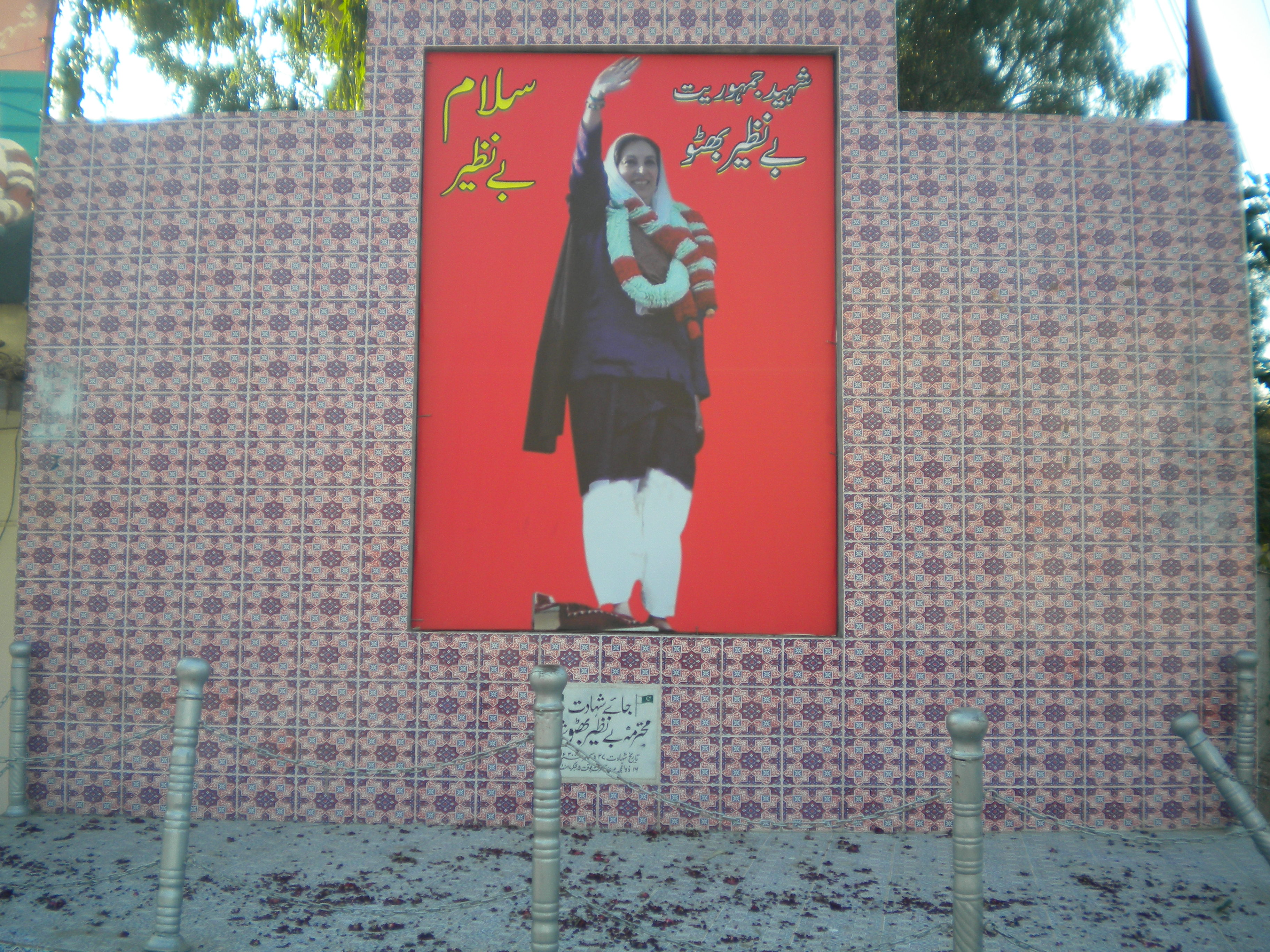
Assassination of Benazir Bhutto
The doctor who tried to save her was the son of the doctor who had tried to save Liaquat Ali Khan -- Pakistan's first prime minister, assassinated in the same park and rushed to the same hospital in 1951. History in Rawalpindi does not merely repeat; it returns to the same coordinates. On the evening of 27 December 2007, Benazir Bhutto stood through the sunroof of her white Toyota Land Cruiser at Liaquat National Bagh, waving to supporters after a Pakistan Peoples Party rally. Three gunshots rang out, followed by a suicide bomb that killed twenty-three people in the crowd around her. She was declared dead at Rawalpindi General Hospital at 6:16 PM local time. Bhutto was fifty-four years old, a two-time prime minister, and the first woman to lead a Muslim-majority nation. She had been back in Pakistan for barely two months.
Eight Years in Exile, Ten Weeks at Home
Bhutto left Pakistan in 1999 amid pending corruption cases in Pakistani and foreign courts, settling into a long exile split between Dubai and London. She returned to Karachi on 18 October 2007, invited by the possibility of a power-sharing arrangement with President Pervez Musharraf ahead of the January 2008 general elections. Her homecoming nearly killed her before she reached the city. En route from Jinnah International Airport to a rally, two explosions -- a suicide bombing -- tore through her motorcade. Bhutto survived; 139 people did not, including at least fifty PPP security guards who had formed a human chain around her truck. In the weeks that followed, Bhutto sought protection from every quarter available: the CIA, Scotland Yard, the private security firms Blackwater and ArmorGroup. Pakistan's government refused to issue visas for foreign security contractors. American diplomats passed her confidential intelligence on threats. None of it was enough.
The Rally at Liaquat Bagh
Liaquat National Bagh -- the park named for Pakistan's assassinated first prime minister -- sits in the garrison city of Rawalpindi, adjacent to Islamabad. Bhutto addressed a crowd of PPP supporters there on the afternoon of 27 December, then climbed into her bulletproof vehicle to leave. She stood through the sunroof to wave. Getty Images photographer John Moore, who was present, later described what happened next: three gunshots, then an explosion as a suicide bomber detonated beside the vehicle. Amateur footage broadcast by the Times of India showed the assassin firing before the blast. An unconscious Bhutto was rushed to Rawalpindi General Hospital, where a team led by Mohammad Musaddiq Khan performed an emergency thoracotomy. The effort failed. A UN investigation would later conclude bluntly that her assassination "could have been prevented if adequate security measures had been taken." President Musharraf, for his part, blamed Bhutto herself for taking "unnecessary risks."
A Death Disputed
Within hours of Bhutto's death, the question of how exactly she died became a political battleground in itself. Pakistan's Interior Ministry initially claimed she was killed by a skull fracture caused when the blast threw her against her vehicle's sunroof latch -- no gunshots, no shrapnel. Bhutto's aides insisted she was shot twice before the bomb detonated. The hospital's lead doctor described severe skull fractures but, under apparent government pressure, stopped speaking publicly. No formal autopsy was performed. According to the Washington Post, the crime scene was hosed down before forensic examiners could complete their work. Bhutto's husband, Asif Ali Zardari, refused to authorize an autopsy in Pakistan, citing distrust of the process. In February 2008, Scotland Yard investigators concluded Bhutto died from impact injuries caused by the blast, not bullets -- though the New York Times noted the difficulty of reaching "conclusive findings absent autopsy results or other potentially important evidence that was washed away." The truth of how Bhutto died remained, like so much in Pakistani politics, a matter of which authority you chose to believe.
A Country Unravels
Pakistan broke. Supporters outside the hospital wept, smashed glass doors, and chanted against Musharraf. Within hours, demonstrations had spread across the country. In Sindh -- Bhutto's home province -- the violence was worst. Rioters destroyed 176 banks, thirty-four gasoline stations, and hundreds of vehicles and shops. Police in Peshawar fired tear gas into crowds. Two officers were shot dead in Karachi. At least forty-seven people died in the unrest that followed the assassination. The Pakistan Rangers issued shoot-on-sight orders against arsonists, though the military attempted to avoid direct confrontation where possible. The Election Commission postponed the January general elections until February. When voters finally went to the polls, Bhutto's party won -- propelled by a wave of sympathy that transformed grief into political mandate. Zardari, following Bhutto's political will, placed their nineteen-year-old son Bilawal as PPP chairman while serving as co-chairman himself, calculating that the Bhutto name would hold the fractious party together better than his own.
The Same Park, the Same Hospital
Rawalpindi is not a city that forgets its dead. Liaquat Ali Khan was assassinated at Liaquat Bagh in 1951. Fifty-six years later, Benazir Bhutto was killed leaving the same park. Both were rushed to Rawalpindi General Hospital. The coincidence is not merely geographic -- it speaks to something structural about Pakistani political life, where power and its violent contestation cycle through the same institutions, the same families, and sometimes the same physical spaces. A memorial now marks the assassination site at Liaquat Bagh. The park remains a rallying point for political gatherings in Rawalpindi. Bhutto's legacy, like the circumstances of her death, resists simple resolution. She was a democratic icon and a figure dogged by corruption allegations, a champion of women's political participation and a dynastic heir, beloved by millions and distrusted by many in the military establishment whose tolerance she required to govern. What is beyond dispute is that on 27 December 2007, Pakistan's democratic trajectory was violently redirected, and the reverberations are still felt.
From the Air
Rawalpindi (33.61N, 73.06E) sits adjacent to Pakistan's capital Islamabad in the Pothohar Plateau region. Liaquat National Bagh, the assassination site, is in central Rawalpindi. The nearest major airport is Islamabad International Airport (OPIS/ISB), approximately 30km northwest. The older Chaklala Airbase (OPRN), from which Bhutto's body was flown to Sukkur, is on Rawalpindi's eastern edge. The twin cities of Rawalpindi and Islamabad are clearly distinguishable from altitude: Islamabad's planned grid layout and green Margalla Hills backdrop contrast with Rawalpindi's dense, older urban fabric to the south.