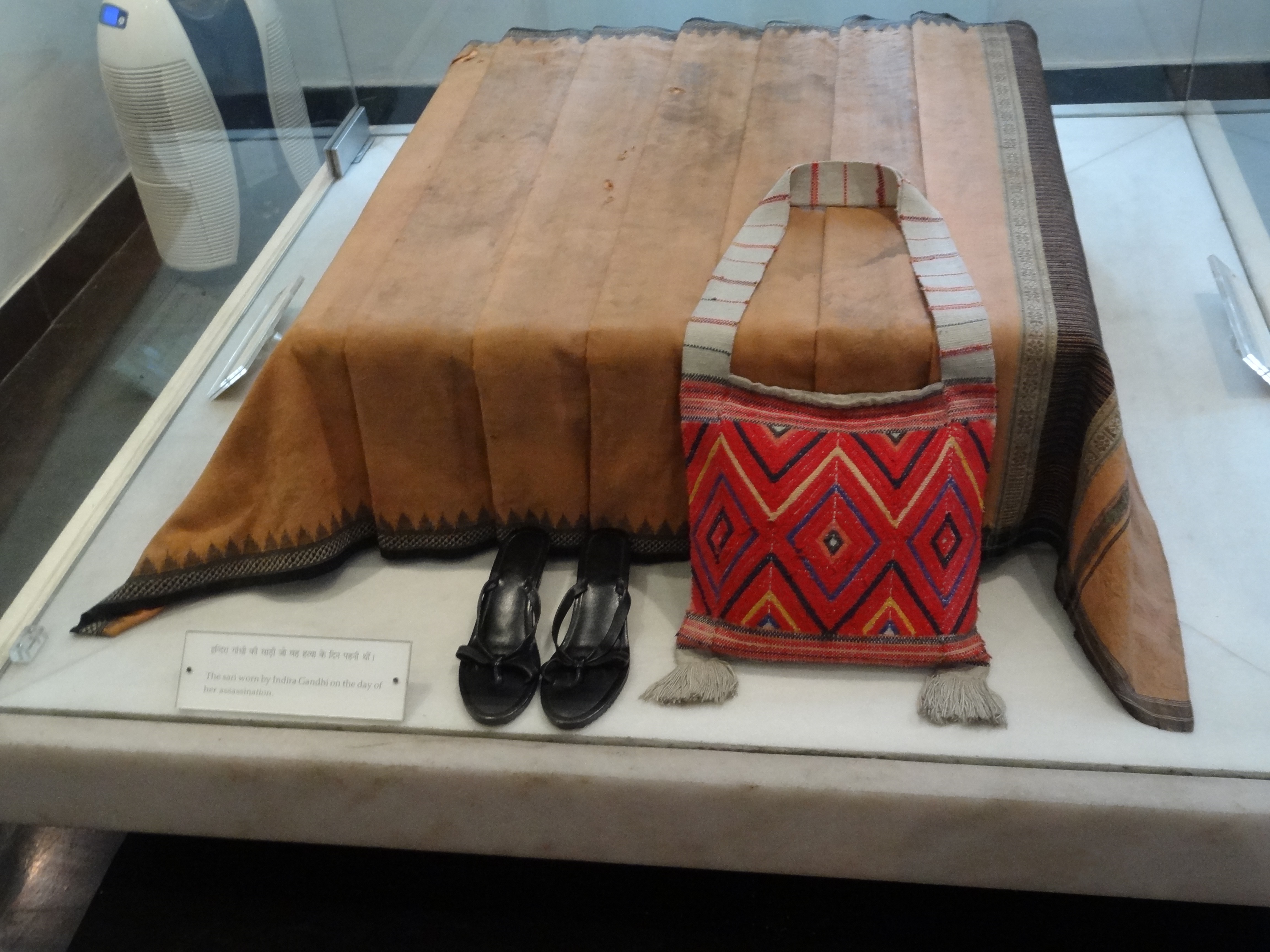
Assassination of Indira Gandhi
She had been warned not to keep them. After the Indian Army's assault on the Golden Temple in Amritsar that June -- Operation Blue Star, which killed hundreds of people inside Sikhism's holiest shrine -- the Intelligence Bureau removed all Sikh officers from Indira Gandhi's personal security detail. Gandhi overruled them. She feared the removal would confirm her image as anti-Sikh, and she personally ordered the reinstatement of her Sikh bodyguards, including Sub-Inspector Beant Singh, whom she had known for ten years and considered a favorite. On the morning of October 31, 1984, Beant Singh and Constable Satwant Singh were waiting at the wicket gate in the garden of 1 Safdarjung Road.
A Walk Through the Garden
Gandhi was dressed in a saffron sari that morning, on her way to an interview with British actor Peter Ustinov, who was filming a documentary for Irish television. She had been advised to wear a bulletproof vest at all times since Operation Blue Star, but she chose not to that day. Accompanied by her personal secretary R.K. Dhawan and security officer Rameshwar Dayal, she walked from the Prime Minister's residence toward her office at 1 Akbar Road, a path that took her through the garden and past the wicket gate. Beant Singh fired three rounds from his .38 revolver into her abdomen. Satwant Singh, just twenty-two years old and assigned to Gandhi's detail only five months earlier, emptied his Sterling submachine gun. Of the thirty-three bullets fired, thirty struck her. Twenty-three passed through her body. She was declared dead at 2:20 p.m. at the All India Institute of Medical Sciences.
The Seeds at Amritsar
The assassination did not come from nowhere. Operation Blue Star, carried out between June 1 and 8, 1984, was a full military assault on the Harmandir Sahib complex in Amritsar -- the Golden Temple, the most sacred site in Sikhism. Gandhi had ordered the operation to dislodge militant leader Jarnail Singh Bhindranwale and armed Sikh separatists who had fortified positions within the complex. The assault killed hundreds of pilgrims who were present for a Sikh holy day -- official figures cite around 500 civilians; independent estimates run considerably higher -- damaged the Akal Takht -- the seat of Sikh temporal authority -- and destroyed the Sikh Reference Library, which held irreplaceable manuscripts and historical documents. For many Sikhs worldwide, the operation was not a security measure but a desecration. The fury it generated was deep and lasting, and it reached into Gandhi's own household security.
Ten Hours of Silence
India did not learn of its Prime Minister's death for more than ten hours. Salma Sultan delivered the news on Doordarshan's evening broadcast on October 31, long after Gandhi had been pronounced dead. The delay fed confusion and fear. Meanwhile, the mechanisms of retribution were already in motion. The government ordered national mourning from November 1 through November 12. Flags flew at half-staff. Offices closed. Gandhi's body was borne on a gun carriage through Delhi's streets to Teen Murti Bhavan, where her father Jawaharlal Nehru had once lived and where she lay in state before her cremation. Heads of state from around the world issued condolences. Tanzania declared seven days of mourning; Uganda five; Cuba four. The grief was real. But the violence that accompanied it was something else entirely.
Four Days of Fire
What followed was not spontaneous mob rage. Congress party workers organized systematic attacks on Sikh communities across India, aided by government officials who provided transportation -- trucks and state buses -- along with weapons and flammable materials. Over four days, mobs targeted Sikh homes, businesses, and gurdwaras. Official government figures placed the death toll at 3,350. Independent investigations have estimated between 8,000 and over 25,000 Sikhs killed. Forty historic gurdwaras were destroyed. The violence was concentrated in Delhi but extended to Haryana, Uttar Pradesh, and beyond -- to places like the hamlet of Hondh-Chillar, where 32 Sikhs were murdered on November 2 and buried in mass graves that would not be discovered for twenty-six years. The scale of the pogrom, and the state's complicity in it, remains one of the most painful chapters in India's post-independence history.
Justice and Memory at Safdarjung Road
Beant Singh was shot dead by other security personnel immediately after the assassination. Satwant Singh survived and stood trial alongside Kehar Singh, who was convicted as a co-conspirator. Both were hanged on January 6, 1989. The Thakkar Commission, established to investigate the assassination, concluded that the "needle of suspicion" pointed at R.K. Dhawan, Gandhi's personal secretary, who had reportedly overruled intelligence officials' orders to remove the Sikh bodyguards. Today, the residence at 1 Safdarjung Road has been converted into the Indira Gandhi Memorial, preserving the path she walked that morning, the garden, and the spot where she fell. A crystal walkway marks her final steps. The memorial is both a place of political reverence and an unavoidable reminder that the consequences of that October morning extended far beyond one life and one garden.
From the Air
Located at 28.60N, 77.21E in central New Delhi. The assassination site at 1 Safdarjung Road (now the Indira Gandhi Memorial) is in the diplomatic enclave area of Lutyens' Delhi, near the intersection of Safdarjung Road and Akbar Road. From the air, the area is identifiable by the large tree-lined avenues and bungalow compounds characteristic of New Delhi's government district. Rashtrapati Bhavan and Parliament House are approximately 2 km to the northeast. Nearest airport is Indira Gandhi International (VIDP/DEL), about 12 km southwest. Best viewed at 2,000-4,000 feet AGL.