Assassination of James A. Garfield
Charles Guiteau chose the ivory-handled revolver because he thought it would look better in a museum. The gun shop owner, sensing Guiteau's budget was tight, dropped the price by a dollar. It was the kind of absurd detail that defined everything about the assassination of James A. Garfield -- a tragedy born not from grand conspiracy but from one man's staggering delusion that a rambling, plagiarized campaign speech entitled him to a diplomatic posting in Paris. On July 2, 1881, less than four months into Garfield's presidency, Guiteau waited at the Baltimore and Potomac Railroad Station in Washington, D.C., got his shoes shined, arranged a cab for his getaway, and shot the 20th president of the United States twice in the back.
The Stalwart and His Speech
Guiteau had failed at everything he tried -- theology, law, bill collecting, and communal living at the utopian Oneida Community. When he latched onto Republican politics, he authored a speech called "Grant against Hancock" supporting Ulysses S. Grant's presidential bid. When the nomination instead went to dark horse candidate James A. Garfield, Guiteau simply changed the name. He never delivered the speech publicly, never paid the printer's bill, and his hasty find-and-replace left Garfield credited with Grant's accomplishments. Yet Guiteau convinced himself that these few hundred pamphlets were largely responsible for Garfield's narrow victory. He first demanded the consulship in Vienna, then said he would settle for Paris. He loitered around Republican headquarters in New York all winter, then moved to Washington the day after Garfield's inauguration. For two months he roamed the capital -- sleeping in rooming houses without paying, writing letters on stolen hotel stationery, shuffling between the White House and the State Department. On May 14, 1881, Secretary of State James G. Blaine told him: "Never speak to me again on the Paris consulship as long as you live."
Two Shots at the Train Station
Guiteau spent weeks stalking the president around Washington, practicing with his new .442 Webley caliber British Bulldog revolver -- the recoil nearly knocked him over the first time he fired. He wrote letters to General William Tecumseh Sherman requesting military protection from the mob he expected after the killing, and even toured the District of Columbia jail where he planned to be held. On one occasion, he followed Garfield to the train station but decided not to shoot because the president's wife, Lucretia, was in poor health and he did not want to upset her. On July 2, Garfield arrived at the Baltimore and Potomac Railroad Station on the southwest corner of Sixth Street and Constitution Avenue, accompanied by his sons James and Harry and Secretary of State Blaine. Secretary of War Robert Todd Lincoln -- son of Abraham Lincoln -- waited to see him off. The first bullet grazed the president's shoulder. The second entered his back, passing the first lumbar vertebra and lodging behind his pancreas. Policeman Patrick Kearney collided with Guiteau as he fled and arrested him. "I am a Stalwart," Guiteau declared, "and want Arthur for President."
Seventy-Nine Days of Dying
What followed was one of the most agonizing medical dramas in American history. Doctors carried Garfield to an upstairs room of the station, where Dr. Charles Purvis -- the first African-American physician to attend a sitting president -- tended to him. Robert Todd Lincoln, watching from nearby, said quietly: "How many hours of sorrow I have passed in this town." Garfield was moved to the White House, where doctors repeatedly probed his wound with unwashed fingers and unsterilized instruments, searching for the bullet. Alexander Graham Bell built a metal detector specifically for the task, but the self-appointed chief physician, Doctor Willard Bliss, only allowed Bell to scan Garfield's right side -- where Bliss wrongly insisted the bullet lay. One doctor punctured the president's liver during examination. Navy engineers rigged an early air conditioning system, blowing fans over blocks of ice to lower the sickroom temperature by 20 degrees. Garfield wasted from 210 pounds to 130 pounds over the summer, surviving on liquid nutrients and enemas. On September 6, volunteers built an entire spur rail line overnight to transport him to a seaside mansion in Elberon, New Jersey. He died there on September 19, 1881, at 10:35 p.m. Most historians now believe Garfield would have survived had his doctors simply left the wound alone.
The Trial of the Century
Guiteau's trial was a spectacle unlike anything Washington had seen. He insulted his own defense team, recited his testimony in epic poetry, passed notes to spectators soliciting legal advice, sang "John Brown's Body" to the court, and dictated an autobiography to the New York Herald -- ending it with a personal ad seeking "a nice Christian lady under 30." He was oblivious to the fact that he had been nearly killed twice -- once in prison and once during transport. His most memorable legal argument was devastatingly logical in its absurdity: "I deny the killing, if your honor please. We admit the shooting." His trial became one of the first major American cases to consider the insanity defense. While awaiting his verdict, Guiteau was busy planning a lecture tour and a presidential run in 1884. The jury convicted him on January 25, 1882. He was hanged on June 30, 1882, two days before the anniversary of the shooting. Part of Guiteau's preserved brain is on display at the Mutter Museum in Philadelphia.
A Legacy Written in Reform
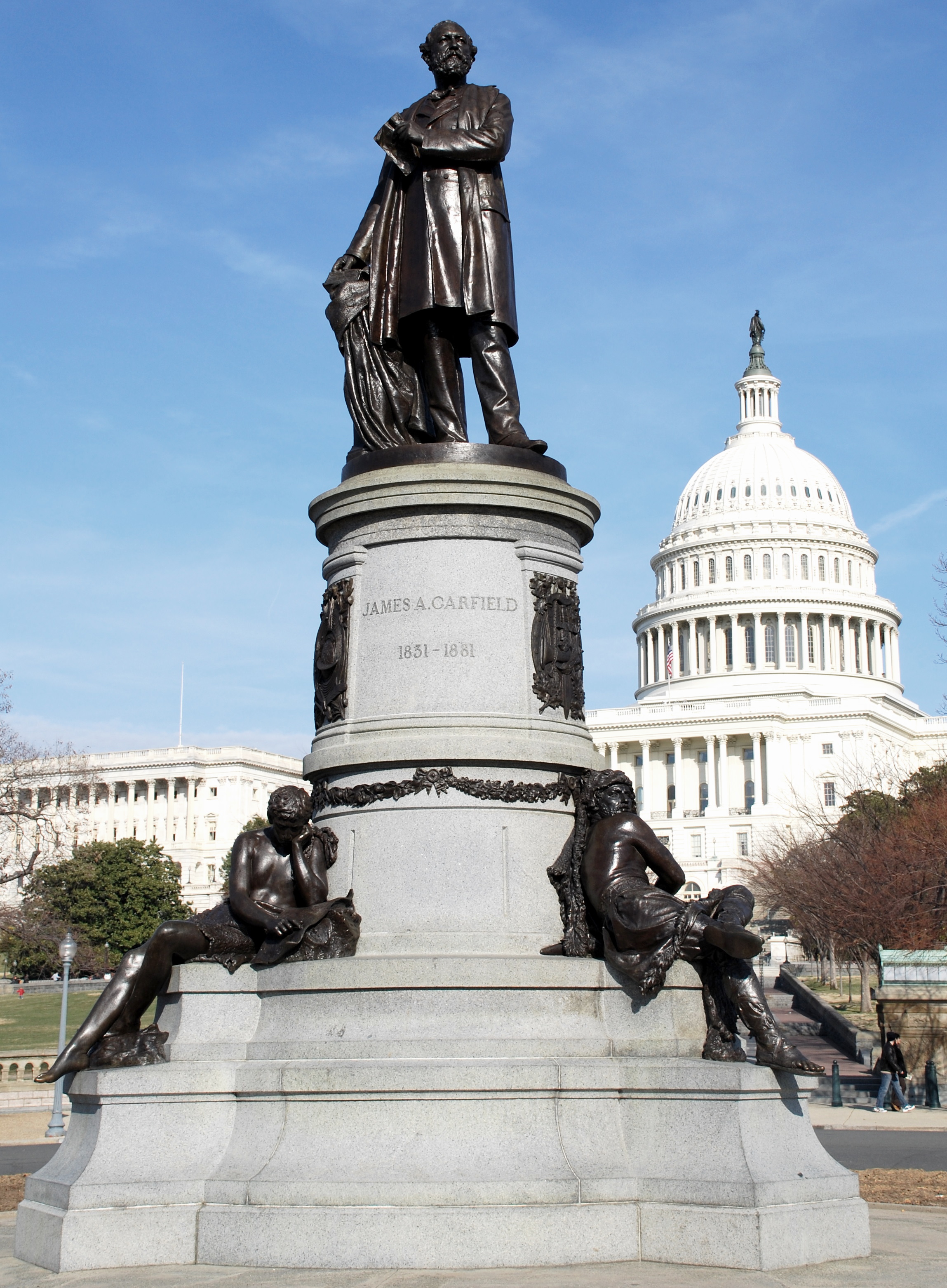
The assassination site at the Baltimore and Potomac Railroad Station is long gone -- the West Building of the National Gallery of Art now stands on the spot. In 2018, the National Park Service placed permanent wayside signs to mark the location. A few blocks away, the James A. Garfield Monument stands on the southwest corner of the U.S. Capitol grounds. Garfield's death accomplished what his presidency could not. His assassination was instrumental to the passage of the Pendleton Civil Service Reform Act in 1883, ending the spoils system that had driven Guiteau's delusion. The question of what to do when a president is alive but incapacitated -- Garfield lay helpless for 79 days, signing only a single extradition paper -- went unanswered for nearly a century, through Woodrow Wilson's debilitating stroke and beyond, until the Twenty-fifth Amendment was ratified in 1967. And it was not until the assassination of William McKinley twenty years later that Congress finally assigned the Secret Service to protect the president.
From the Air
Located at 38.89N, 77.02W in the heart of Washington, D.C. The assassination site is now the National Gallery of Art on the National Mall, easily visible from the air. The Garfield Monument is on the U.S. Capitol grounds to the east. Recommended viewing altitude: 2,000-3,000 feet AGL. Nearest airports: KDCA (Reagan National, 3nm south), KIAD (Dulles International, 24nm west). The National Mall corridor is restricted airspace (P-56) -- observe all TFRs.