Assassination of Kim Jong-nam
It took less than five seconds. On the morning of 13 February 2017, a heavyset man in a gray blazer stood near a self-check-in kiosk at KLIA 2, the low-cost carrier terminal of Kuala Lumpur International Airport, waiting for his 10:50 a.m. AirAsia flight to Macau. Two women approached from behind. One grabbed his face; the other smeared a liquid across it. The man stumbled to an airport receptionist, saying someone had splashed something on him. Within twenty minutes, Kim Jong-nam, the eldest son of the late North Korean dictator Kim Jong-il and half-brother to the sitting supreme leader Kim Jong-un, was dead.
The Exile Who Knew Too Much
Kim Jong-nam had been living outside North Korea since 2003, when he fell from his father's favor. The precise reasons remain murky, though a humiliating 2001 incident at Tokyo's Narita Airport -- where he was caught trying to enter Japan on a forged Dominican passport, reportedly to visit Tokyo Disneyland -- is widely cited as the beginning of the end. He drifted through Macau, Beijing, and Southeast Asia, a man caught between worlds: too prominent to disappear, too estranged to return. Reports later revealed he had been a CIA informant, meeting with American intelligence contacts in the years before his death. At the time of the assassination, he was traveling under the alias "Kim Chol" and carrying four North Korean passports, all under that false name. His backpack held roughly $100,000 in cash. Even in exile, Kim Jong-nam carried the weight -- and the resources -- of a dynasty.
A Weapon Disguised as a Prank
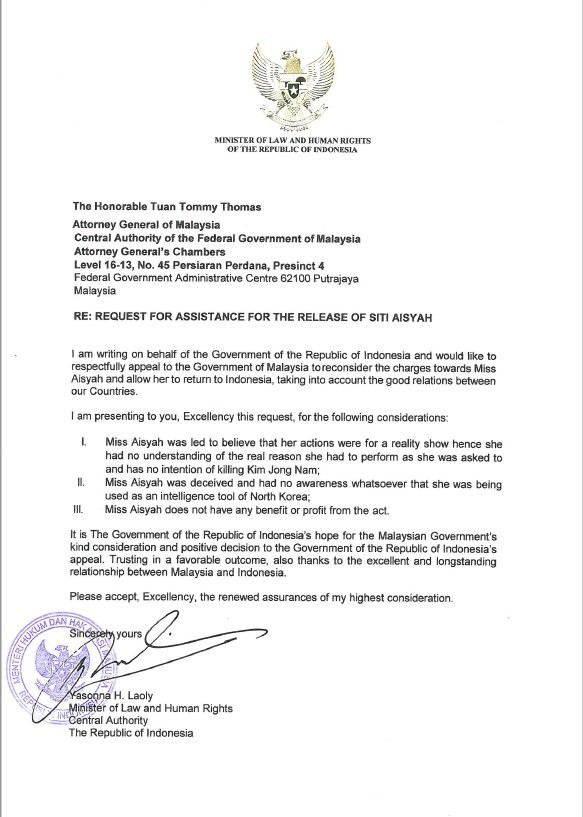
The substance on the women's hands was VX, one of the deadliest chemical weapons ever synthesized. A single drop absorbed through the skin can kill an adult. The genius of the plot, from the assassins' perspective, was its construction: the two women each carried a separate precursor chemical, individually harmless. Only when they combined on Kim's face did the binary mixture become lethal. Siti Aisyah, a 25-year-old Indonesian, and Doan Thi Huong, a 28-year-old Vietnamese woman, were later arrested and charged with murder. Both insisted they believed they were filming a prank for a reality television show, having been recruited and rehearsed by North Korean handlers over the preceding weeks. The murder charges were eventually dropped against Aisyah, while Huong pleaded guilty to a lesser charge and was sentenced to three years and four months. She was released from prison on 3 May 2019.
A Death in Public View
KLIA 2 is one of the busiest terminals in Southeast Asia -- a bright, modern building full of budget travelers and duty-free shops. The attack happened at the departure level, near the check-in kiosks, in full view of security cameras that captured the entire sequence. After being grabbed, Kim staggered to an information counter, then to the Menara Medical Clinic inside the terminal. Nurse Rabiatul Adawiyah Mohd Sofi and Dr. Nik Mohd Adzrul Ariff Raja Azlan treated him with atropine and adrenaline, but his pupils had already constricted to pinpoints -- a classic sign of nerve agent exposure. He was sweating, in pain, and quickly becoming unresponsive. He died while being transported by ambulance, never reaching a hospital. The brazenness of the location was itself a message: nowhere was beyond Pyongyang's reach.
The Handlers Who Vanished
Four North Korean men, later confirmed as intelligence operatives, had coordinated the entire operation from within Malaysia. They left KLIA 2 on flights departing shortly after the assassination, transiting through Jakarta and reaching Pyongyang before Malaysian authorities understood what had happened. Other North Korean nationals were arrested but released without charge. The diplomatic fallout was severe. Malaysia expelled the North Korean ambassador, and North Korea retaliated by barring Malaysian citizens from leaving Pyongyang -- effectively holding them hostage until a body exchange was negotiated. The crisis ultimately ended with the two countries severing diplomatic ties entirely. In November 2017, the United States returned North Korea to its list of state sponsors of terrorism, citing the assassination. The Organisation for the Prohibition of Chemical Weapons formally condemned the use of VX in a public setting.
The Terminal Today
KLIA 2 still hums with the everyday rhythm of Southeast Asian air travel -- the shuffle of flip-flops, the beep of boarding passes, the announcements cycling through Malay, English, and Mandarin. The kiosk area where Kim Jong-nam was attacked holds no plaque or marker. Millions of passengers pass through annually, most unaware that this ordinary stretch of polished floor was the site of one of the most audacious political assassinations in recent history. The killing demonstrated that a UN-banned chemical weapon could be deployed in a civilian airport, by unwitting accomplices, in broad daylight. That the perpetrators escaped is perhaps the most chilling detail of all.
From the Air
Located at 2.74N, 101.69E at Kuala Lumpur International Airport (KLIA 2 terminal). The airport is ICAO code WMKK, one of Southeast Asia's busiest hubs. The main terminal complex is visible from 3,000-5,000 feet, with the distinctive satellite building and connecting rail visible. Sultan Abdul Aziz Shah Airport (WMSA/Subang SkyPark) is 35 nm to the northwest. The Strait of Malacca is visible to the west on clear days.