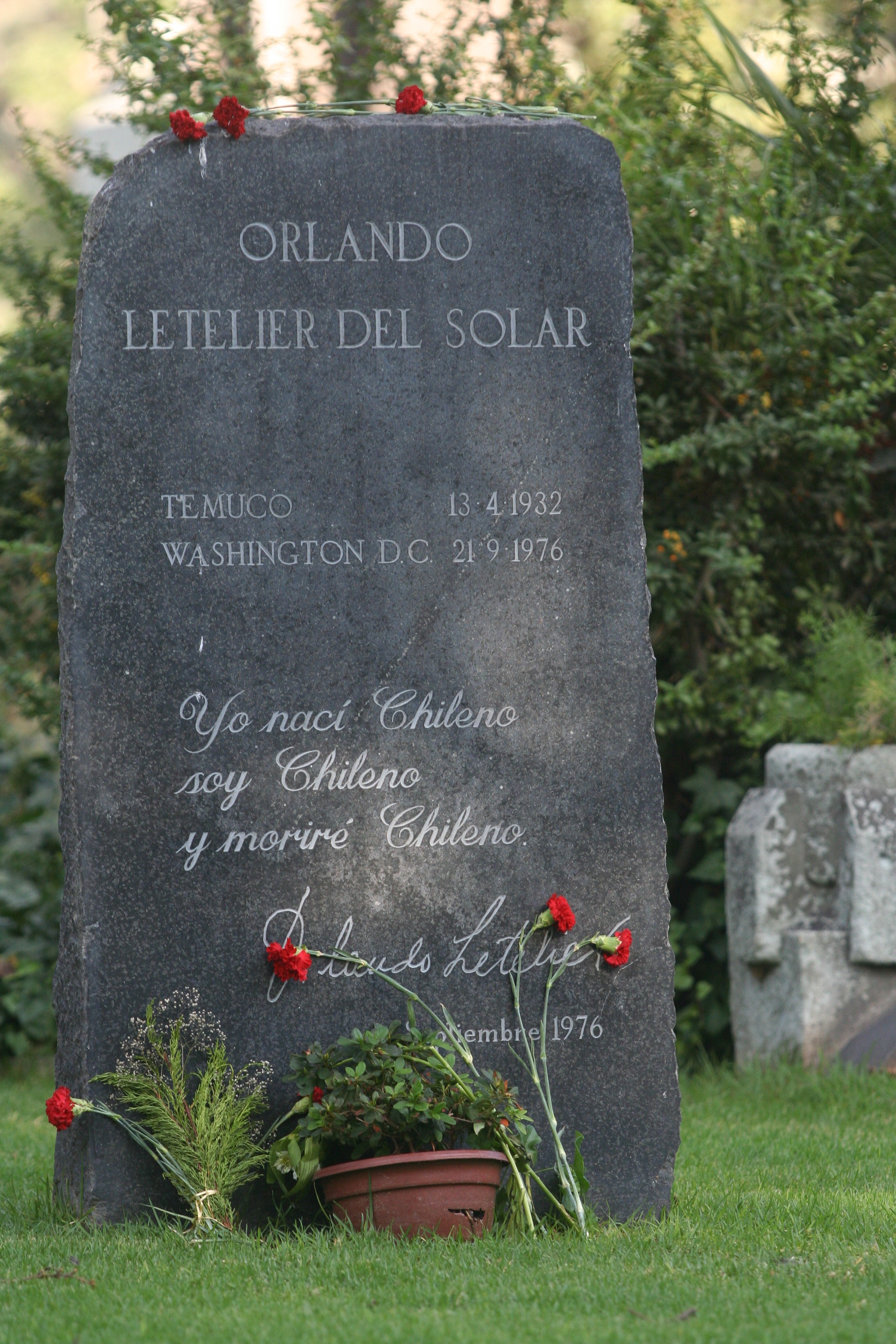
Assassination of Orlando Letelier
At 9:35 on the morning of September 21, 1976, a car rounded Sheridan Circle on Embassy Row in Washington, D.C., and an explosion lifted it off the pavement. Orlando Letelier, a former Chilean ambassador and outspoken critic of Augusto Pinochet's military dictatorship, was at the wheel. His colleague Ronni Moffitt sat beside him. Her husband Michael was in the back seat. The bomb had been placed under the driver's side of the car. It was not the work of a lone extremist or a random act of violence. Declassified documents would eventually confirm what investigators suspected from the start: the assassination was ordered personally by Pinochet, carried out by Chile's secret police, and executed with the help of Cuban exile operatives -- all on the streets of the American capital, just steps from the Irish Embassy.
Death on Embassy Row
When the blast subsided, the car had collided with a Volkswagen illegally parked in front of the Irish Embassy. Michael Moffitt crawled out the shattered rear window and saw his wife of four months stumbling away from the wreckage. Assuming she was safe, he turned to help Letelier, who was still pinned in the driver's seat. Both Letelier and Ronni Moffitt were rushed to George Washington University Medical Center. Letelier was pronounced dead at 9:50 a.m. At the hospital, doctors discovered that a piece of flying shrapnel had severed Ronni's larynx and carotid artery. She died at 10:37 a.m. Michael Moffitt suffered only a minor head wound. The medical examiner listed the cause of death for both victims as explosion-incurred injuries from a car bomb. Ronni Moffitt was 25 years old. She and Letelier both worked at the Institute for Policy Studies in Washington.
A Dictator's Reach
The FBI investigation that followed unraveled a conspiracy that stretched from Santiago to Asuncion to Washington. Michael Townley, an American expatriate working for Chile's DINA -- the Direccion de Inteligencia Nacional, Pinochet's feared secret police -- had organized the assassination. He entered the United States on a fraudulent Chilean passport, recruited a team of anti-Castro Cuban exiles, and rigged the bomb under Letelier's car. The operatives included Jose Dionisio Suarez Esquivel, Virgilio Paz Romero, and the Novo Sampol brothers. Pinochet had personally called Paraguayan dictator Alfredo Stroessner to arrange false passports for the assassination team. The cover-up effort was extensive enough to earn its own code name: Operacion Mascarada. In 1978, Chile turned Townley over to the United States, where he pleaded guilty to conspiracy to commit murder in exchange for a ten-year sentence. Eight separate CIA reports, sourced to what the State Department called "extremely sensitive informants," documented Pinochet's direct involvement in ordering the killing and directing the cover-up.
What Washington Knew
The assassination was not merely a failure of international law -- it was a failure of American intelligence. Documents released in 1999 and 2000 established that the CIA had inside intelligence about the assassination alliance known as Operation Condor at least two months before Letelier was killed, but failed to act. The intelligence described Condor's plans to kill prominent exiles outside Latin America, though it did not name Letelier specifically. A month before the bombing, Secretary of State Henry Kissinger ordered that Latin American rulers be warned that assassinations abroad "would create a most serious moral and political problem." The warning was never delivered. The U.S. embassy in Santiago declined to pass it along, arguing that such a rebuke would upset the dictator. On September 20, 1976 -- the day before Letelier and Moffitt died -- the State Department instructed its ambassadors to take no further action regarding the Condor scheme. In 2010, the Associated Press reported that a document discovered by the National Security Archive confirmed Kissinger himself had blocked the warning communique.
Justice Delayed, Never Completed
The legal aftermath stretched across decades and continents. Townley testified extensively, implicating the Cuban exile operatives and DINA leadership including General Manuel Contreras and his deputy Pedro Espinoza. Suarez and Paz evaded capture for years before their eventual arrests. The Pinochet regime fought extradition and accountability at every turn. Chile eventually agreed to pay reparations to the families of both victims, with amounts determined by an arbitration commission in the early 1990s. But full justice remained elusive. Pinochet died in 2006 without ever standing trial for the Letelier assassination or for the broader crimes of his regime. Letelier's body was taken to Caracas, Venezuela, for burial by Venezuelan diplomat Diego Arria, where it remained until the end of Pinochet's rule, when it could finally be returned to Chile. The Letelier-Moffitt case remains the most notorious act of state-sponsored terrorism committed on American soil during the Cold War.
Sheridan Circle Today
Sheridan Circle sits at the intersection of Massachusetts Avenue and 23rd Street NW, at the heart of Washington's Embassy Row. The traffic circle is named for Civil War General Philip Sheridan, whose equestrian statue commands the center. Embassies of Turkey, Ireland, Egypt, and other nations line the surrounding blocks. Today the circle is a quiet, tree-shaded roundabout where diplomats and joggers pass without knowing what happened here. A small memorial marks the spot where Letelier and Moffitt died. The case permanently changed how the United States responded to foreign intelligence operations on its soil and became a landmark in the declassification movement, as researchers at the National Security Archive spent decades prying loose the documents that proved what happened and who ordered it.
From the Air
Located at 38.91N, 77.05W on Embassy Row in northwest Washington, D.C. Sheridan Circle is visible at the intersection of Massachusetts Avenue and 23rd Street NW, surrounded by embassy buildings. The site is approximately 1.5nm northwest of the White House. Recommended viewing altitude: 2,000-3,000 feet AGL. Nearest airports: KDCA (Reagan National, 4nm south), KIAD (Dulles International, 23nm west). This area falls within P-56 restricted airspace -- observe all TFRs.