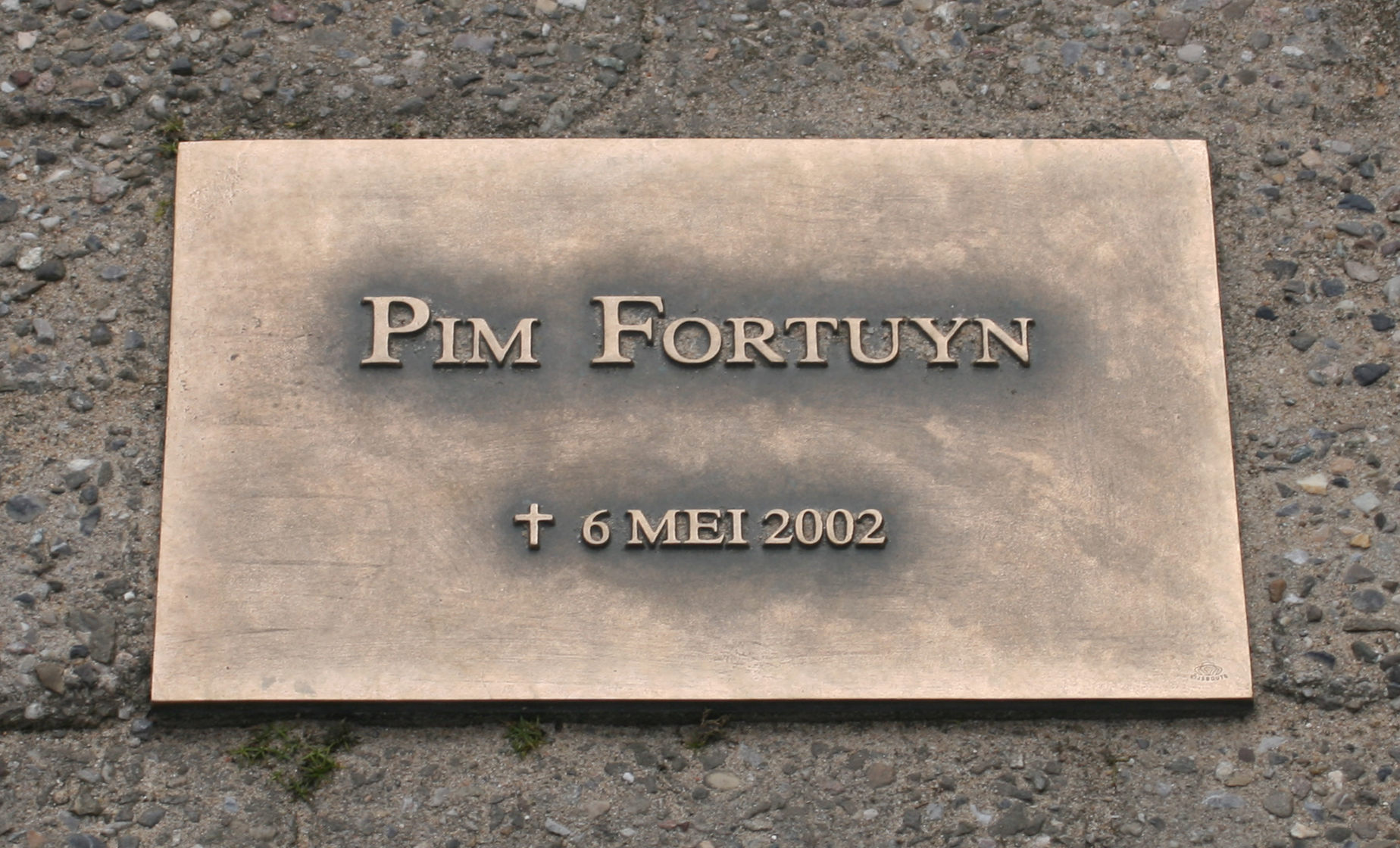
Assassination of Pim Fortuyn
At about a quarter past six on the evening of 6 May 2002, a fifty-four-year-old man named Pim Fortuyn walked out of a recording studio at the Media Park in Hilversum, where he had just finished a live interview with the radio host Ruud de Wild on 3FM. Fortuyn was a former sociology professor with a shaved head, a chauffeur, and a small Maltese dog named Kenneth. He was nine days away from a national election in which his new political party, the Pim Fortuyn List, was leading in the polls. As he crossed the parking lot, a man in a baseball cap and dark glasses walked past him, turned, and fired six shots from a Star Firestar M43 pistol concealed in a plastic bag. Five of the bullets hit Fortuyn in the back and head. He died on the pavement within minutes. The Netherlands, a country that had not seen a political assassination in over three hundred years, lost its composure that night and has, in some ways, never fully gotten it back.
The Man Who Was Killed
Pim Fortuyn was not easy to summarize. He was openly gay, comfortably wealthy, fond of his butler, and intellectually trained as a Marxist sociologist before swinging hard to the right on questions of immigration and Islam. He argued, often provocatively, that Dutch tolerance was being undermined by religious conservatism imported from abroad, and that the country's political establishment was refusing to talk honestly about it. His critics called him a demagogue and a bigot. His supporters called him the only politician willing to say what they were thinking. He was pied during a public appearance shortly before his death; on the talk show Jensen on 22 March 2002, he had spoken openly about his fear of being murdered. Whatever your view of his politics, he was a real person with a household, a family, and a brother who buried him. By the time he was shot, he had reshaped Dutch political discourse in a matter of months.
The Man Who Killed Him
Volkert van der Graaf was thirty-two, a vegan, an environmental and animal-rights activist with a partner and a small daughter. He bought the pistol illegally from a man in a cafe in Ede and the 9mm cartridges in The Hague. On the morning of 6 May he went to work, then told colleagues he was taking the afternoon off to enjoy the beautiful weather. He drove to Hilversum with a backpack containing the gun, latex gloves, a baseball cap, and dark glasses. He stopped to buy a razor to shave off his stubble, but the razor did not work. He had never been to the Media Park; he had printed maps and photographs off the internet. He hid in the bushes outside the studio for nearly two hours, listening to fragments of Fortuyn's interview through a speaker on the building. In court he said he killed Fortuyn to stop the politician from exploiting Muslims as scapegoats and from targeting the weak members of society in his pursuit of power. He was convicted on 15 April 2003 and sentenced to eighteen years. He was released on parole in May 2014 after serving two-thirds of the sentence, and has lived since in Apeldoorn.
Nine Days
Riots broke out on the Binnenhof, the medieval government square in The Hague, on the evening after the killing. Every political party suspended campaigning. Some called for the election to be postponed, but Dutch law did not allow the ballots to be reprinted in time, and so Fortuyn became a posthumous candidate on his own party's list. On 15 May 2002, nine days after his death, the Pim Fortuyn List won 26 of the 150 seats in the House of Representatives, the largest debut in modern Dutch electoral history. The People's Party for Freedom and Democracy and the Labour Party both took heavy losses and replaced their leaders within weeks. A coalition cabinet was formed with the Christian Democratic Appeal and the Pim Fortuyn List; it collapsed three months later under the weight of internal LPF infighting. By the 2006 election, the party Fortuyn had founded held no seats at all.
After
Fortuyn's death did not end Fortuynism. It rerouted it. Rita Verdonk, the former Minister for Integration and Immigration, rose in profile. Geert Wilders, who had broken from the VVD shortly before Fortuyn's murder, founded the Party for Freedom and won 9 seats in 2006, 24 in 2010, and went on to lead the largest party in the 2023 Dutch general election. The 2002 elections were also the last time Dutch politics felt, to many Dutch people, like a closed conversation among establishment parties. Two and a half years after Fortuyn's killing, the filmmaker Theo van Gogh was assassinated in Amsterdam-Oost by a Dutch-Moroccan extremist over a film critical of Islam, and the country went through another collective shock. In a 2004 television vote for the Greatest Dutchman of All Time, Fortuyn was initially declared the winner. It later emerged that William the Silent, the sixteenth-century founder of the Dutch Republic, had received more votes, with a portion uncounted due to technical problems. The pistol Volkert van der Graaf used to kill Fortuyn was eventually donated to the Rijksmuseum. It will not be exhibited, the museum has said, for several decades.
From the Air
The site of the assassination is at the Media Park in Hilversum, at roughly 52.235N, 5.172E, about 30 km southeast of central Amsterdam. The Media Park is a cluster of broadcasting studios and office buildings on the northeast side of Hilversum. Hilversum lies in the wooded Gooi region. The nearest airport is Schiphol (EHAM), roughly 30 km west; smaller Hilversum Aerodrome (EHHV) sits to the southwest of the town. From the air the Media Park reads as a dense knot of mid-rise buildings surrounded by green parkland, with the rest of Hilversum spreading out in a low residential lattice to the west and south.