Assassination of Rafic Hariri
The meeting lasted ten minutes. In August 2004, Syrian President Bashar al-Assad summoned Lebanese Prime Minister Rafic Hariri to Damascus and told him that the term of Lebanese President Emile Lahoud -- Assad's man in Beirut -- would be extended. "Lahoud is me," Assad reportedly said. "If Chirac wants me out of Lebanon, I will break Lebanon." According to testimony later submitted to the United Nations, Assad added that if Hariri opposed the extension, the Syrians would "blow him up" and hunt his family anywhere in the world. Six months later, on February 14, 2005, a truck bomb detonated on the Beirut Corniche as Hariri's six-car convoy passed the St. George Hotel.
The Builder of Beirut
Rafic Hariri was not a typical politician. A self-made billionaire who had amassed his fortune in Saudi construction, he returned to Lebanon after the civil war with a vision to rebuild Beirut from the rubble. As prime minister through most of the 1990s, he oversaw the reconstruction of the downtown district, transforming cratered blocks into the gleaming Solidere development that became the symbol of postwar Lebanon. He was close to French President Jacques Chirac, well-connected across the Gulf states, and seen by many Lebanese as the man who could bridge the country's sectarian divides through sheer economic ambition. But Hariri's wealth and Western connections also made him a threat to the Syrian regime that had occupied Lebanon since 1976. When he began openly opposing Syria's extension of Lahoud's presidential term, he crossed a line that Damascus considered unforgivable.
Six and a Half Minutes
On the morning of February 14, Hariri visited parliament, then stopped at the Cafe de l'Etoile for about twenty minutes. He left in a six-car convoy following a route kept secret until the last moment. Six and a half minutes after departing the cafe, as the convoy neared the St. George Hotel on the Corniche, a truck bomb detonated with a force that left a crater in the road and damaged buildings for blocks in every direction. Hariri and 21 others were killed, including several of his bodyguards. He was buried near the Mohammad Al-Amin Mosque, alongside the men who had died protecting him. A videotape found hanging from a tree near the scene claimed responsibility on behalf of the "Nusra and Jihad Group in Greater Syria" -- a claim investigators would later determine was fabricated, the supposed bomber having been lured into making a false confession video.
The Cedar Revolution
Hariri's assassination did the opposite of what his killers intended. Rather than silencing opposition to Syrian influence, the bombing ignited it. Massive demonstrations -- eventually numbering over a million people in a country of four million -- filled Martyrs' Square in downtown Beirut, demanding the withdrawal of Syrian forces. The movement became known as the Cedar Revolution. Under intense international pressure, Syria withdrew its troops from Lebanon on April 26, 2005, ending a military presence that had lasted twenty-nine years. The United Nations established an International Independent Investigation Commission that quickly pointed toward Syrian and Lebanese intelligence officials. Four pro-Syrian Lebanese generals were arrested. Syrian Interior Minister Ghazi Kanaan, interviewed by the commission as a witness, was found dead of a gunshot wound in his Damascus office weeks later. The assassinations did not stop with Hariri -- journalist Samir Kassir, politician Gebran Tueni, and several others who opposed Syrian influence were killed by car bombs in the months that followed.
Fifteen Years to a Verdict
The Special Tribunal for Lebanon, established in 2007 and seated at The Hague, became the first international court to prosecute terrorism as a distinct crime. The trial proceedings, which began in January 2014, were conducted entirely in absentia -- the four Hezbollah operatives indicted for the assassination had disappeared. The tribunal's investigation, built partly on the work of Lebanese police captain Wissam Eid who was himself assassinated in 2008, traced networks of cellphones that connected scores of operatives to the attack. On August 18, 2020 -- fifteen years after the bombing -- the tribunal found Salim Ayyash, a senior Hezbollah operative and leader of the organization's assassination Unit 121, guilty of five charges including intentional murder with premeditation. Three co-defendants were acquitted. The judges concluded there was "no evidence that the Hezbollah leadership had any involvement" and "no direct evidence of Syrian involvement." Hezbollah denied responsibility. Ayyash was sentenced to life imprisonment in absentia. He was reportedly killed in an Israeli airstrike in Syria in November 2024.
A Crater on the Corniche
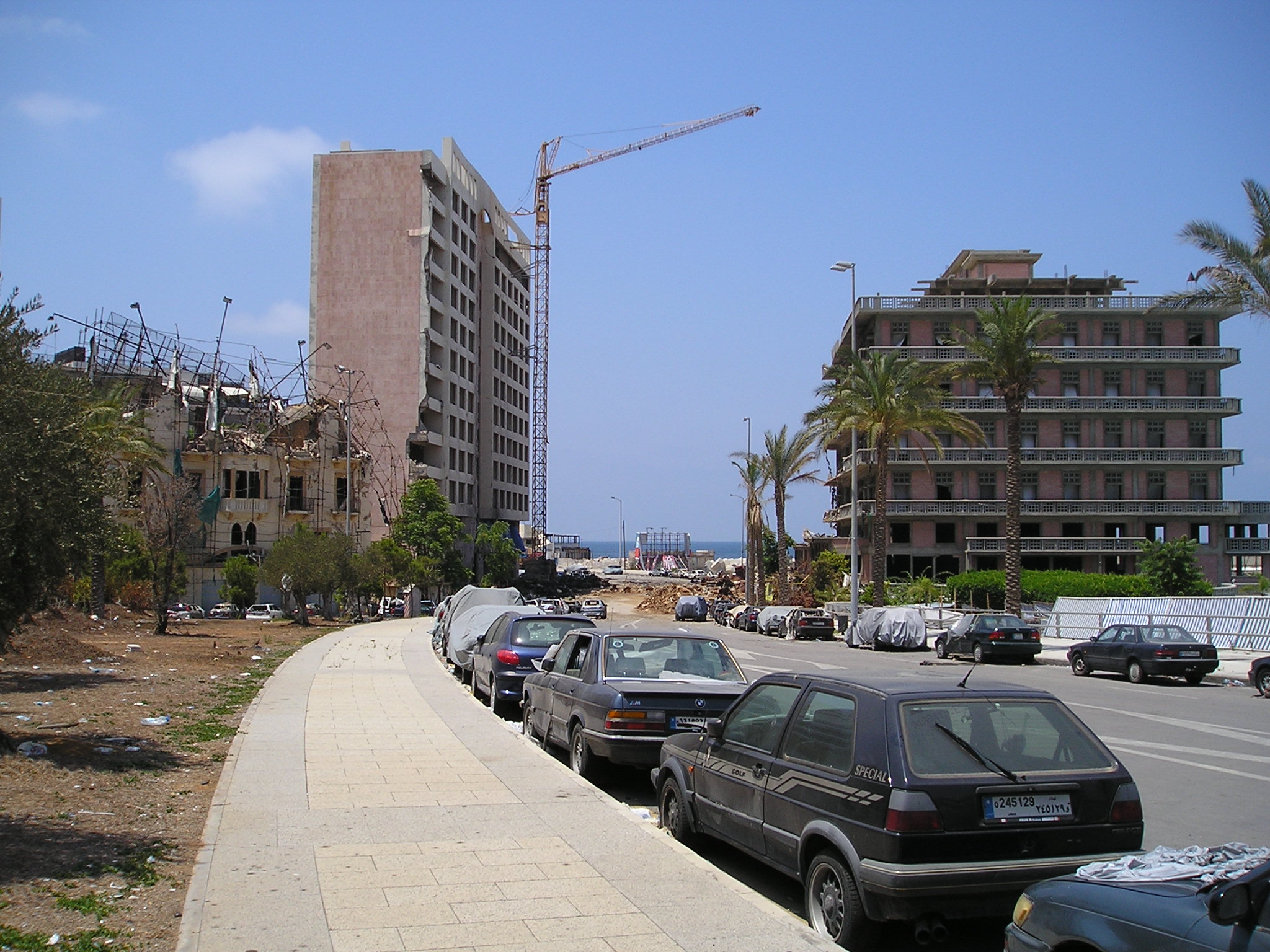
The assassination site along the Beirut Corniche, near the St. George Hotel that itself had been a landmark of the civil war's Battle of the Hotels, has been rebuilt. A memorial shrine marks the spot where Hariri and his bodyguards died. The Mohammad Al-Amin Mosque, its blue dome visible from across the city, stands nearby. From the air, this stretch of the Corniche is unmistakable -- the curved waterfront road tracing the edge of the Ras Beirut peninsula, with the reconstructed downtown district that Hariri himself built spreading inland. The St. George Hotel, still bearing scars from the civil war, sits as a stubborn reminder that in Beirut, the wounds of one era rarely heal before the next ones are inflicted.
From the Air
Located at 33.90N, 35.49E on the Beirut Corniche near the St. George Hotel. The assassination site is on the waterfront road of the Ras Beirut peninsula. Nearest airport: OLBA (Beirut Rafic Hariri International, 5nm south). The blue dome of the Mohammad Al-Amin Mosque is a prominent visual landmark nearby. Best viewed at 2,000-4,000 feet from over the Mediterranean.