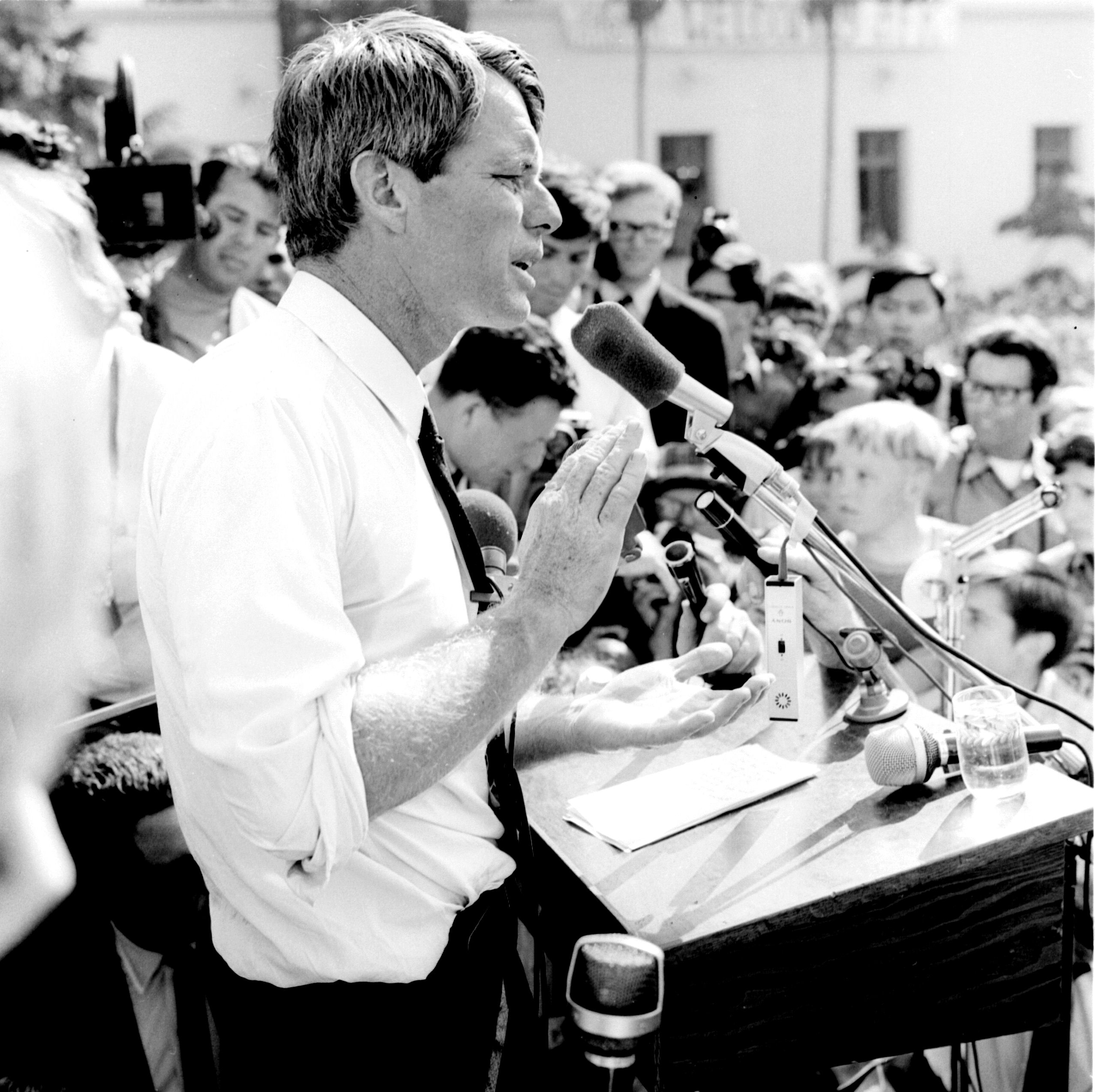
Assassination of Robert F. Kennedy
Just after midnight on June 5, 1968, Robert F. Kennedy finished his victory speech in the Ambassador Hotel's Embassy Ballroom and said goodbye to his supporters. His campaign aide had redirected his exit route at the last moment — through the hotel kitchen rather than back through the crowd — to accommodate a press conference. In the narrow pantry corridor behind the ballroom, 24-year-old Sirhan Sirhan stepped down from a low tray-stacker, rushed forward, and fired a .22 caliber revolver at point-blank range. A busboy named Juan Romero, who had been shaking Kennedy's hand, cradled his head on the floor and placed a rosary in his palm. Kennedy asked: 'Is everybody OK?' He died 25 hours later.
The Night of the California Primary
Kennedy had won California and South Dakota that day, June 4, 1968, putting him in a strong position to challenge Hubert Humphrey for the Democratic presidential nomination. The year had been catastrophic: Martin Luther King Jr. had been killed in April, the Vietnam War was tearing apart the Democratic coalition, and Kennedy himself had entered the race only in March after Eugene McCarthy nearly defeated Lyndon Johnson in New Hampshire. The California victory felt like a turning point. Former football player Rosey Grier and Olympic champion Rafer Johnson served as unofficial bodyguards — the government did not yet provide Secret Service protection to presidential candidates.
Sirhan Sirhan
Sirhan Sirhan was born in Jerusalem in 1944 to an Arab Christian family. He came to the United States with his family in 1956, eventually settling in Pasadena. His trajectory in America had been difficult: his father abandoned the family, a sister died, two brothers were arrested, and he was expelled from Pasadena City College. In 1966 he fell from a horse and suffered a head injury. He developed intense anti-Zionist beliefs and fixated on Kennedy's support for Israel and his commitment to provide jet aircraft to the Israeli military. When police searched his home, they found a diary entry from May 18 stating: 'Robert Kennedy must be assassinated.' He was convicted of murder in April 1969 and sentenced to death; the sentence was later commuted to life in prison. As of 2023, he has been denied parole 17 times.
Five Others Wounded
The shooting wounded five people in addition to Kennedy: William Weisel of ABC News, Paul Schrade of the United Automobile Workers union, Democratic activist Elizabeth Evans, journalist Ira Goldstein, and Kennedy campaign volunteer Irwin Stroll. Ethel Kennedy, three months pregnant, was elsewhere in the hotel when the shooting occurred and was led to her husband's side. Kennedy was taken first to Central Receiving Hospital and then transferred to Good Samaritan Hospital, where he underwent three hours and forty minutes of neurosurgery. His last words, before losing consciousness on the stretcher, were: 'Don't lift me.'
What Changed Because of It
Kennedy's assassination, following his brother John's in 1963 and King's just two months earlier, produced a specific legislative response: Congress extended Secret Service protection to major presidential and vice-presidential candidates. Hubert Humphrey won the Democratic nomination at the Chicago convention — the convention accompanied by violent clashes between police and protesters in the streets outside — and lost the general election to Richard Nixon by fewer than 800,000 popular votes. Whether Kennedy would have won the nomination remains one of the enduring historical counterfactuals of the 20th century. He was buried at Arlington National Cemetery the night of June 8, the first burial there to take place after dark.
The Questions That Remain
Conspiracy theories about a second gunman have persisted for decades, fueled in part by the fact that Kennedy's fatal wound entered behind his right ear at a range of about one inch — a position that some witnesses found inconsistent with Sirhan's established location in front of Kennedy. Thomas Noguchi, the Los Angeles County Chief Medical Examiner, documented the wound location carefully, and his findings have been cited both by those who accept the official account and by those who dispute it. A 2004 audio analysis claimed to identify 13 shots on a recording of the victory speech, though Sirhan's revolver held only eight rounds. Other acoustic experts found no more than eight. Sirhan claims to have no memory of the crime.
From the Air
The Ambassador Hotel stood at 34.0597°N, 118.2972°W on Wilshire Boulevard in the Mid-Wilshire district of Los Angeles. The site is now occupied by the Robert F. Kennedy Community Schools. From the air, Wilshire Boulevard is one of the most prominent east-west corridors in the Los Angeles basin, running from downtown to the Pacific Ocean. Nearest airports: Burbank Bob Hope (KBUR) 10 miles northeast, Santa Monica (KSMO) 8 miles west, Los Angeles International (KLAX) 9 miles southwest.