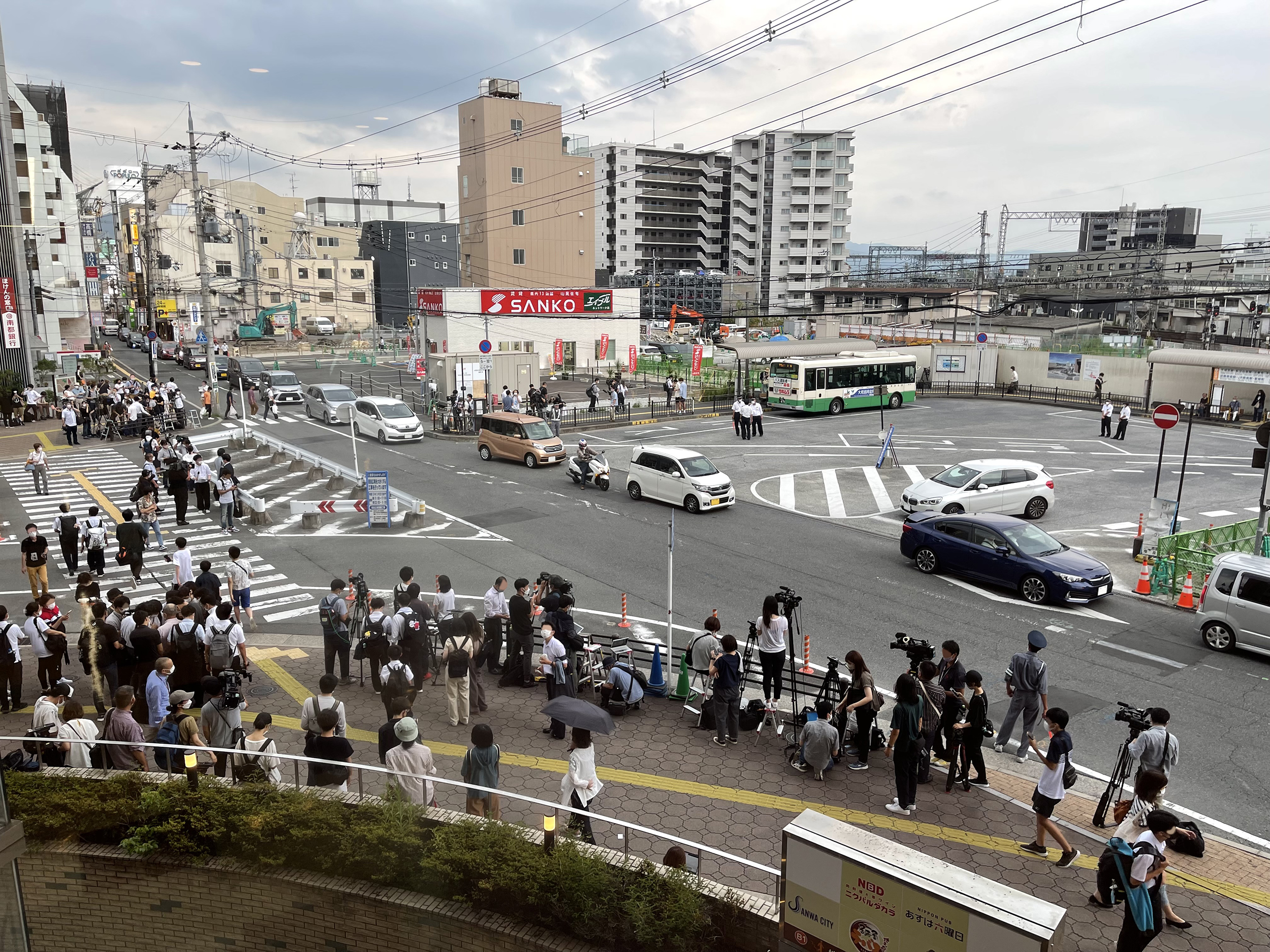
Assassination of Shinzo Abe: The Shots That Shook Japan
The sound was wrong. Security guards stationed outside Yamato-Saidaiji Station in Nara on the morning of July 8, 2022, heard what they thought was fireworks or a tire blowing out. It was neither. At approximately 11:30 a.m., as former Prime Minister Shinzo Abe addressed a small crowd during a campaign speech for an upcoming House of Councillors election, a man approached from behind carrying what appeared to be a crude, taped-together device. The first blast missed. Abe turned toward the noise. The second shot struck him in the neck and chest. Japan's longest-serving prime minister stumbled forward, fell to his knees, and collapsed on the pavement. In a country where gun deaths are almost nonexistent -- Japan typically records fewer than ten firearm homicides per year -- the assassination sent shockwaves across the nation and the world, and tore open a hidden scandal that would reshape Japanese politics for years to come.
A Homemade Weapon, A Borrowed Grudge
The man detained at the scene was Tetsuya Yamagami, a 41-year-old unemployed resident of Nara with no criminal record. His weapon was a battery-ignited homemade gun fashioned from metal pipes, a wooden board, and duct tape, capable of firing six pellets at a time. It resembled a sawn-off double-barreled shotgun. But Yamagami's true target was not Abe himself. In letters and testimony, he explained that his grudge was against the Unification Church, which he blamed for destroying his family. His mother had joined the organization in 1998 and eventually donated the family's entire fortune, driving them into poverty. Unable to reach church leader Hak Ja Han, Yamagami turned his rage toward Abe, whom he considered one of the church's most influential political sympathizers. The connection between the Unification Church and Japan's ruling Liberal Democratic Party had been an open secret for decades. Yamagami's act of violence blew it into the open.
Five Hours in Nara
Paramedics reached Abe within seven minutes. An ambulance arrived at 11:41 a.m. He was airlifted by emergency helicopter to Nara Medical University Hospital in Kashihara, arriving roughly fifty minutes after being shot with no vital signs -- cardiopulmonary arrest had set in during transport. Doctors administered four hours of blood transfusions, using 100 units of blood. Prime Minister Fumio Kishida held a press conference at 2:45 p.m. declaring Abe was in critical condition. Abe's wife Akie arrived at the hospital at 4:55 p.m. Eight minutes later, at 5:03 p.m., doctors pronounced him dead. He was 67. The cause of death was blood loss from a bullet that had damaged the subclavian artery beneath his collarbone. Abe had been hit by two bullets; one was never found in his body. Within hours, former prime ministers and senior officials were making their way to the hospital. The next morning, a five-vehicle motorcade carried his body home to Tokyo.
The Church and the Party
The assassination cracked open a political fault line that Japanese media had largely avoided scrutinizing. The Unification Church confirmed Yamagami's mother was a member. Anti-cult lawyers from the advocacy group Zenkoku Benren revealed that church-related victims had reported 5.1 billion yen in damages across more than 400 cases between 2017 and 2020 alone. As journalists investigated ties between the church and the LDP, the Kishida Cabinet's approval rating dropped sharply -- by up to 13 percent according to NHK polling. More than 80 percent of respondents felt politicians' disclosures of their church ties were insufficient. Kishida reshuffled his cabinet earlier than planned, promising that all members would be vetted for church connections. The minister Taro Kono established a review committee on the church's controversial 'spiritual sales' practices and publicly called the Unification Church a cult. On October 12, 2023, the Ministry of Education applied to the Tokyo District Court for dissolution of the church's religious corporation status. On March 25, 2025, the court upheld the dissolution order, though the church appealed.
A Divided Funeral
The Kishida Cabinet decided on a state funeral for Abe, to be held September 27, 2022, at the Nippon Budokan in Tokyo. The total cost was estimated at up to 1.66 billion yen, drawn from emergency contingency funds without parliamentary approval. The decision proved deeply polarizing. Abe was Japan's longest-serving prime minister with significant achievements in foreign policy, including his role founding the Quad security partnership and securing the 2020 Tokyo Olympics. But opponents pointed to his controversial security legislation and, now, his party's entanglement with the Unification Church. Rallies against the funeral drew thousands. On September 21, a man in his seventies set himself alight near the Prime Minister's Office in protest. Representatives from 217 countries and regions attended the funeral, though no sitting G7 leaders were present. On the streets outside the Budokan, 3,000 protesters marched while 20,000 police officers maintained order. National days of mourning were declared in India, Brazil, Bangladesh, Nepal, Bhutan, Cambodia, Cuba, and Sri Lanka.
Aftershocks Still Felt
The place where Abe fell, outside the north exit of Yamato-Saidaiji Station, carries no official monument. After local residents objected to a memorial, the Nara City government folded the site into a routine redevelopment plan. An unmarked flowerbed now occupies the spot. But the political aftershocks continue. In December 2022, Japan's parliament passed two bills restricting religious organizations' fundraising practices and providing relief to cult victims. Yamagami's trial began on October 28, 2025, at the Nara District Court, where he pleaded guilty, and on January 21, 2026, he was sentenced to life imprisonment. Nine months after Abe's assassination, a man threw a pipe bomb at Prime Minister Kishida during a campaign event -- commentators believed the attacker was inspired by Yamagami. The assassination has been included in Japanese middle school textbooks beginning in 2025. In the Yomiuri Shimbun's reader poll of the top news stories of 2022, Abe's killing was voted the most important by 91.2 percent of respondents. The shot that sounded like fireworks had reverberated further than anyone could have imagined.
From the Air
Located at 34.69°N, 135.78°E, just outside Yamato-Saidaiji Station in Nara, Japan. The site sits in the urban area between Nara and Osaka, approximately 30 km east of Osaka city center. From altitude, the Kintetsu Railway lines converge at the station area amid dense low-rise urban development. Nara's historic temple district lies approximately 5 km to the east. The nearest significant airport is Kansai International Airport (RJBB), roughly 60 km to the southwest. Osaka Itami Airport (RJOO) is approximately 35 km to the west-northwest. Best viewed at 3,000-5,000 feet AGL to see the station area in its urban context.