The Assassination of William McKinley: The Handshake That Changed America
The president gave away his good-luck piece minutes before he was shot. A twelve-year-old girl named Myrtle Ledger of Spring Brook, New York, had asked William McKinley for the red carnation he always wore on his lapel, and he handed it to her with a smile. Then he resumed shaking hands - fifty per minute, his experienced politician's grip pulling each visitor past him quickly. At 4:07 p.m. on September 6, 1901, inside the Temple of Music at the Pan-American Exposition in Buffalo, New York, a man with his right hand wrapped in a handkerchief as if injured reached toward the president. McKinley extended his left hand instead. As their hands touched, Leon Czolgosz fired twice through the handkerchief into the president's abdomen. McKinley was the third American president to be assassinated, and his death at age 58 would put Theodore Roosevelt in the White House and propel the nation into a new century.
A President Who Wouldn't Hide
William McKinley loved meeting people and refused to be separated from them. His personal secretary, George B. Cortelyou, had tried twice to remove the Temple of Music reception from the schedule, fearing an assassination attempt. McKinley restored it both times. 'Why should I? No one would wish to hurt me,' the president said. When Cortelyou warned that many visitors would be disappointed since McKinley would not have time to shake every hand, the president replied, 'Well, they'll know I tried, anyhow.' In his hometown of Canton, Ohio, McKinley walked to church without protection. In Washington, he took carriage drives with his wife and no guard. He was at the height of his power - re-elected in 1900, having led the nation to victory in the Spanish-American War and back to prosperity after the Panic of 1893. The Exposition visit was supposed to showcase American optimism.
The Assassin in the Crowd
Leon Czolgosz was born in Detroit in 1873, the son of Polish immigrants. He lost his factory job in Cleveland during the economic turmoil of the Panic of 1893, and drifted toward anarchism. Emma Goldman's speeches burned in his head, though Goldman herself grew uneasy about his persistent attention. By early September 1901, Czolgosz had moved to Buffalo, boarding in the suburb of West Seneca for two dollars a week above a saloon. On September 3, he bought a .32-caliber Iver Johnson revolver at Walbridge's Hardware Store on Main Street. The next day, he shoved forward in the crowd as McKinley arrived by train but found the president too well guarded. On September 5, he stood close to the podium during McKinley's speech - the president's final address, urging an end to American isolationism before 50,000 people - but could not get a clear shot. On the morning of September 6, he rose early and waited.
Four Minutes in the Temple of Music
The Temple of Music was an ornate auditorium in the heart of the fair. Grand Marshal Louis Babcock had arranged a broad aisle from the east doors to where McKinley would stand, an American flag draped behind him, potted plants arranged around his position. Secret Service agents, Buffalo detectives, Exposition police, and a dozen artillerymen in dress uniform crowded the space - but the artillerymen, untrained in police work, actually obstructed the professionals' view. As the pipe organ played 'The Star-Spangled Banner,' McKinley ordered the doors opened. The line moved quickly. Then the Secret Service men noticed a tall man who seemed restless, but he passed without incident. The man behind him had his right hand wrapped in a handkerchief. Two shots. Czolgosz disappeared beneath a pile of men. He was heard to say, 'I done my duty.' McKinley, staggering backward, first ordered the beating stopped, then turned his thoughts to his wife: 'My wife - be careful, Cortelyou, how you tell her - oh, be careful.'
Eight Days of False Hope
The best surgeon in Buffalo was in Niagara Falls performing a neck operation. When told the president of the United States needed him, Roswell Park said he could not leave. Then they told him who had been shot. Park arrived too late; another surgeon, Matthew D. Mann - a gynecologist with no experience in abdominal wounds - had already operated by fading afternoon light in the Exposition's small hospital. A primitive X-ray machine was on display at the fair but was never used on McKinley. Thomas Edison sent another from New Jersey; it too went unused. For a week, the nation believed its president would survive. Roosevelt left for a vacation in the Adirondacks. Dignitaries departed Buffalo. Secretary of State John Hay, who had been Lincoln's secretary and Garfield's friend, arrived and was told of the president's recovery. He responded flatly: the president would die. On September 13, McKinley collapsed as gangrene spread through his stomach, pancreas, and kidney. He told his doctors, 'It is useless, gentlemen. I think we ought to have prayer.' He died at 2:15 a.m. on September 14, 1901.
The Century Turns
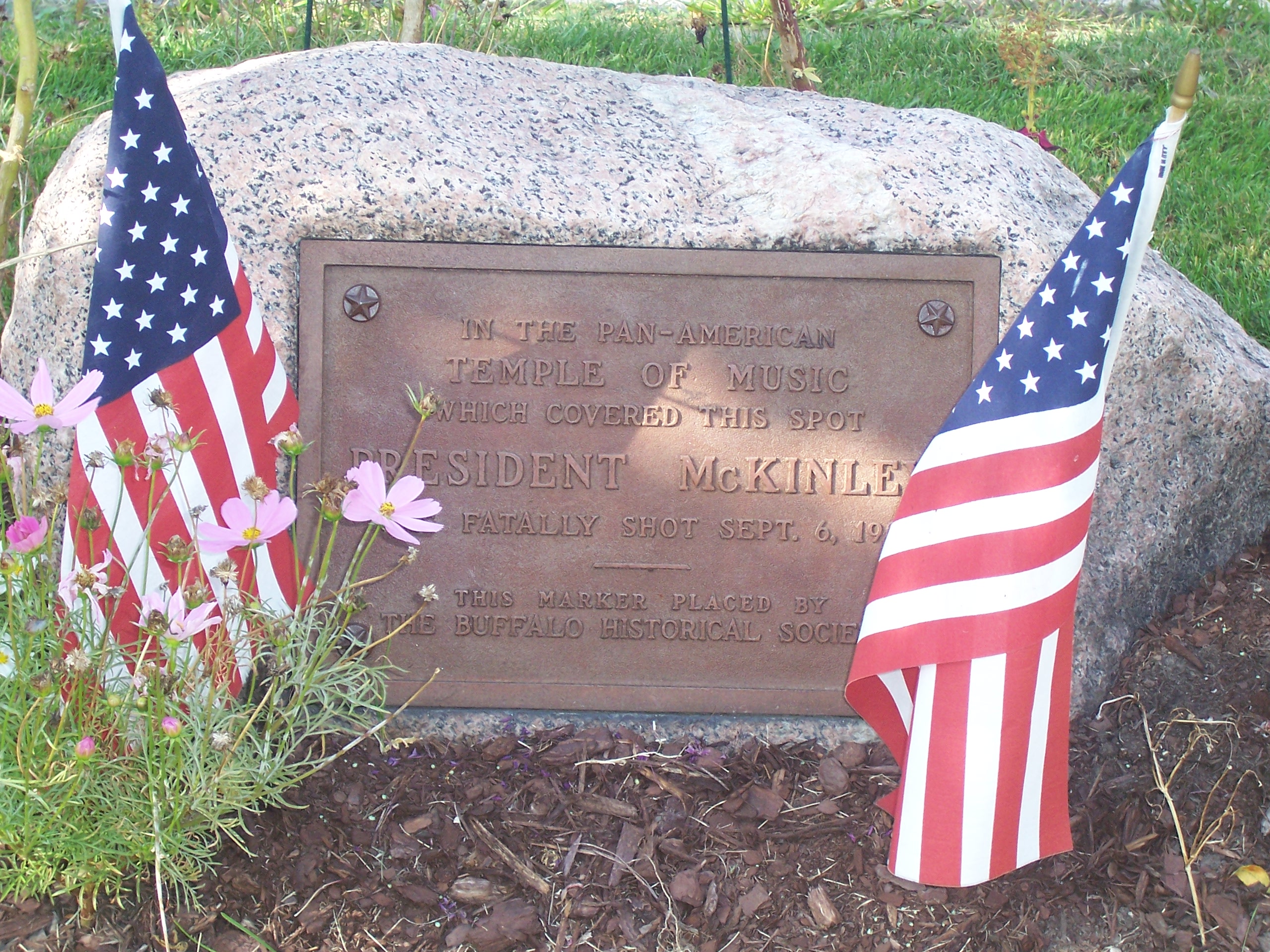
Roosevelt was racing over Adirondack mountain roads by carriage when he learned McKinley was dead. He took the oath of office that afternoon at the Ansley Wilcox House in Buffalo. Czolgosz went to trial nine days after the president died, was convicted in half an hour, and was executed by electric chair on October 29, 1901. Acid was placed in the casket to dissolve his body. On the day of McKinley's funeral, September 19, all activity ceased in the nation for five minutes - trains halted, telegraph service stopped. Congress would formally charge the Secret Service with protecting the president in 1906. The fear of anarchists led to surveillance programs eventually consolidated in 1908 as the Federal Bureau of Investigation. The Temple of Music is long gone, the Exposition fairgrounds now a residential neighborhood. A stone marker stands where the building once was. What remains most vividly is the image of a president reaching out his hand to greet his people, and the nation that changed when someone reached back with a gun.
From the Air
Located at 42.94N, 78.87W in what is now a residential neighborhood in north Buffalo, New York. The Pan-American Exposition grounds where the Temple of Music stood are no longer visible - the area was developed into housing after the fair closed. A small stone marker at the intersection of Fordham Drive and what was the Exposition site marks the approximate location. The Theodore Roosevelt Inaugural National Historic Site (Ansley Wilcox House), where Roosevelt took the oath of office, is at 641 Delaware Avenue in downtown Buffalo. Buffalo Niagara International Airport (KBUF) is approximately 6 nm east. Best viewed in context with the broader Buffalo waterfront and downtown from 2,000-3,000 feet AGL.