The Astor Place Riot: When Shakespeare Turned Deadly
Which man played Macbeth better? That was the question, and in May 1849, New Yorkers killed each other over the answer. The American was Edwin Forrest -- muscular, passionate, a hero to the working class, a man who had made his debut at the Bowery Theatre and whose booming delivery was considered admirably "American." The Englishman was William Charles Macready -- refined, restrained, the darling of New York's Anglophile upper class. Their rivalry had festered for years across two continents. When both men were scheduled to perform Macbeth on the same night in lower Manhattan, three blocks apart, the city did not simply choose sides. It exploded.
The Bard as Battleground
To understand how Shakespeare provoked a massacre, you need to understand what theater meant in 1849. It was not high culture reserved for the educated. Gold rush miners in California acted out Shakespeare's plays from memory around campfires. Ralph Waldo Emerson wrote in his journal that beings on other planets probably called the Earth "Shakespeare." Theaters were mass entertainment, the main gathering places in most cities, and audiences treated them as arenas to make their feelings known -- not just about the performers, but about class, politics, and national identity. Theater riots were not unusual in New York. What made Astor Place different was the scale.
Two Actors, Three Fault Lines
The rivalry between Forrest and Macready ran along three fractures in American society. First, a personal grudge: the two had once been friends, but Forrest became convinced Macready was sabotaging his career in London, and on one visit he stood up during a performance of Hamlet and loudly hissed the Englishman from the audience. Second, a cultural divide: working-class Americans and Irish immigrants, though hostile to each other in most contexts, found common cause in their resentment of the British. Third, a class war: Forrest's fans were the laborers and gang members of the Five Points and the Bowery, while Macready's supporters were the wealthy Anglophile elite who built the Astor Opera House as a temple to refined taste. The question of who played Shakespeare better had become a proxy for the future of American culture itself.
Rotten Eggs and Ripped-Up Seats
On May 7, three nights before the riot, Forrest's supporters bought hundreds of tickets to the upper gallery of the Astor Opera House. When Macready took the stage as Macbeth, they pelted him with rotten eggs, potatoes, lemons, shoes, and bottles of foul-smelling liquid. They ripped up their seats and hurled the pieces. The performers tried to continue but were drowned out by hissing, groans, and cries of "Down with the codfish aristocracy!" Meanwhile, a few blocks away, Forrest's own audience roared with approval when he delivered Macbeth's line: "What rhubarb, senna or what purgative drug will scour these English hence?" Macready announced he would leave for England on the next ship. But a petition signed by 47 prominent New Yorkers -- including Herman Melville and Washington Irving -- persuaded him to stay and perform again.
Paving Stones Against Militia
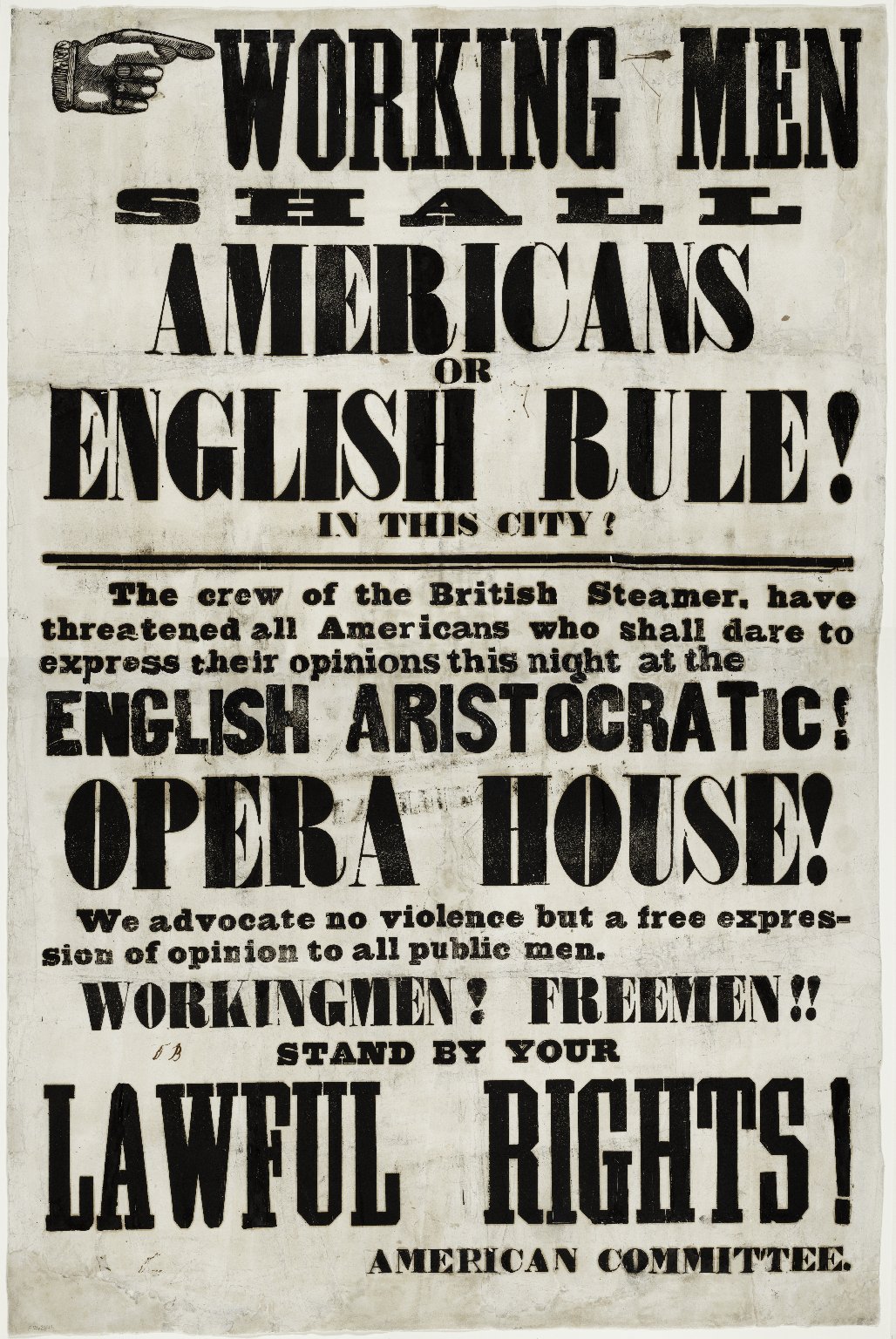
On the night of May 10, Macready returned to the stage under heavy police guard. Outside, a mob gathered. Ned Buntline, a nationalist agitator, had distributed handbills rallying working-class New Yorkers to the scene. The crowd tore up cobblestones and hurled them through the opera house windows. The New York Tribune reported that "the Opera House resembled a fortress besieged by an invading army rather than a place meant for the peaceful amusement of civilized community." Rioters tried to set the building on fire. Police fought running battles in the streets. When the violence overwhelmed them, the state militia was called. Soldiers fired into the crowd. Between 22 and 31 people were killed -- the largest number of civilian casualties from military action in the United States since the Revolutionary War. Forty-eight rioters were wounded. Up to 70 policemen were injured, along with 141 militiamen struck by flying stones and debris.
The Morning After
The next day, thousands gathered at City Hall Park, demanding revenge against the authorities. During the confrontation, a young boy was killed. An angry crowd marched up Broadway toward Astor Place and fought mounted troops from behind improvised barricades. The riot's consequences extended far beyond the dead and wounded. It led directly to the militarization of New York's police force: larger batons, riot control training, a new understanding that crowd violence in an industrial city required a different kind of response. The Astor Opera House never recovered. It closed and was eventually demolished. Today, Astor Place is a subway stop and a public plaza in the East Village, a quiet intersection where the deadliest clash of class and culture in nineteenth-century New York left no visible trace.
From the Air
Astor Place is located in Manhattan's East Village (40.7298N, 73.9915W), at the intersection of Astor Place, Lafayette Street, and 4th Avenue. The original Astor Opera House was demolished and no longer exists. The area is identifiable from altitude by Cooper Square and the distinctive Cooper Union building nearby. Nearby airports: KJFK (John F. Kennedy, 24km SE), KLGA (LaGuardia, 14km NE), KEWR (Newark Liberty, 15km W). Best viewed at 2,000-4,000 feet AGL.