Astoria, Oregon
In April 1811, thirty-three men stepped off the ship Tonquin and began building a fur trading post from bark-covered logs at the mouth of the Columbia River. They were working for John Jacob Astor, a German-born immigrant who envisioned a chain of trading posts stretching across western North America, funneling furs to markets in China. The settlement they built — Fort Astoria — became the first permanent American outpost on the Pacific coast. Two centuries later, the city that bears Astor's name remains a place shaped by ambition, reinvention, and a stubborn refusal to fade into the background.
Empires and Canneries
Fort Astoria's early years were turbulent. During the War of 1812, the Pacific Fur Company sold the post to the British-backed North West Company, who renamed it Fort George. The Oregon Treaty of 1846 settled the border question, and Astoria returned to American hands. But it was not diplomacy that built the town — it was salmon. By the 1870s, canneries lined the Columbia River waterfront, and Astoria earned the title "Salmon Canning Capital of the World." At its peak, thirty canneries operated along the river, employing thousands of workers who packed the silver-sided fish into tins destined for tables across America and Europe. The industry drew waves of immigrants: Scandinavians who knew cold water, Chinese laborers who filled the cannery floors, and Punjabi workers from India's Columbia River communities.
Uniontown's Finnish Heart
Of all the immigrant communities that shaped Astoria, none left a deeper mark than the Finns. Fleeing famine and economic instability in the late 1800s, they settled in a neighborhood called Uniontown — named for the Union Cannery that once anchored it — and became the backbone of the Columbia River gillnet fleet. Finnish fishermen founded the Union Fishermen's Co-Operative Packing Company, a worker-owned cannery that grew into one of the largest on the river. Their ambitions extended beyond fishing. In 1904, Finns established a Socialist Club, and by 1907 they were publishing Toveri, a Finnish-language socialist newspaper that by 1916 boasted a daily circulation of 4,000 — larger than any other paper in town. The Suomi Hall, the community sauna, and the cooperative meat market made Uniontown a city within a city.
The Night Everything Burned
Around two o'clock in the morning on December 8, 1922, fire broke out in downtown Astoria. Fanned by strong winds and fed by wooden buildings perched on timber pilings, the blaze raged for eleven and a half hours. By the time it was contained, thirty blocks lay in ruins — 220 buildings destroyed, 2,500 residents displaced. Ninety percent of the buildings had been light-frame construction, a legacy of the region's abundant lumber and a calculated bet that cheap, fast building was worth the risk. The bet lost. But Astoria rebuilt, and the replacement buildings — sturdier, many in brick and concrete — form much of the historic downtown that visitors walk through today. The city's resilience after the 1922 fire became a defining chapter in its identity.
Goonies Never Say Die
Astoria's second act as a cultural landmark arrived in 1985, when director Richard Donner brought The Goonies to life there — a film conceived by Steven Spielberg. The movie's treasure-hunting kids, Victorian houses, and moody coastal atmosphere turned the town into a pilgrimage site for a generation of fans. Hollywood kept coming back: Short Circuit, Kindergarten Cop, Free Willy, The Black Stallion, Into the Wild, and Green Room all filmed here. The old Clatsop County Jail appeared in The Goonies' opening scene and now houses the Oregon Film Museum. Pop punk bands The Ataris and Marianas Trench both named albums after the city, drawing on its cinematic mythology. Clark Gable is claimed to have launched his acting career at the Astoria Theatre in 1922, and Leroy "Ed" Parsons developed one of America's first cable television systems here in 1948.
Where River Meets Ocean
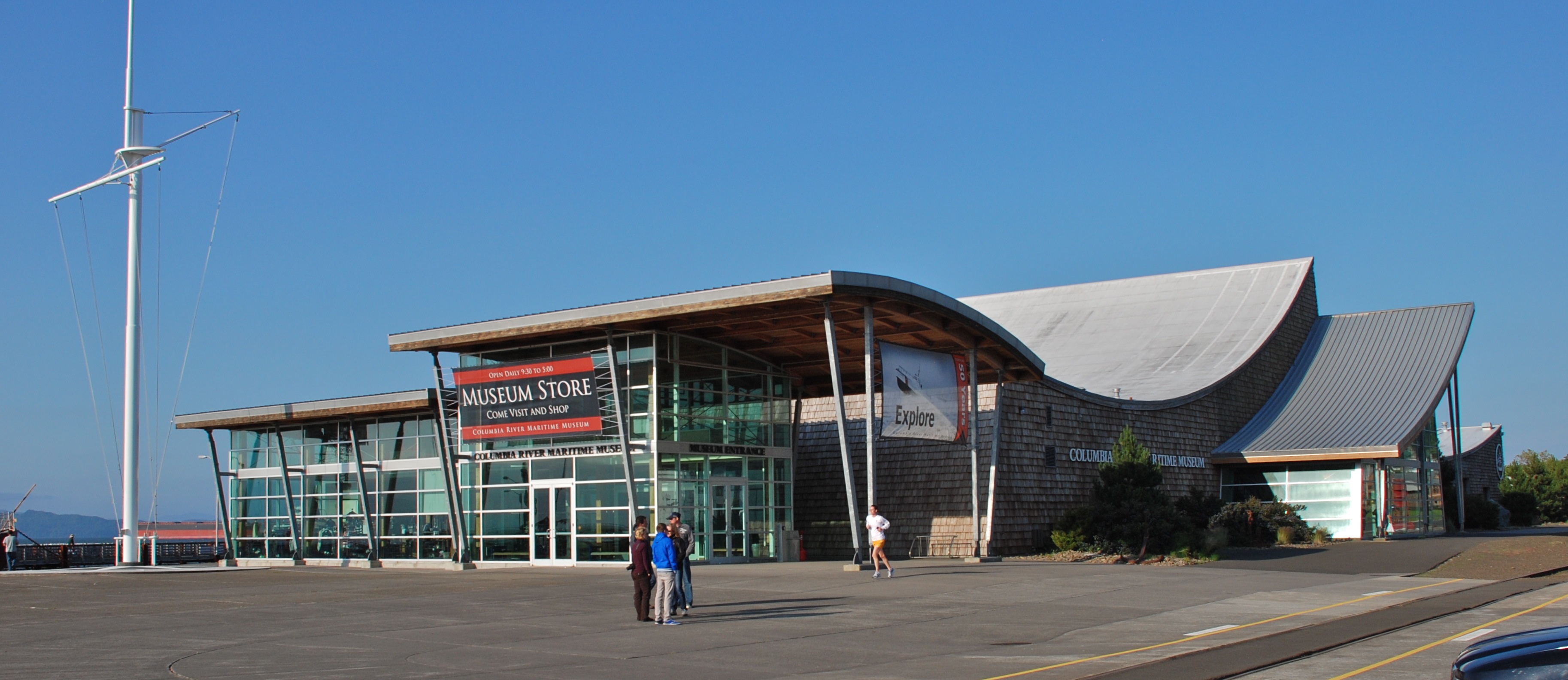
Today Astoria is a city of roughly 10,000 people perched at the intersection of U.S. Routes 101 and 30, where the Columbia River — having traveled 1,243 miles from its source in British Columbia — finally meets the Pacific. The Astoria Column stands on Coxcomb Hill, the city's highest point, offering panoramic views of the river, the ocean, and the 4.1-mile Astoria–Megler Bridge arcing toward Washington. Along the waterfront, the Astoria Riverwalk follows the old railroad grade past the Columbia River Maritime Museum and restored cannery buildings. The Port of Astoria, established in 1910, still handles cargo and welcomes cruise ships. Two U.S. Navy cruisers have carried the city's name, including the USS Astoria that was lost at the Battle of Savo Island in August 1942. For a town that began as a speculative fur outpost, Astoria has accumulated an outsized share of American history.
From the Air
Astoria sits at 46.183°N, 123.835°W, at the mouth of the Columbia River on the Oregon coast. From 3,000–5,000 feet AGL, the city's grid is visible against the south bank of the river, with the Astoria Column on Coxcomb Hill as a prominent landmark. The Astoria–Megler Bridge stretches north across the river. Astoria Regional Airport (KAST) is located 5 miles southwest in Warrenton, shared with Coast Guard Air Station Astoria. The Columbia River Bar, one of the most dangerous river entrances on the Pacific coast, is visible to the west. Frequent fog, low clouds, and rain characterize the area year-round.