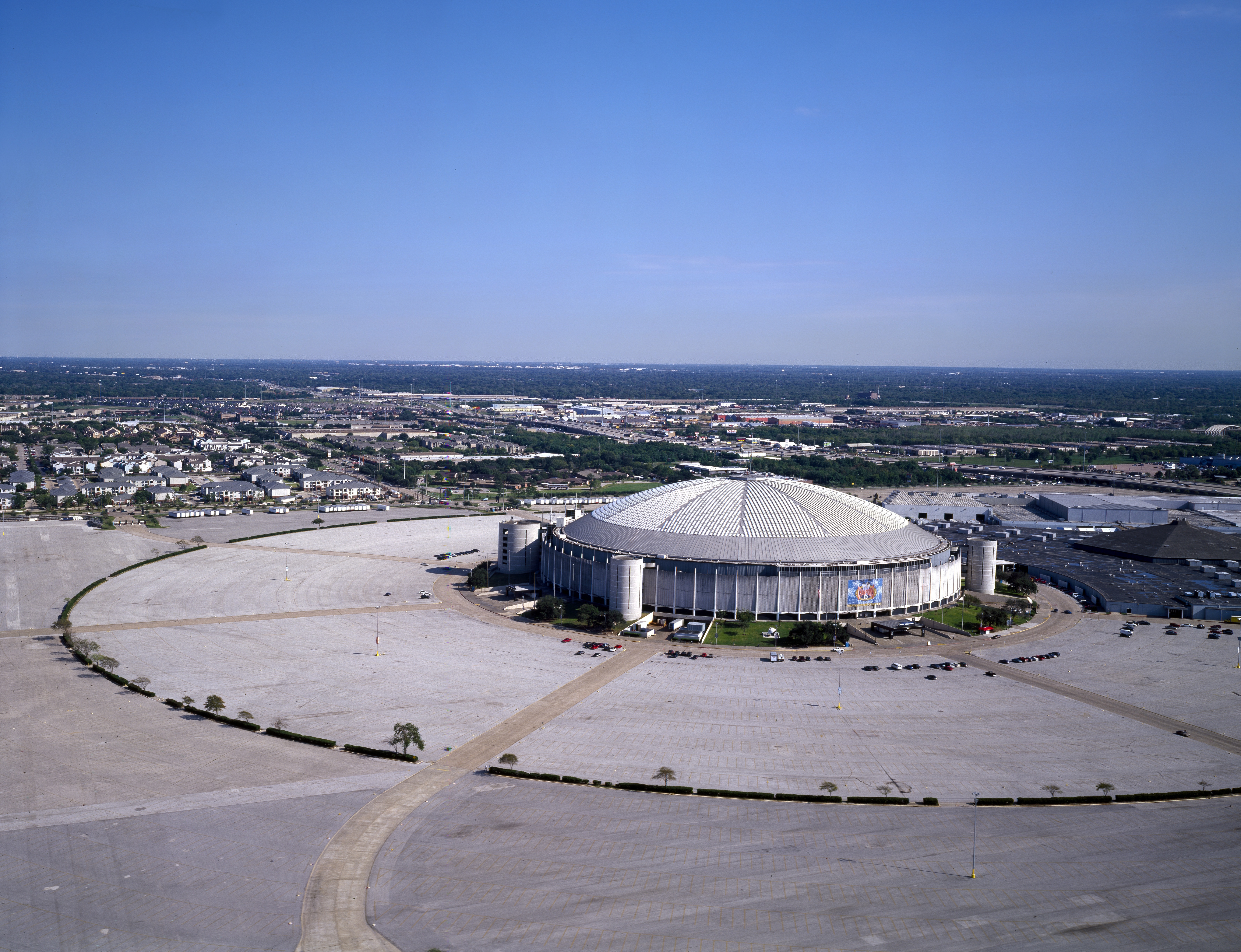
The Astrodome
The building was so large that clouds once threatened to form inside it. When the Houston Astrodome opened on April 9, 1965, it was immediately dubbed the Eighth Wonder of the World, and the nickname was only slight hyperbole. Standing eighteen stories tall with a ceiling soaring above the playing surface, the dome was unlike anything America had seen. President Lyndon B. Johnson and Lady Bird watched from Judge Roy Hofheinz's private box as Mickey Mantle hit the first home run in indoor baseball history, and the Astros won 2-1 in twelve innings. Satchel Paige, who had thrown the dome's very first test pitches two months earlier, had already declared it a pitcher's paradise. The lack of wind, he said, gave hurlers exquisite control. He was right. The Astrodome would give up fewer home runs than any other park in the National League for decades.
The Judge's Palace
Roy Hofheinz, the former Harris County judge who dreamed the Astrodome into existence, was not a man who did things modestly. He built himself a seven-floor private apartment inside the stadium, tucked against the right field bleachers, complete with a bowling alley, a shooting gallery, a chapel, and a presidential suite. The dome's four-story animated scoreboard, the Astrolite, cost $2.1 million and was the world's first of its kind, erupting after every Astros home run with pistols, bulls, and fireworks rendered in thousands of light bulbs. Hofheinz had rejected the initial generic scoreboard design and demanded spectacle. The air conditioning system was engineered to move enormous volumes of air, with ten percent drawn from outside to limit carbon dioxide buildup, while roughly a quarter of the roof's area was covered with sound-absorbing materials to manage the acoustic chaos of 50,000 fans enclosed under concrete and steel.
When the Grass Died and a Revolution Grew
The dome ceiling contained thousands of semi-transparent Lucite panes meant to nurture the Tifway 419 Bermuda grass playing surface. Players quickly complained the glare made it impossible to track fly balls, so two sections of panes were painted white. The grass died within months, starved of sunlight. For most of the 1965 season, the Astros played on green-painted dirt and dead turf. The solution was a product called ChemGrass, an experimental artificial surface that, once installed under the dome, became known worldwide as AstroTurf. Supply was so limited that only the infield was covered at first; the outfield remained painted dirt until after the 1966 All-Star Game. Groundskeepers dressed as astronauts vacuumed the new turf between innings. AstroTurf would transform playing surfaces across every major American sport, and it was born from a Houston embarrassment.
The Arena of Everything
The Astrodome's versatility was staggering. On January 20, 1968, the Houston Cougars defeated John Wooden's UCLA Bruins 71-69 before 52,693 fans in the Game of the Century, the first NCAA basketball game broadcast in nationwide prime time, establishing college basketball as a television commodity. On September 20, 1973, Billie Jean King defeated Bobby Riggs in straight sets in the Battle of the Sexes tennis match, a milestone for women's sports watched by millions on ABC. Muhammad Ali fought four times under the dome between 1966 and 1971. Elvis Presley drew 200,000 fans over six shows in early 1970. Evel Knievel jumped thirteen cars on consecutive nights in January 1971. WrestleMania X-Seven set the all-time Astrodome attendance record at 67,925 in 2001. Selena's final televised concert, before a crowd of over 67,000, was recorded here on February 26, 1995, just weeks before her murder.
Shelter from the Storm
By 2002, the Astrodome had been eclipsed by the retractable-roofed NRG Stadium next door, and its last major tenant, the Houston Livestock Show and Rodeo, moved out in 2003. George Strait's farewell concert before 68,266 fans was the dome's last musical act. Then, in September 2005, the Astrodome found an unexpected second purpose. In the wake of Hurricane Katrina, Harris County agreed to shelter at least 25,000 evacuees from New Orleans, many transferred directly from the ravaged Louisiana Superdome. A full field hospital operated inside neighboring Reliant Arena. By September 16, the evacuees had been relocated to permanent housing or other shelters, but for those harrowing weeks, the Eighth Wonder of the World served as exactly what its builders had always intended: a refuge from the elements.
The Dome That Will Not Die
The Astrodome has been closed since 2008, cited for numerous code violations, and the decades since have produced an almost comic parade of failed renovation proposals. A luxury hotel. A movie studio. An Olympic stadium for a Houston 2012 bid that never materialized. A $213 million convention center rejected by voters in 2013. An indoor city park. A massive underground parking garage approved in 2016, then scrapped in 2019. Through it all, demolition has been repeatedly blocked. In 2014, the Astrodome was added to the National Register of Historic Places. In 2017, the Texas Historical Commission designated it a State Antiquities Landmark, meaning it cannot be removed or altered without a permit. The latest proposal, from the Astrodome Conservancy in 2024, envisions a multiuse destination with an arena, a pedestrian boulevard, restaurants, and a hotel. The dome waits, empty but protected, too beloved to tear down and too enormous to ignore.
From the Air
The Astrodome (29.685N, 95.408W) sits within the NRG Park complex in southwest Houston. The massive dome is readily identifiable from the air, adjacent to the larger NRG Stadium. Nearest airports: William P. Hobby Airport (KHOU) 10km east, Houston George Bush Intercontinental (KIAH) 40km north, and Ellington Field (KEFD) 20km southeast. The dome's distinctive circular silhouette and surrounding parking infrastructure make it easy to spot at moderate altitude. Weather: hot and humid year-round, with afternoon thunderstorms common in summer.