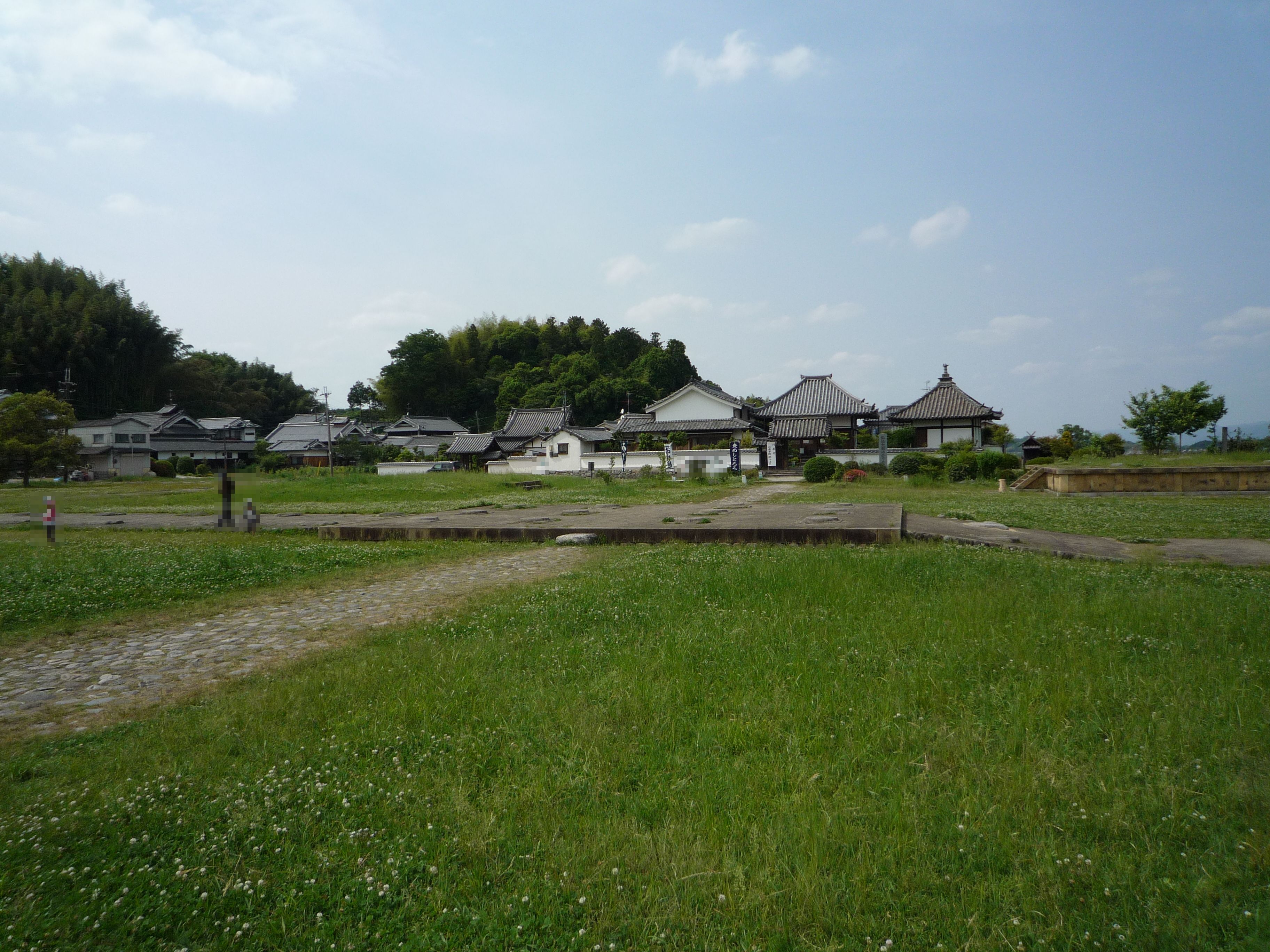
Asuka-Fujiwara: Where Japan Became Japan
Somewhere beneath the rice paddies of central Nara, a water clock once kept time for an empire. The Asuka Water Clock Site, one of nineteen archaeological treasures clustered in this quiet valley, held a sophisticated clepsydra that measured the hours for seventh-century courtiers governing a nation still inventing itself. Today the paddies are green and silent, and the palaces are gone. But what happened here between the late sixth and early eighth centuries shaped everything Japan would become -- its Buddhism, its poetry, its imperial system, its relationship between ruler and ruled. Asuka-Fujiwara is not a single monument but a constellation of places, submitted to UNESCO's World Heritage Tentative List in 2007, that together tell the story of Japan's transformation from a collection of warring clans into a centralized state.
Temples That Changed a Nation
The temple sites scattered across the Asuka valley read like a timeline of Japan's Buddhist revolution. Asuka-dera, founded in the late sixth century, was one of the country's first true Buddhist temple complexes. Kawara-dera produced roof tiles that have been called among the most beautiful ever made in Japan. Tachibana-dera, Hinokuma-dera, and Yamada-dera each represent chapters in the story of how an imported religion reshaped Japanese art, architecture, and governance. Yamada-dera is especially remarkable -- its well-preserved wooden corridors, discovered in 1982, are designated Important Cultural Properties. Hinokuma-dera received a thirty-year maintenance grant of a hundred households in 686, a detail chronicled in the Nihon Shoki that reveals how deeply intertwined temple and state had become. Motoyakushiji, precursor to the famous Yakushi-ji in Nara, was established by Emperor Temmu for the recovery of Empress Jito -- personal devotion expressed through monumental construction.
Painted Tombs and Seventy-Five-Ton Stones
The burial mounds of Asuka are as extraordinary as its temples. Ishibutai Kofun, a seventh-century tomb whose earthen covering has long eroded away, exposes a massive stone chamber where the largest single stone weighs more than seventy-five tons. The engineering required to maneuver such weight into place in the seventh century remains astonishing. But the true treasures lie underground. Takamatsuzuka and Kitora, both Special Historic Sites, contained wall paintings so significant they were designated National Treasures. The Kitora tomb's murals depict the Four Directional Gods -- Azure Dragon, White Tiger, Vermilion Bird, and Black Tortoise -- alongside an astronomical chart mapping the ancient sky. The Takamatsuzuka paintings, detached in 2007 for conservation, include elegant court figures that have become icons of the Asuka period. These tombs were not mere graves but statements of cosmological belief, connecting the dead to the movements of the heavens.
Fujiwara: Japan's First Grid City
In 694, the imperial court moved from the Asuka valley to a new purpose-built capital at Fujiwara-kyo, just a few kilometers to the north. Modeled after Chinese Tang dynasty capitals, Fujiwara-kyo was Japan's first city laid out on a formal grid, with a grand palace at its center. The Fujiwara Palace Site, now a Special Historic Site, preserves the foundations of that ambition -- the place where Japan first attempted to organize its government into a permanent, monumental capital rather than shifting from palace to palace with each new ruler. Daikandaiji, the great temple built within the new capital, would later become Daian-ji in Nara. Fujiwara-kyo lasted only sixteen years before the court moved to Nara in 710, but those sixteen years established the template for Japanese capitals for centuries to come.
A Living Landscape
Since 2011, the Cultural Landscape of the Asuka Hinterland has been officially protected as one of Japan's Cultural Landscapes. Sixty hectares fall within the Asuka Historical National Government Park. The valley remains remarkably unchanged -- terraced paddies climb the hillsides, narrow lanes wind between villages, and the three mountains of Yamato Sanzan, celebrated in Japanese poetry for over a millennium, frame the horizon. The Yamato Sanzan were designated a Place of Scenic Beauty, a meisho whose profiles have appeared in countless poems since the Man'yoshu. Walking through Asuka today, you pass from ancient tomb to temple ruin to palace foundation, each site a few minutes apart, the landscape itself serving as the museum. The nineteen component sites, reduced from an original twenty-eight in the UNESCO nomination, represent a concentrated archive of Japan's foundational centuries -- the period when writing, Buddhism, urban planning, and centralized law arrived and transformed an archipelago forever.
From the Air
Located at 34.47N, 135.82E in the Asuka valley of Nara Prefecture, central Japan. The cluster of archaeological sites is spread across flat agricultural land flanked by low hills, with the three peaks of Yamato Sanzan visible as prominent landmarks. Best viewed at 3,000-5,000 feet AGL to appreciate the valley layout and relationship between temple, tomb, and palace sites. Nara Airport is approximately 20 nautical miles north. Kansai International Airport (RJBB) lies roughly 40 nautical miles to the west-southwest. Osaka Itami Airport (RJOO) is about 30 nautical miles to the northwest. The area sits inland from Osaka Bay in a sheltered valley often clear in the morning hours.