Asuka Historical Museum: A Window into Japan's Formative Century
Most museums collect famous objects and display them behind glass. The Asuka Historical Museum collects dirt -- or rather, what comes out of it. Founded in 1975 as a unit of the Nara National Research Institute for Cultural Properties, this small institution in the village of Okuyama does something unusual in the Japanese museum world: it exhibits materials from recent, local excavations rather than well-known masterpieces gathered from across the country. Each spring and fall, special exhibits showcase the latest discoveries pulled from the rice paddies and hillsides of the Asuka valley, where archaeologists from the Institute's Department of Imperial Palace Sites Investigations have been systematically uncovering Japan's formative centuries, one trench at a time.
Three Palaces, One Collection
The museum's collections center on materials from three of Japan's most significant ancient palace complexes: Asuka, Fujiwara, and Heijo. The Asuka palaces served as the seat of imperial power during the late sixth and seventh centuries, the period when Buddhism arrived and transformed Japanese governance. Fujiwara-kyo, built in 694, was Japan's first capital laid out on a formal Chinese-style grid. Heijo-kyo, modern-day Nara, succeeded it in 710 and served as capital until 784. Together, these three sites span the critical centuries when Japan consolidated from competing clans into a centralized state with written law, a bureaucratic system, and monumental architecture. The artifacts excavated from their ruins -- pottery, tools, roof tiles, personal ornaments -- tell that story not through grand narratives but through the everyday objects of the people who lived it.
Stone Giants in the Garden
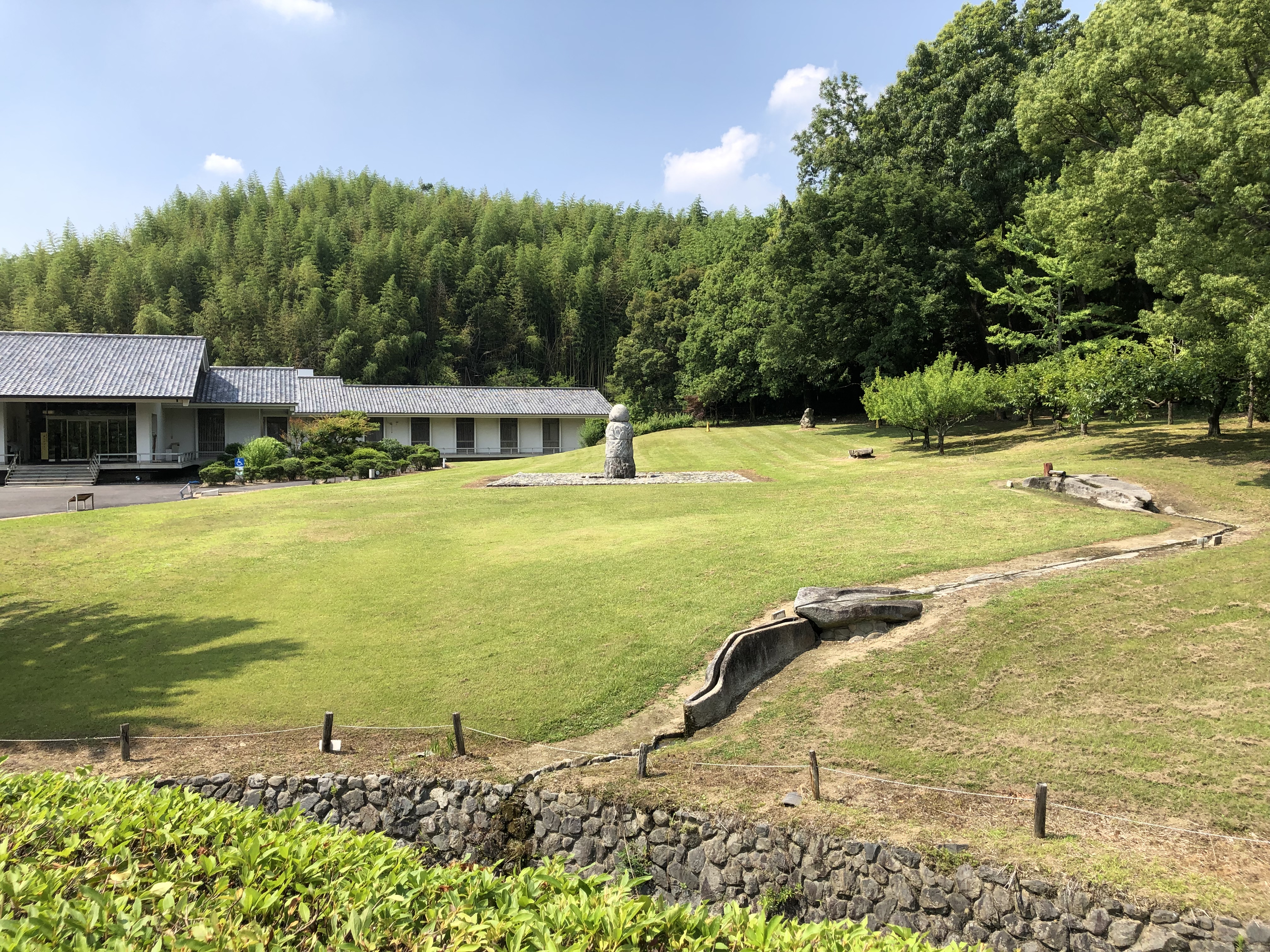
Step outside the museum's main building and you encounter something unexpected: the gardens are populated with large-scale reproductions of Asuka-period rock carvings and stone statues. The originals, scattered across the surrounding valley, include some of Japan's most enigmatic ancient objects -- carved stone troughs, ritual stones with channels cut into their surfaces, and figures whose purposes archaeologists still debate. The reproductions allow visitors to examine these objects up close before seeking them out in their original settings across the landscape. The effect turns the museum into a gateway: visitors study the replicas, then walk or cycle through the Asuka valley to find the real things nestled among rice fields and village lanes, creating a museum experience that extends across sixty hectares of protected Cultural Landscape.
The Institute Behind the Glass
The Asuka Historical Museum is not a standalone institution but a working arm of the Nara National Research Institute for Cultural Properties, one of Japan's premier archaeological research organizations. This means the museum functions as both public gallery and active repository, receiving artifacts directly from ongoing excavations. The institute's Department of Imperial Palace Sites Investigations conducts systematic work across the Asuka and Fujiwara palace complexes, and each season's discoveries can appear in the museum's display cases within months of being unearthed. The museum also publishes exhibition catalogs and technical reports, making its research available to scholars worldwide. A small library rounds out the academic resources. The museum covers the Asuka period (538 to 710) but also reaches into the late Kofun period (250 to 538) and the Nara period (710 to 794), offering a sweep of nearly five and a half centuries of Japanese material culture.
A Village Museum in an Ancient Valley
Reaching the Asuka Historical Museum is itself a journey into rural Japan. Visitors arrive by bus from railway stations including Kashiharajingu-mae on the Kintetsu Kashihara Line, Asuka Station on the Yoshino Line, or Sakurai Station on JR West's Man'yo Mahoroba Line. The ride passes through a landscape that has changed remarkably little since the periods the museum documents -- terraced fields, wooded hillsides, and narrow village streets. The museum sits within the Asuka Historical National Government Park, a protected zone of sixty hectares that preserves both the archaeological sites and the agricultural landscape surrounding them. It is the kind of place where a morning spent examining seventh-century pottery in a quiet gallery naturally leads to an afternoon wandering among the actual ruins that produced it, the past and present layered together in a valley that time treats gently.
From the Air
Located at 34.48N, 135.82E in the village of Asuka, Nara Prefecture, central Japan. The museum sits within the Asuka Historical National Government Park, visible from the air as a cluster of low buildings amid protected agricultural landscape in the Asuka valley. Best viewed at 2,000-4,000 feet AGL. Kansai International Airport (RJBB) lies approximately 40 nautical miles west-southwest. Osaka Itami Airport (RJOO) is about 30 nautical miles northwest. The surrounding valley, flanked by the three peaks of Yamato Sanzan, provides clear visual orientation.