Asuka Pond Workshop Site: The Factory Floor of an Empire
For centuries, the water of Asukaike Pond kept a secret. When reclamation work drained the Edo-period reservoir in 1991, the muddy valley floor revealed something no one expected: the remains of an industrial complex so large and so organized that it rewrote the history of Japanese coinage. More than 300 furnaces stretched across 230 meters of valley floor, arranged by trade -- gold here, glass there, lacquerware in another section. Among the debris lay 560 unfinished Fuhonsen coins and the molds used to cast them, proof that Japan was minting currency earlier than historians had believed. The complex had operated during the late 7th and early 8th centuries, within sight of the imperial palace and the great temple of Asuka-dera. Someone with enormous resources had built a factory district in the heart of the Asuka capital.
Draining the Centuries
Asukaike Pond sat in a valley in the hills of Asuka, at the southern end of the Nara Basin. Nobody suspected what lay beneath it. When the pond was drained in 1991, the archaeological potential was immediately obvious, and systematic excavations began in 1997. What emerged was staggering in scale: the ruins extended 230 meters from north to south along the valley, with a clear division between a southern workshop zone and a northern administrative zone separated by a wall running across the middle. The southern workshops were not a jumble of activity but a carefully planned industrial district, each craft allocated its own space. Metal processing covered gold, silver, copper, and iron. Bead-making handled glass, crystal, and amber. Other areas specialized in lacquerware, tiles, and tortoiseshell. The level of organization suggested centralized management, not independent artisans working side by side.
The Coins That Changed History
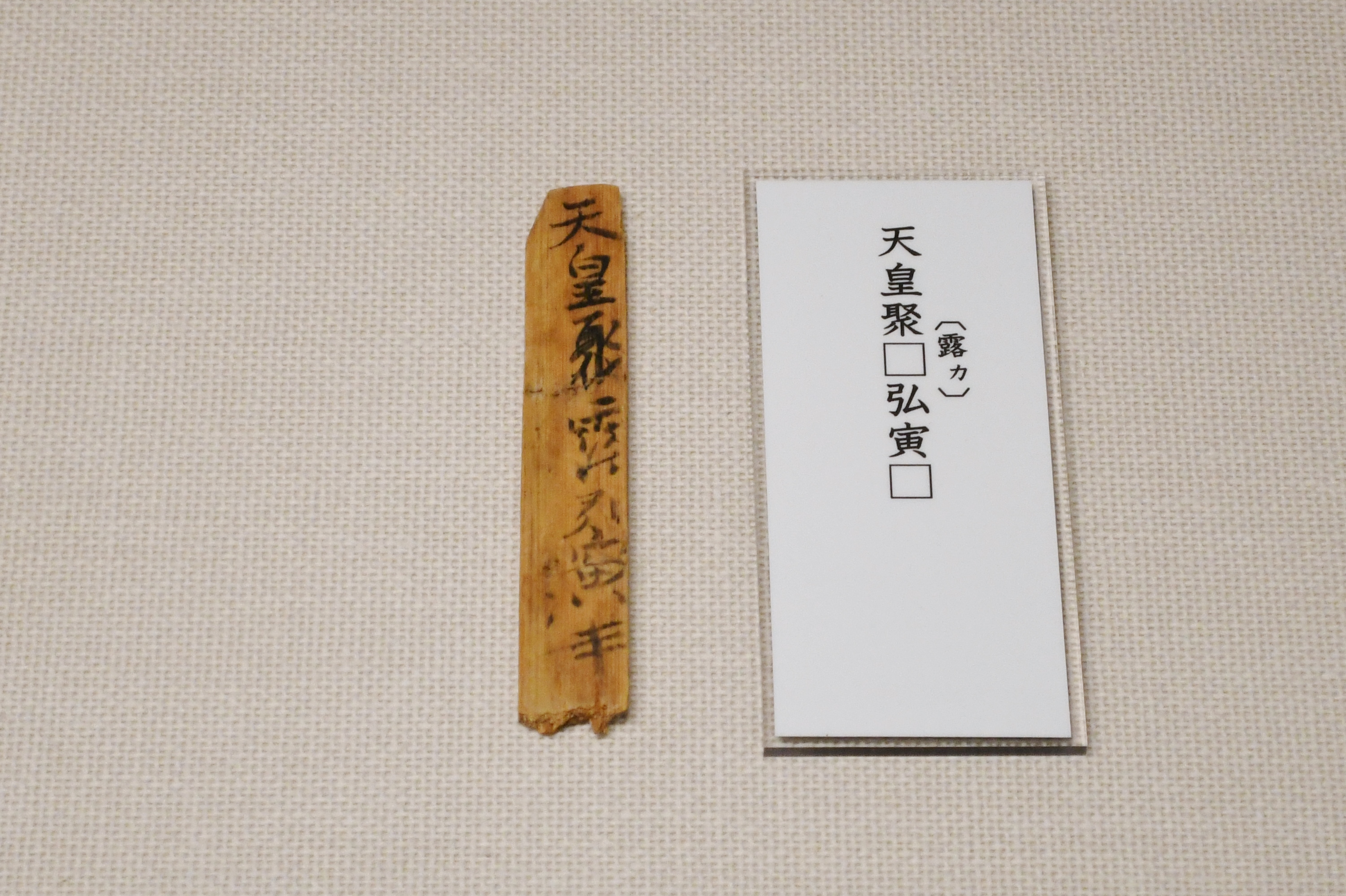
The most significant discovery was numismatic. Among the workshop debris, archaeologists found 560 unfinished Fuhonsen coins along with the casting molds and poles used to produce them. Before this find, the Wadokaichin -- minted in 708 AD -- was widely considered Japan's oldest coin. The Fuhonsen pushed that date back by at least a decade, possibly more. Wooden tablets excavated from the site confirmed that operations dated to the reigns of Emperor Tenmu and Empress Jito in the late 7th century, extending into the 8th century. Another 33 completed Fuhonsen coins turned up in the northern administrative zone. The coins were made of copper and antimony, and their presence alongside the production equipment left no room for doubt: this was a mint, and it was operating before the date previously accepted for the birth of Japanese coinage.
Government Office or Temple Workshop?
The northern zone told a different story from the furnaces to the south. Here, archaeologists found a stone-paved well, a square stone pond, water channels, and a building constructed in the formal style of a government office. Large numbers of wooden tablets -- the bureaucratic records of 7th-century Japan -- confirmed that this area served an administrative function, likely managing the workshops below. The site sits just southeast of Asuka-dera, one of Japan's oldest Buddhist temples, and northeast of Asuka Kiyomihara Palace, the imperial residence. This proximity has generated two competing theories about who controlled the workshops: one holds that they were attached to Asuka-dera, serving the temple's needs; the other argues they were a state enterprise linked to the imperial household, possibly an early version of the Takumi-ryo, the Ministry of Crafts that would later be formalized under the Ritsuryo legal system of the Nara period.
An Empire's Material Culture
What the Asuka Pond Workshop Site reveals is the material sophistication of late 7th-century Japan. This was not a subsistence economy cobbling things together. Over 300 furnaces burning simultaneously required fuel supply chains, raw material procurement across multiple trades, and a workforce organized by specialty. The artisans working here produced the physical trappings of imperial power: coins for commerce, gold ornaments for the court, glass beads for decoration, lacquerware for ceremony. The site was designated a National Historic Site of Japan in 2001, recognizing both its archaeological significance and its role in reshaping understanding of early Japanese statecraft. Today the valley where the pond once stood is quiet, the furnaces reduced to foundations and ash layers. But the scale of what operated here -- a centralized, multi-industry production facility serving the needs of an emerging nation-state -- remains remarkable.
From the Air
Located at 34.478N, 135.822E in Asuka village, Nara Prefecture, Japan, in the hills at the southern end of the Nara Basin. The site lies in a narrow valley just southeast of the Asuka-dera temple complex. Kansai International Airport (RJBB) is approximately 30 nautical miles to the west-northwest; Yao Airport (RJOY) is about 20 nautical miles to the north-northwest. Best viewed at 2,000-3,000 feet AGL. The valley setting is visible as a depression in the rolling Asuka hills.