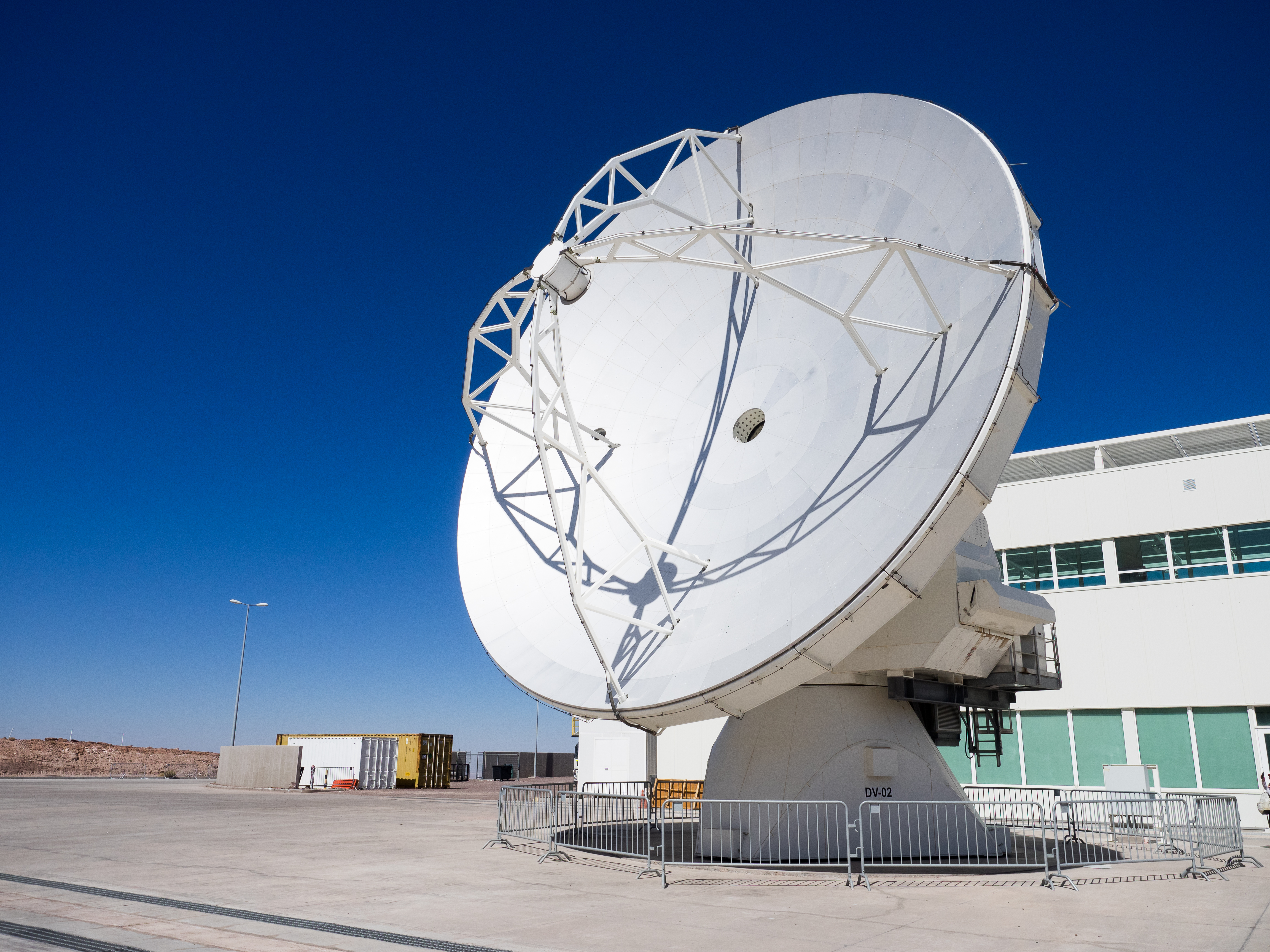
Atacama Large Millimeter Array
The drivers who deliver ALMA's antennas to work carry supplemental oxygen. They have to -- the Chajnantor plateau sits at 5,000 meters above sea level, where the air holds roughly half the oxygen found at the coast. Custom-built 28-wheel transporters, each weighing 130 tonnes, haul 115-tonne radio dishes from the assembly facility at 2,900 meters up to the array site, placing them on concrete pads with centimeter precision. The thin, desiccated air that makes the job punishing is precisely why the telescopes are here. At this altitude, water vapor -- the enemy of millimeter-wave astronomy -- is nearly absent. ALMA, the Atacama Large Millimeter/submillimeter Array, is the most expensive ground-based telescope ever built, a US$1.4 billion collaboration between Europe, North America, East Asia, and Chile that has been fully operational since March 2013.
Sixty-Six Dishes Acting as One
ALMA is not a single telescope but an interferometer: 66 individual antennas whose signals are combined by a supercomputer to simulate a single dish as wide as the distance between them. The main array consists of fifty 12-meter antennas -- 25 built by American contractors, 25 by the European AEM Consortium (Thales Alenia Space, European Industrial Engineering, and MT-Mechatronics). Japan contributed 16 additional antennas, four at 12 meters and twelve at 7 meters, forming the Atacama Compact Array. By spreading the dishes across the plateau over distances ranging from 150 meters to 16 kilometers, astronomers can zoom in and out, achieving spatial resolution ten times sharper than the Very Large Array in New Mexico and five times better than the Hubble Space Telescope. The array operates at wavelengths between 0.32 and 3.6 millimeters, revealing the cold universe invisible to optical telescopes.
The Image of a Black Hole
ALMA's most famous contribution may be one it shared with seven other observatories around the world. As part of the Event Horizon Telescope project, ALMA provided critical data that led to the first direct image of a black hole, published in April 2019. The image showed the shadow of the supermassive black hole at the center of galaxy M87, ringed by glowing superheated gas. ALMA's sensitivity and location made it one of the most important stations in the Earth-spanning virtual telescope. The array has also produced groundbreaking images of protoplanetary disks -- the swirling clouds of gas and dust where planets are born. In 2014, ALMA captured the disk around the young star HL Tauri, revealing concentric rings separated by gaps that indicate planets forming far earlier than existing theories predicted. By 2022, ALMA had launched exoALMA, a detailed survey of 15 protoplanetary disk systems to hunt for planets still in the process of formation.
Three Projects Became One
ALMA grew from the merger of three independent dreams. The United States had proposed the Millimeter Array, Europe the Large Southern Array, and Japan the Large Millimeter Array. In 1997, the National Radio Astronomy Observatory and the European Southern Observatory agreed to combine efforts, and the merged project inherited the best of both: the sensitivity of the European design and the frequency coverage and superior site of the American one. The name ALMA was chosen in March 1999 -- meaning "soul" in Spanish and "learned" in Arabic. Japan formally joined in 2004, contributing the Compact Array and additional receiver bands. A groundbreaking ceremony was held on November 6, 2003. The first antennas arrived at the site in late 2008, and by the summer of 2011 enough were operational to produce ALMA's first scientific images: a view of the colliding Antennae Galaxies revealing clouds of dense cold gas invisible to optical light.
Working Where the Air Runs Out
Life at 5,000 meters demands adaptation. The Operations Support Facility at 2,900 meters serves as base camp, where staff acclimatize before ascending to the array. Even so, the altitude takes a toll. In August 2013, workers went on strike for 17 days demanding better pay and working conditions for high-altitude labor -- one of the first strikes in astronomical observatory history. The agreement that followed provided reduced schedules and higher wages for work done at the array site. In 2013, the Atacama Compact Array was renamed the Morita Array in honor of Professor Koh-ichiro Morita, the Japanese designer of the compact array who died in Santiago in May 2012. The COVID-19 pandemic shut ALMA down in March 2020. In October 2022, a cyberattack suspended observations for 48 days before operations resumed in December.
Listening for the Universe's Coldest Secrets
What ALMA hears is invisible and cold. Millimeter and submillimeter radiation comes from the coolest objects in the cosmos: molecular clouds where stars are forming, dusty envelopes around dying stars, and the faint glow of galaxies at the edge of the observable universe. ALMA can detect the chemical signatures of molecules in comets, measure the distribution of formaldehyde and hydrogen cyanide in cometary tails, and study the composition of atmospheres in our own solar system. Its controversial participation in the claimed detection of phosphine in Venus's atmosphere -- a potential biomarker -- remains unresolved and awaits further measurements. The array's point-source detection sensitivity is 20 times better than the Very Large Array. Its resolution of 10 milliarcseconds corresponds to the ability to distinguish a golf ball from 15 kilometers away. On the Chajnantor plateau, where the air is too thin for comfortable breathing and too dry for clouds to form, ALMA listens to the universe at wavelengths that most of Earth's atmosphere would otherwise swallow whole.
From the Air
ALMA sits at 23.02°S, 67.75°W on the Chajnantor plateau at 5,000 m elevation in Chile's Atacama Desert. The array is visible from altitude as a cluster of white dish antennas spread across a brown high-altitude plain. The Operations Support Facility is at 2,900 m to the west. Nearest commercial airport is El Loa (SCCF/CJC) at Calama, approximately 50 km to the northwest. The road from San Pedro de Atacama (22 km to the southwest) climbs steeply to the plateau. The Licancabur volcano is visible to the north. Extremely clear skies; the site was specifically chosen for minimal atmospheric water vapor.