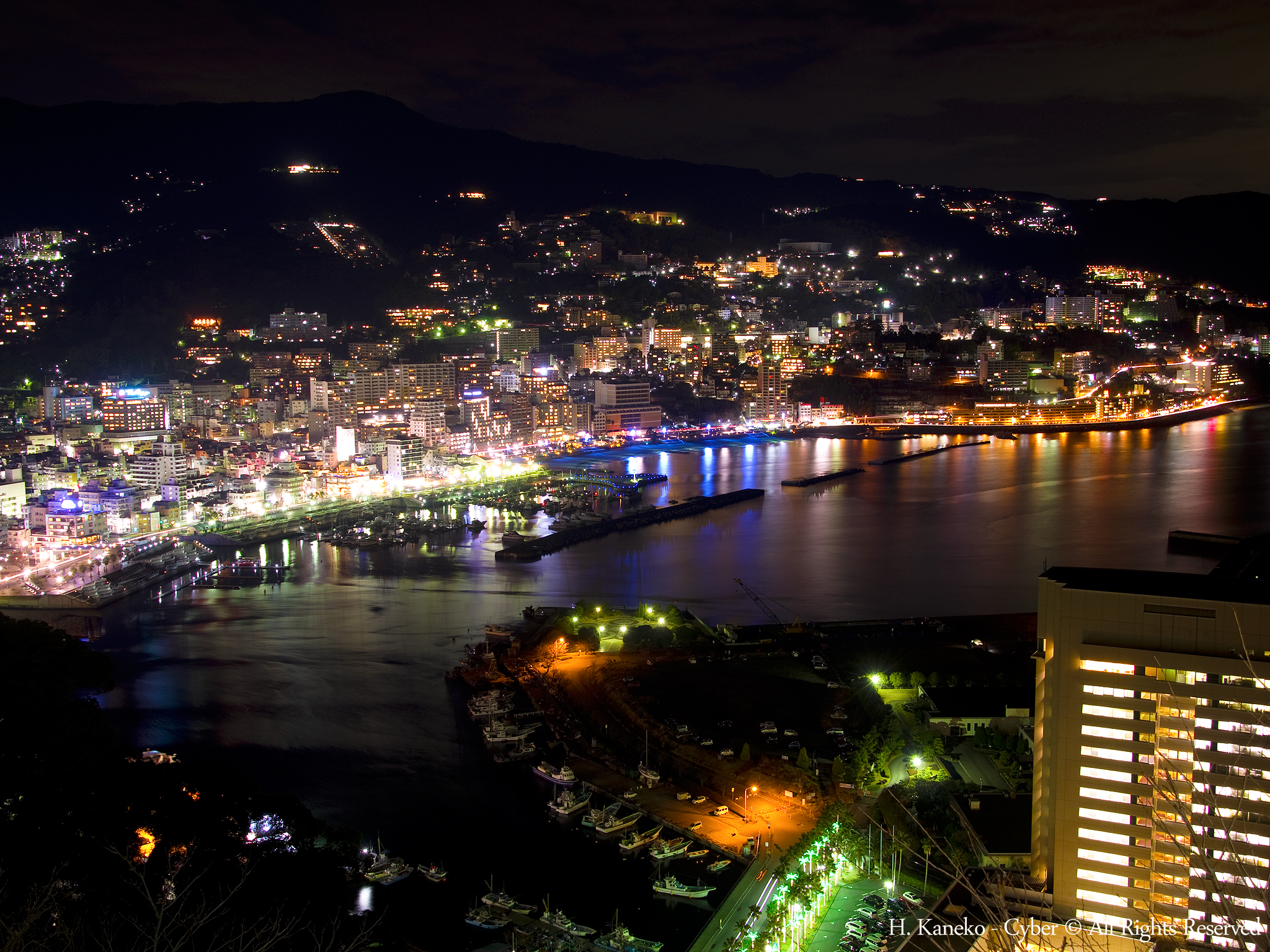
Atami
Godzilla and King Kong once destroyed Atami Castle during a cinematic brawl, tumbling over the cliffs into Sagami Bay. The real Atami has endured worse. An 11-meter tsunami in 1923 drowned dozens of people. A yakuza empire was born here in 1949. A devastating landslide killed 27 in 2021. And yet this small city on the northeast tip of the Izu Peninsula keeps rebuilding, keeps heating its bathwater, keeps welcoming the trains from Tokyo. Atami has been a hot springs resort since the 8th century, and twelve hundred years of practice have given it a particular talent for survival.
Shoguns and Steam
The hot springs drew visitors long before the railways arrived. During the Kamakura period, the shogun Minamoto no Yoritomo and his wife Hojo Masako bathed here -- a stamp of aristocratic approval that set the tone for centuries. Under the Tokugawa shogunate in the Edo period, all of Izu Province fell under direct shogunal control as tenryo territory, and Atami's springs became a retreat for the ruling class. The modern city was formally established on April 10, 1937, through the merger of Atami Town with neighboring Taga Village. But the real transformation came in 1950, when the Japanese government proclaimed Atami an 'International Tourism and Culture City,' triggering a wave of massive resort hotel construction. When the Tokaido Shinkansen added an Atami stop in 1964, the city became less than an hour from Tokyo, and the corporate vacation boom that followed made it one of the most popular group travel destinations in Japan.
Earthquake, Tsunami, and the Great Shaking
Atami sits dangerously close to the seismic engine that drives the entire Izu Peninsula. In 1923, the Great Kanto earthquake struck with its epicenter deep beneath Izu Oshima Island in Sagami Bay, just offshore. The shaking devastated the city, but it was the tsunami that proved catastrophic. An 11-meter wave -- roughly 35 feet -- crashed over the waterfront and surged inland, killing scores of people and flattening much of the town. The entire Kanto region suffered enormously in the disaster, which killed over 100,000 people across the Tokyo-Yokohama corridor, but Atami's coastal exposure and proximity to the epicenter made it one of the hardest-hit communities on the peninsula. The city rebuilt, as it always does, but the memory of that wave remains embedded in local consciousness.
The Rise and Fall of the Party Town
For decades after World War II, Atami thrived on a very specific model: large groups of company employees, dispatched on corporate-sponsored vacations, filling enormous resort hotels for nights of hot spring bathing, elaborate banquet dinners, and entertainment by onsen geisha. It was a uniquely Japanese institution, and Atami was its capital. But the economic bubble burst in the 1990s, and the Lost Decades that followed gutted the corporate entertainment budget. Group travel evaporated. Hotels emptied. Atami's population, already modest, entered a slow decline that continues today, with the city's estimated population at around 36,865. The grand resort infrastructure built for an era of excess became a landscape of faded glamour. Yet Atami has found a new identity as a commuter town, its Shinkansen connection making it feasible to live among the hot springs and work in Tokyo or Yokohama.
The Mud That Came Down the Mountain
On July 3, 2021, after days of torrential rainfall, a landslide broke loose from the mountainside above Atami and roared through a residential neighborhood. The wall of mud and debris killed 27 people and injured 3 more. Investigations revealed that improperly managed construction fill dumped uphill had contributed to the disaster, adding human negligence to the natural hazard. The event was a brutal reminder that Atami's dramatic setting -- steep volcanic slopes rising directly from the coast -- carries real risk. Prime Minister Yoshihide Suga surveyed the damage personally. The city mourned, cleared the debris, and began rebuilding once again.
Castles, Shrines, and Monsters
Atami Castle is not a real castle. Built in 1959 as a museum and tourist attraction, the replica sits on a hilltop surrounded by over 200 sakura trees and offers sweeping views of Sagami Bay. Below it, the ancient Izusan Jinja shrine has been a center of Shugendo mountain worship for centuries, while the MOA Museum of Art houses the eclectic collection of the religious leader and multimillionaire Mokichi Okada. The city's cultural footprint extends into fiction: Ozu's 1953 masterpiece Tokyo Story sends its elderly protagonists to Atami's hot springs, and the first episode of Neon Genesis Evangelion partially unfolds here, with Shinji Ikari being picked up by Misato Katsuragi on Atami's streets. In the 1962 film King Kong vs. Godzilla, the two titans destroy Atami Castle before plunging into the bay. For a small city that keeps getting knocked down, there is something fitting about becoming a favorite stage for cinematic destruction.
From the Air
Located at 35.096N, 139.072E on the northeast coast of the Izu Peninsula. Atami is visible from altitude as a concentrated urban area climbing steep hillsides directly above Sagami Bay. The Atami Castle replica on the hilltop and the harbor area provide distinctive visual landmarks. Nearest airports: RJTO (Oshima Airport) to the east across Sagami Bay, RJNS (Mt. Fuji Shizuoka Airport) to the northwest. Atami Station, a Tokaido Shinkansen stop, is visible near the waterfront. Best viewed at 2,000-4,000 feet to appreciate the steep terrain and coastal setting. The 2021 landslide scar may still be visible on the hillside above the city.