Atewa Range Forest Reserve
In October 2021, two British scientists working in a Ghanaian forest heard a call that no researcher had recorded in the country for nearly 150 years. Shelley's eagle-owl, enormous and elusive, was staring back at them from the canopy of the Atewa Range. The bird's rediscovery was not a fluke of luck but a consequence of where it was found: a 17,400-hectare block of upland evergreen forest in southeastern Ghana so biologically rich that scientists keep finding species science has never described, or had given up for lost. The Atewa Range Forest Reserve sits near the town of Kibi, southwest of the Kwahu Plateau and the vast surface of Lake Volta. Its steep-sided hills with flat summits are the last surviving remnant of a Cenozoic peneplain, a geological surface that once stretched across all of southern Ghana.
Where Three Rivers Begin
Three major rivers are born in the Atewa Range. The Ayensu and Densu flow south toward the Atlantic coast, supplying water to communities and agriculture along the way. The Birim takes a longer, more circuitous route, looping north and southwest around the range before joining the Pra River. For centuries, the Birim carried more than water: it was an important source of alluvial diamonds, flowing through all three traditional Akyem territories of Ghana. That diamond wealth has declined, but the rivers' hydrological importance has not. Millions of people downstream depend on the clean water that the Atewa forest's root systems filter and release. Strip away the forest for mining, conservationists argue, and you strip away the watershed that keeps those rivers flowing.
A Catalog of the Unseen
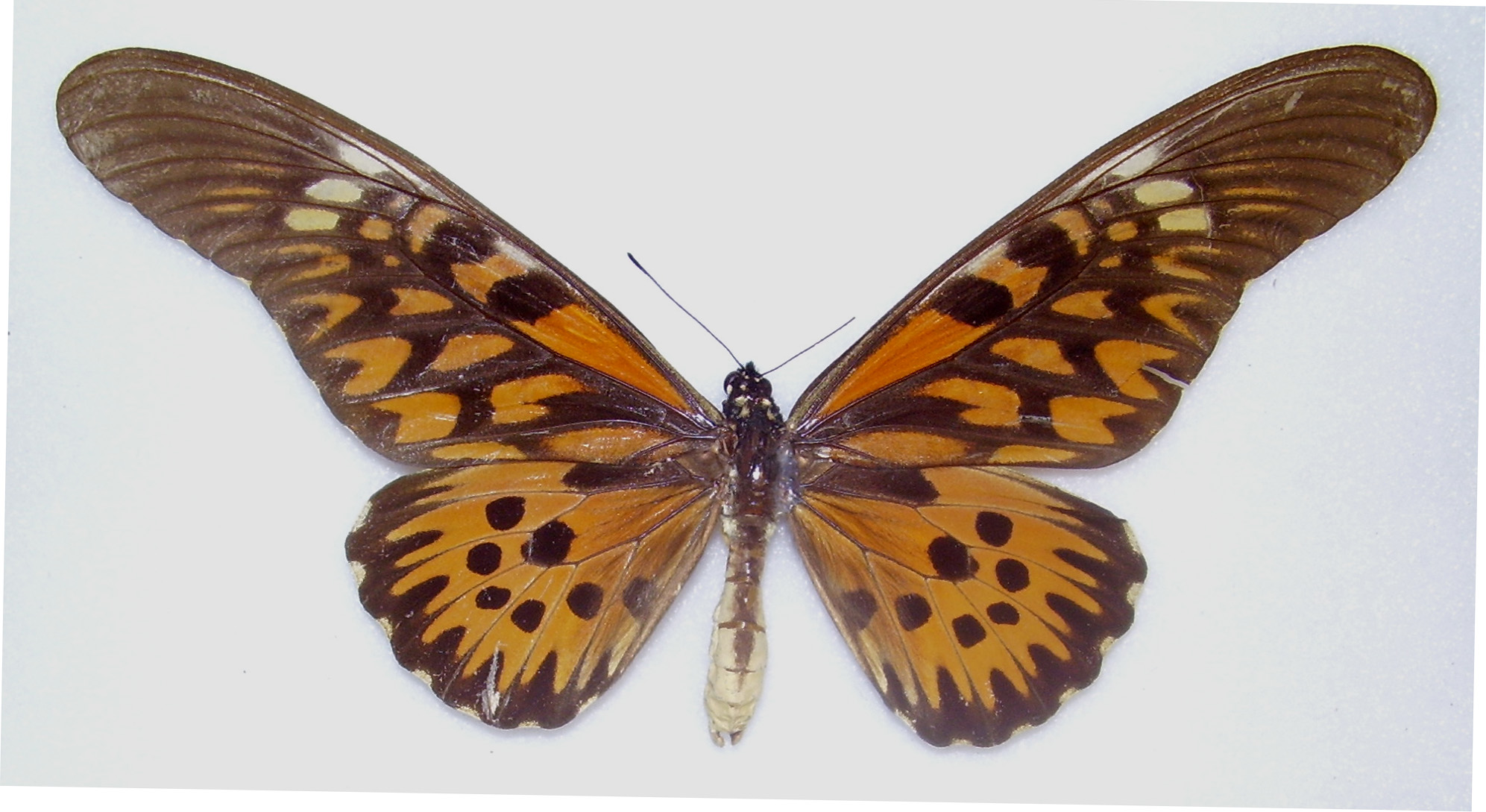
The numbers alone make the case. More than 1,000 plant species grow in the reserve, many found nowhere else in Ghana. Over 230 bird species have been recorded, earning the range designation as an Important Bird Area by BirdLife International. The butterfly count exceeds 570 species, including Papilio antimachus, the largest butterfly in Africa, and Mylothris atewa, a species so rare it may be critically endangered globally. A 2006 expedition turned up ursine colobus and olive colobus monkeys, 17 rare butterfly species, and the critically endangered frog Conraua derooi. In 2017, camera trap footage revealed white-naped mangabeys, a critically endangered primate no one expected to find there. Then, in July 2021, Dr. Caleb Ofori-Boateng and his team from CSIR-FORIG discovered an entirely new frog species, Conraua sagyimase, the Atewa Slippery Frog, named for the community of Sagyimase that had supported the research. In the Akan language, its common name translates simply: the frog of the forest streams.
Bauxite Against Biodiversity
Beneath the forest floor lie deposits of low-grade bauxite and gold, and these have placed the reserve at the center of one of West Africa's most consequential conservation battles. In 2017, Ghana signed a memorandum of understanding with the Chinese state-owned Sinohydro Corporation to develop bauxite mining in the Atewa Range, financed through a resource-backed loan that promised infrastructure development in return. Bauxite extraction requires strip mining, which means removing every tree, every root system, every layer of soil to reach the mineral beneath. For a forest classified as a Globally Significant Biodiversity Area, a Key Biodiversity Area, and an Important Bird Area, the stakes could not be higher. As early as 2012, a coalition of conservation organizations formed CONAMA, the Coalition of NGOs Against Mining in Atewa, demanding that the government revoke all mining contracts. The Okyenhene, Osagyefo Amoatia Ofori Panin, the paramount chief of the Akyem Abuakwa people, has urged the government to convert the reserve into a national park instead.
Peneplain at the Precipice
What makes the Atewa Range irreplaceable is not any single species but its geological identity. A peneplain is a nearly flat erosional surface, the result of millions of years of weathering that levels mountains into plateaus. The one that once covered southern Ghana has been eroded away everywhere except here, where ancient bauxitic soils cap the flat summits like a geological time capsule. This terrain supports a forest type, upland evergreen, that is exceptionally rare for Ghana and creates conditions found almost nowhere else in the region. The Okyeman Environment Foundation, working with the Forestry Commission of Ghana, has restricted farming within the reserve and is promoting eco-tourism as an economic alternative to extraction. Whether the Atewa Range becomes a national park or a mine will likely be decided in the coming years. For now, the forest holds its ground, and somewhere in its canopy, Shelley's eagle-owl keeps its silence.
From the Air
Located at 6.17N, 0.60W in southeastern Ghana, southwest of the Kwahu Plateau. The range runs roughly north-south with steep-sided hills and flat summits reaching approximately 700-800 meters. Nearest major airport is Kotoka International (DGAA/ACC) in Accra, roughly 100 km to the south. The town of Kibi lies at the eastern base of the range. The flat-topped ridgeline is distinctive from altitude, contrasting with surrounding lower terrain. Best viewed from 5,000-8,000 feet AGL. Be aware of mountain weather conditions and potential cloud cover over the summits.