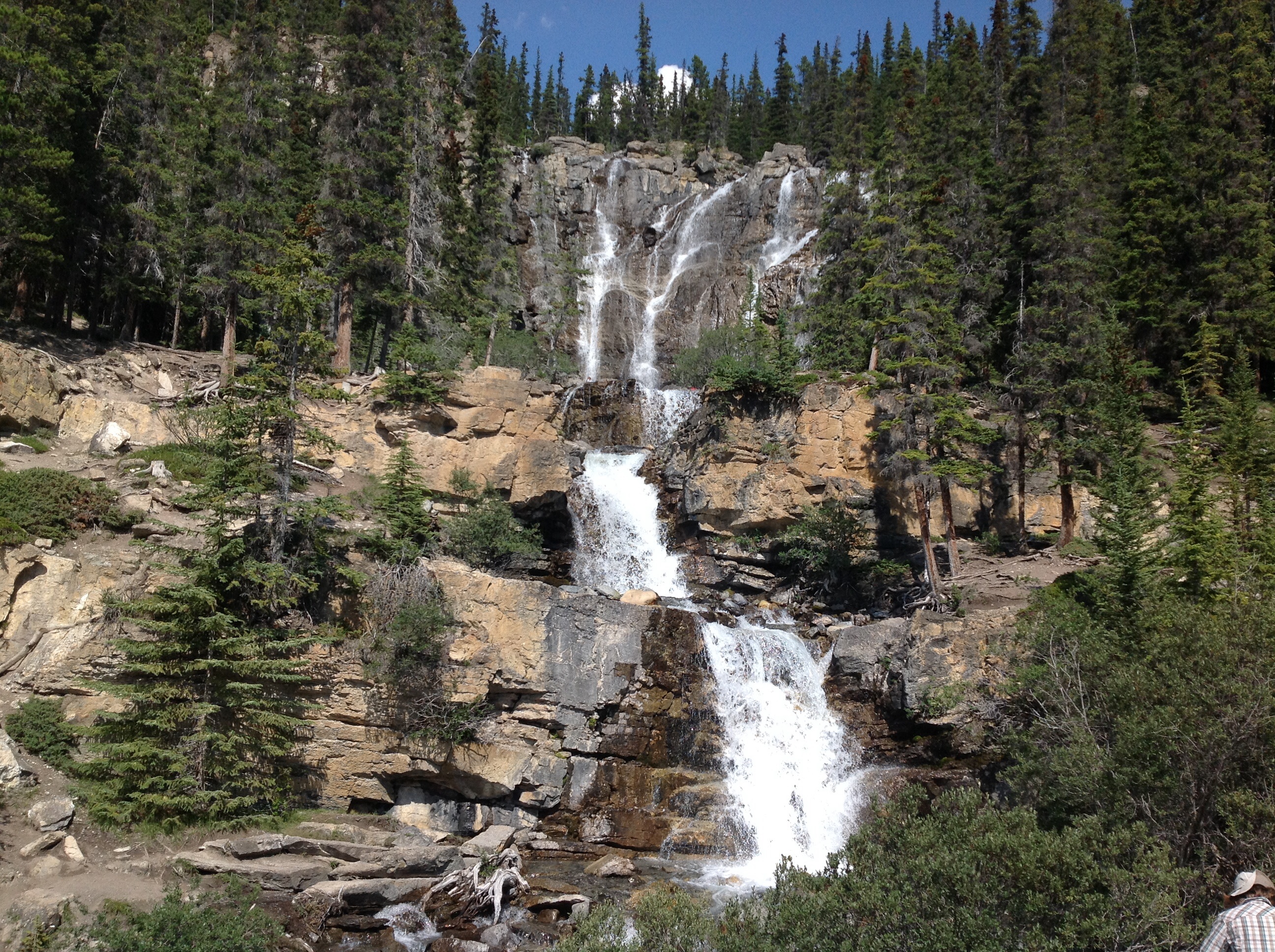
Athabasca Falls
In Jasper National Park, where the Icefields Parkway crosses the Athabasca River, 30 kilometers south of Jasper townsite, water demonstrates patience and power. Athabasca Falls drops only 23 meters - modest by Rocky Mountain standards - but the force is extraordinary. The entire Athabasca River, fed by the Columbia Icefield, funnels through a narrow quartzite gorge before plunging over the falls. The hard quartzite has resisted erosion for thousands of years, creating potholes, channels, and spray-carved caves. At peak flow in July, the roar is constant; the mist coats everything. The falls have been carving this canyon since the glaciers retreated 10,000 years ago. They're still working.
The Geology
Athabasca Falls exists because of a geological bottleneck. Upstream, the Athabasca River flows wide and relatively calm, carrying meltwater from the Columbia Icefield. At the falls, the river encounters a band of hard quartzite - ancient sandstone compressed and metamorphosed into extremely resistant rock. Unable to widen its channel, the river cut down, creating a narrow gorge. The quartzite erodes slowly, measured in inches per century. Potholes, carved by water spinning rocks in circular patterns, dot the gorge. Side channels show where the river once flowed before cutting its current path. The falls will eventually retreat upstream, but the process will take millennia.
The Power
What Athabasca Falls lacks in height it compensates in volume. The entire Athabasca River - one of the largest in Alberta - compresses into a channel that narrows to just a few meters at the brink. At peak flow in July, when glacier melt swells the river, the volume is staggering. The sound is not a roar but a continuous thunder; the mist rises like smoke. Even in lower water, the falls are impressive - the concentrated flow, the spray, the churning pool below. Signs warn visitors to stay behind railings; the rocks are perpetually wet and slick. People have died here, swept in by the force of the current.
The Icefield Connection
The Athabasca River begins at the Columbia Icefield, 50 kilometers to the south - the same icefield that feeds the Athabasca Glacier visible from the Icefields Parkway. Meltwater from hundreds of square kilometers of ice flows north, gathering tributaries, gaining volume, until it reaches the falls. The river eventually flows north to Lake Athabasca, then via the Slave and Mackenzie Rivers to the Arctic Ocean. The falls are a waypoint in a continental water journey - glacier to ocean, 3,000 kilometers. Climate change is accelerating glacier melt; in coming decades, the Athabasca may carry more summer water, then less as the icefields diminish.
The Setting
Athabasca Falls is one of the most accessible major waterfalls in the Canadian Rockies. The parking lot sits beside the Icefields Parkway; paved paths and viewpoints allow easy access. This accessibility makes the falls popular - very popular in summer, when tour buses arrive continuously. Multiple viewpoints reveal different perspectives: the brink, the pool, the downstream canyon. A walking path descends into the canyon below the falls, where the carved rock formations and side channels are visible. The falls are surrounded by boreal forest - spruce and pine - with mountain peaks visible above. Wildlife is common; bears frequent the area.
Visiting Athabasca Falls
Athabasca Falls is located on the Icefields Parkway (Highway 93), 30 kilometers south of Jasper townsite. The parking lot and viewpoints are free. Paved paths lead to multiple overlooks; the lower canyon trail requires stairs. Allow 30-60 minutes. Peak flow occurs in July; fall offers lower water but autumn colors. The falls are accessible year-round, though winter access depends on road conditions and some paths may be closed. The Columbia Icefield and Athabasca Glacier are 50 kilometers south. Jasper townsite has full services. Edmonton is 360 kilometers east. The Icefields Parkway between Jasper and Lake Louise is one of the world's great scenic drives; the falls are a natural stop.
From the Air
Located at 52.66°N, 117.88°W in Jasper National Park, Alberta. From altitude, the Athabasca River is visible flowing north from the Columbia Icefield toward Jasper townsite. The falls appear as white water where the river enters a narrow gorge - look for the mist rising from the canyon. The Icefields Parkway parallels the river; the parking lot is visible beside the road. Mount Kerkeslin and other peaks rise to the east. The Columbia Icefield is visible to the south - a vast white expanse feeding this and other rivers. The terrain is classic Rocky Mountain: gray peaks, green valleys, glacial blue water. Jasper townsite is visible to the north.