Athens War Museum
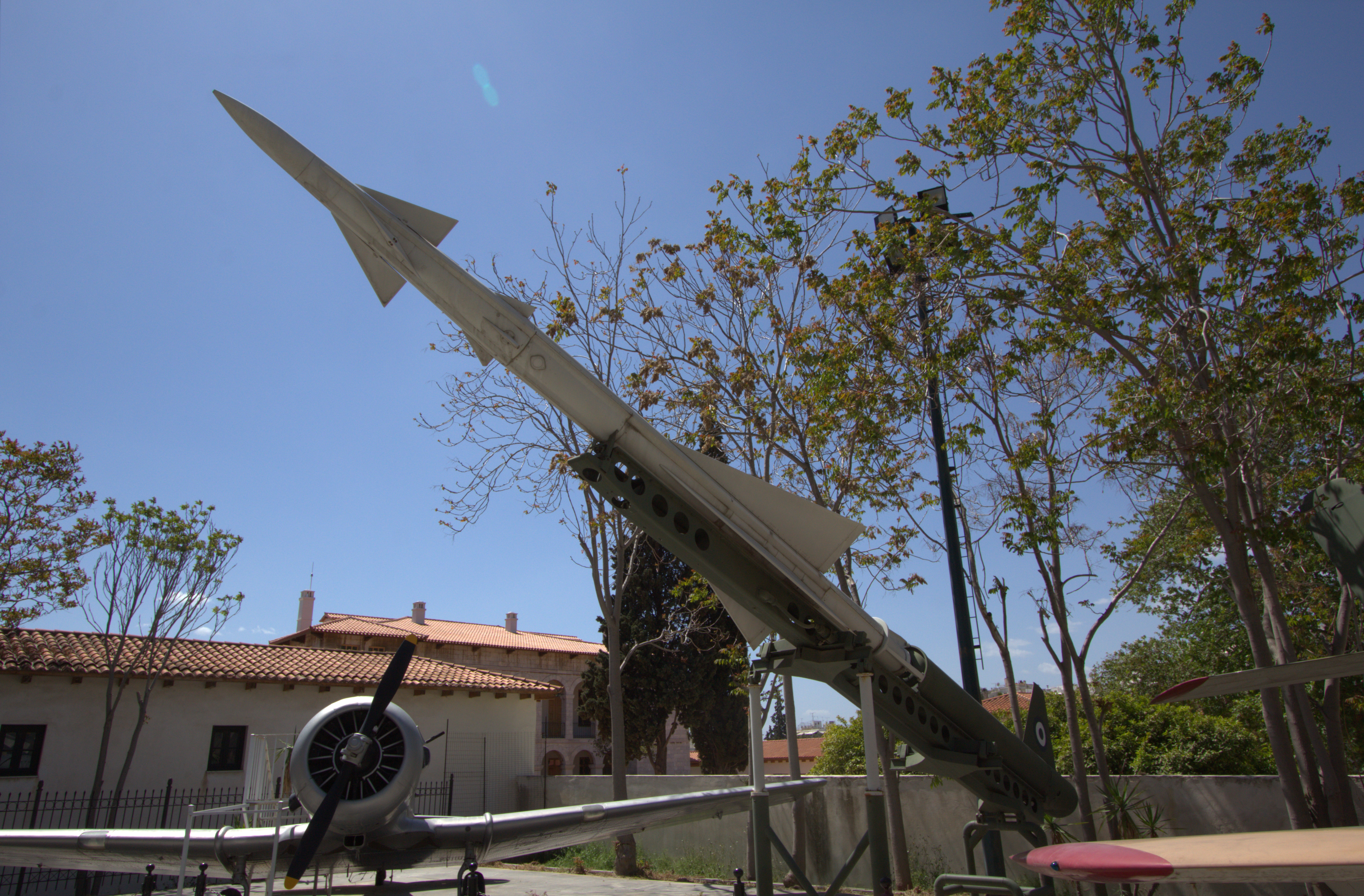
The yard outside the Athens War Museum looks like a parking lot for retired aircraft. A Vought F-8 Crusader sits next to a Republic F-84 Thunderjet; a Mirage F1 keeps company with a Northrop F-5; a Skyhawk waits its turn on the tarmac that is no longer a tarmac. Inside, the chronology runs the other way: you start with bronze helmets that were old when Athens was young, and work forward through every war Greece has fought. The museum tells a long story in a relatively small space, and the walk from a Mycenaean spearpoint to an AIAS surface-to-air missile is shorter than you would expect.
A Bauhaus Bunker in Kolonaki
The building itself is part of the story. Greece's military government in the late 1960s wanted a war museum, and a team of architects led by Thucydides Valentis of the National Technical University of Athens designed it in the rationalist concrete idiom of mid-century European modernism, with strong influences from the Bauhaus. The structure went up in 1972, opened to the public in 1975, and stands a short walk from the Evangelismos Metro station in the diplomatic neighborhood of Kolonaki. Concrete blocks, vertical fins, no decoration to speak of - the building looks somewhere between a bunker and a piece of brutalist sculpture, which is appropriate for what it contains. There is no attempt to soften the subject. The museum has branches in Thessaloniki, Chania, Rethymno, Nafplion, Tripoli, Kalamata, and Chalkida; the Metaxourgeio house of General Napoleon Zervas, leader of EDES partisans during World War II, is also part of the network.
The Saroglos Collection
The interior weapons collection is anchored by a single donor. Petros Saroglos, born 1864 and dead in 1920, was a Greek officer of the old school - well-traveled, independently wealthy, and obsessed with weapons as cultural objects. He gathered swords, firearms, helmets, and pieces of armor from across Europe and the Ottoman world, and willed them to the Greek Army. His samurai armor, his Garibaldini kepi, the small Ottoman child's sword, the engraved silver-mounted dueling pistols - these are not arranged as a chest-thumping inventory of Greek prowess but as the remains of how human beings have armed themselves to kill each other. The collection's strongest pieces come from the Greek War of Independence, when armed irregulars in fustanellas drove the Ottomans out of the Peloponnese with weapons that were often older than they were.
From Mycenae to Mehmed
The earliest cases hold Bronze Age and classical material - spearheads, helmets, a model of a Byzantine dromon warship. There are exhibits on Alexander the Great's campaigns, on the Byzantine Empire's centuries of frontier wars, on the medieval period when Crusaders and Venetians and Ottomans took turns ruling pieces of Greek territory. There are illustrated maps from the Renaissance and engravings of King George I arriving in Athens in 1863, when an independent Greek state was still figuring out what shape it wanted to be. The museum is not encyclopedic about every period, but the curatorial choices are honest: the country has been fighting for or about its independence for most of the time it has been a country.
The Twentieth Century, the Hard One
Half the museum is given over to the wars of the twentieth century, and the displays are unflinching about how many of them there were. The Macedonian Struggle of 1904 to 1908. The First and Second Balkan Wars of 1912 to 1913. The First World War, in which Greece eventually joined the Allies. The Asia Minor Campaign of 1919 to 1922, which ended in the catastrophe at Smyrna and the population exchange that brought a million and a half Greek refugees from Anatolia. The Second World War: the Greco-Italian war that started in October 1940, the German invasion of April 1941, the four years of occupation, the resistance, the famine in Athens, and the civil war that followed. Then Korea, where Greek troops served alongside U.N. forces, and Cyprus - the EOKA struggle of 1955 to 1959 and the Turkish invasion of 1974. Each of these has its own room or wall or case. The uniforms hang empty, and that emptiness is part of what the museum is for.
Reading the Building
What the museum does well is what military museums often miss: it shows you weapons as the work of craft, the price of which was paid by the people who used them. A child's sword from the Ottoman Balkans is a particularly grim object. So is the Hellenic Army uniform from 1940, displayed beside the rifle the soldier carried into the Pindus Mountains in winter. The museum's centerpieces are weaponry from conflicts where Greece was involved, but it also displays warfare as a human universal: the samurai armor, the Garibaldini kepi, the AIAS missile, the dromon model. Walk slowly through the chronological exhibition and you can feel the same observation being made in object after object: somebody made this; somebody used it; somebody who is in the ground today used to wear it. Then you walk back outside, and the F-5 is still parked in the yard, fifty years older than the day it left service, waiting for nobody to come back for it.
From the Air
37.98 N, 23.75 E. The museum stands in central Athens, in the Kolonaki neighborhood about 1 km east-northeast of Syntagma Square and just south of the Lycabettus Hill. Athens International (LGAV) is 30 km east-southeast; the smaller Tatoi airfield (LGTT) is 25 km north. From cruising altitudes, Lycabettus is unmistakable as a steep cone rising 277 meters out of the city; the museum sits at its southern base, three blocks from the U.S. Embassy. Athens haze is heaviest in summer afternoons; clearest visibility is mornings before about 10 a.m.