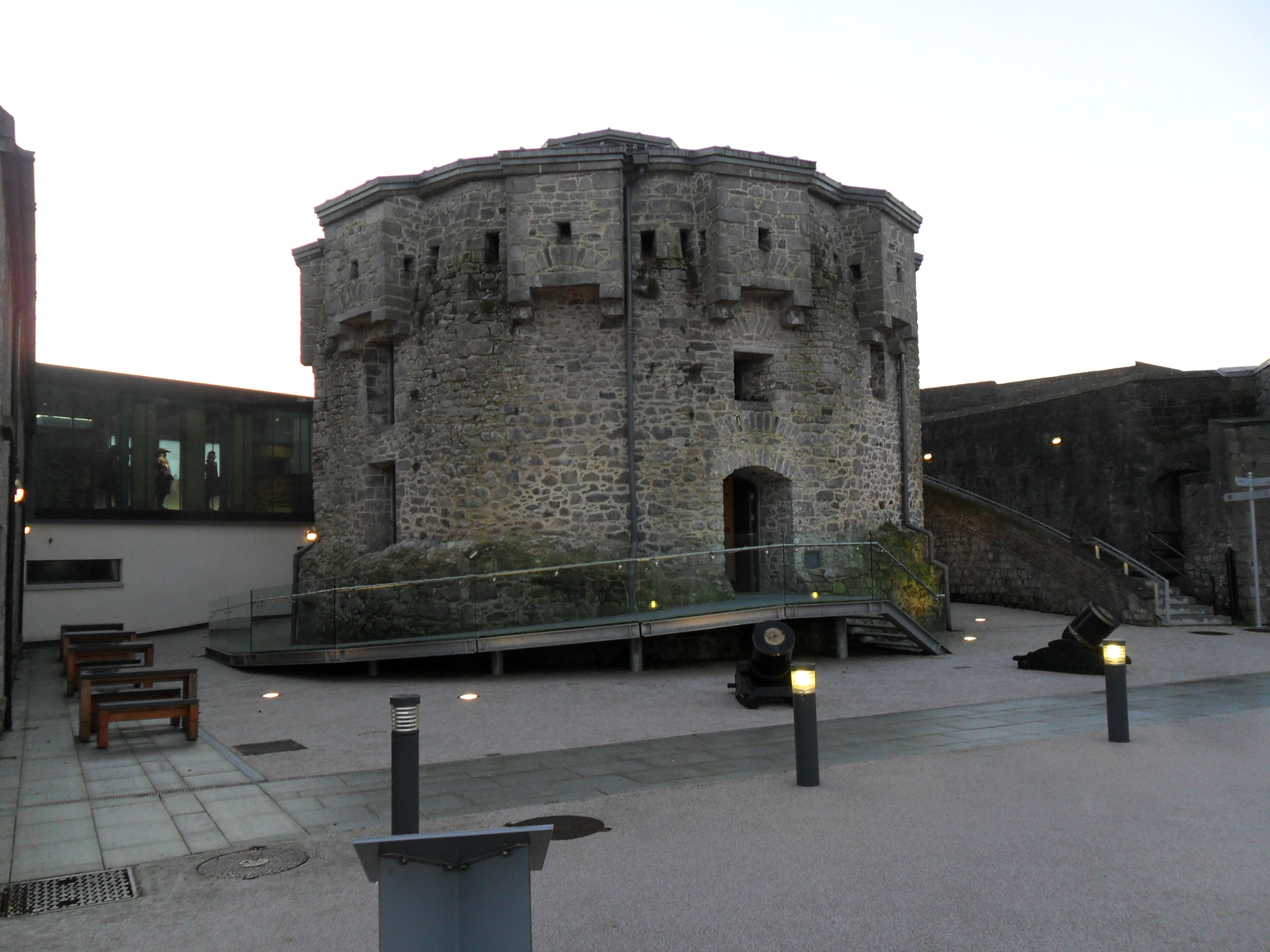
Athlone Castle
Every bridge needs a castle, and every castle needs a bridge. That, in essence, is the story of Athlone Castle -- a fortress built to control the point where Ireland's longest river could be crossed on foot. King John of England ordered it constructed in 1210 to defend the Shannon crossing and give his Norman armies a bridgehead into Connacht. Eight centuries later, the squat stone keep still broods over the water, though the town it spawned has long since grown around and past it.
Before the Stone
An Irish king beat the Normans to it by eighty years. In 1129, Tairrdelbach Ua Conchobair, King of Connacht, built a wooden castle at Athlone -- possibly on the very site where the stone fortress stands today. Wood was the dominant building material of early Irish fortification, and the structure likely served the same strategic purpose: controlling the river crossing. When the Normans arrived, they recognized the spot's value immediately. King John's Irish Justiciar, Bishop John de Gray of Norwich, oversaw the construction of a polygonal stone tower on a motte -- an artificial mound that still forms the base of the central keep. The Shannon at Athlone was wider and wilder then, and the castle likely sat behind a fosse or moat for added protection.
Siege, Fire, and Lightning
The castle was substantially fortified around 1276, when a curtain wall with drum towers enclosed the original motte. Sir William Brabazon reconstructed it in 1547. Then came the Williamite Wars. During the Sieges of Athlone in 1690 and 1691, the external walls and towers took devastating fire from Jacobite and Williamite artillery alike. What the cannon did not destroy, nature finished: in 1697, lightning struck the castle, wrecking much of what remained. The structure you see today owes its squat, muscular profile to Napoleonic-era remodeling, when the castle was modernized and adapted for artillery. The drum towers were rebuilt to resemble the Martello towers that dotted Ireland's coasts against the threat of French invasion. A drawbridge survived into the 1940s before it too was finally removed.
Reading the Walls
A careful eye can still decode the castle's layered history in its stonework. A sally gate in the wall overlooking the Shannon marks where defenders could launch surprise sorties. A bow loop facing Castle Street recalls the era of archers, while gun embrasures and pistol loops on the entrance ramp speak to later centuries of firepower. The 1874 Ordnance Survey map cataloged what was then a functioning military installation: officers' quarters, soldiers' quarters, a master gunner's quarters, guardhouse, cookhouse, and ablutions room. The five-bay, two-storey barrack building overlooking Main Street, a late Georgian addition from around 1810, once housed the garrison. The keep itself is a designated National Monument.
The Castle Reborn
After 750 years of military service, Athlone Castle found a new purpose. The Old Athlone Society established a museum in the castle in 1967, and a modern visitor center followed in 1991. But the most dramatic transformation came in 2012, when a multimillion-euro renovation turned the fortress into a state-of-the-art, multi-sensory experience. Eight exhibition spaces now guide visitors through the castle's history using 3D maps, audiovisual installations, and illustrations by Victor Ambrus, the artist best known for his work on Channel 4's Time Team. The renovation preserved the castle's medieval bones while making its story accessible in ways that a 13th-century Norman builder could never have imagined. Athlone Castle links the modern town with its founders, a physical bridge between centuries as enduring as the river crossing it was built to defend.
From the Air
Athlone Castle is located at 53.423N, 7.943W on the west bank of the River Shannon in County Westmeath, at the geographic center of Ireland. The castle is clearly visible from the air beside the Shannon bridge in the heart of Athlone town. Nearest airports: Athlone Aerodrome is approximately 5 km east; Galway Airport (EICM) about 90 km west; Dublin Airport (EIDW) about 120 km east. Recommended viewing altitude: 2,000-3,000 ft for best visibility of the castle and its relationship to the river crossing.