Atlanta Campaign
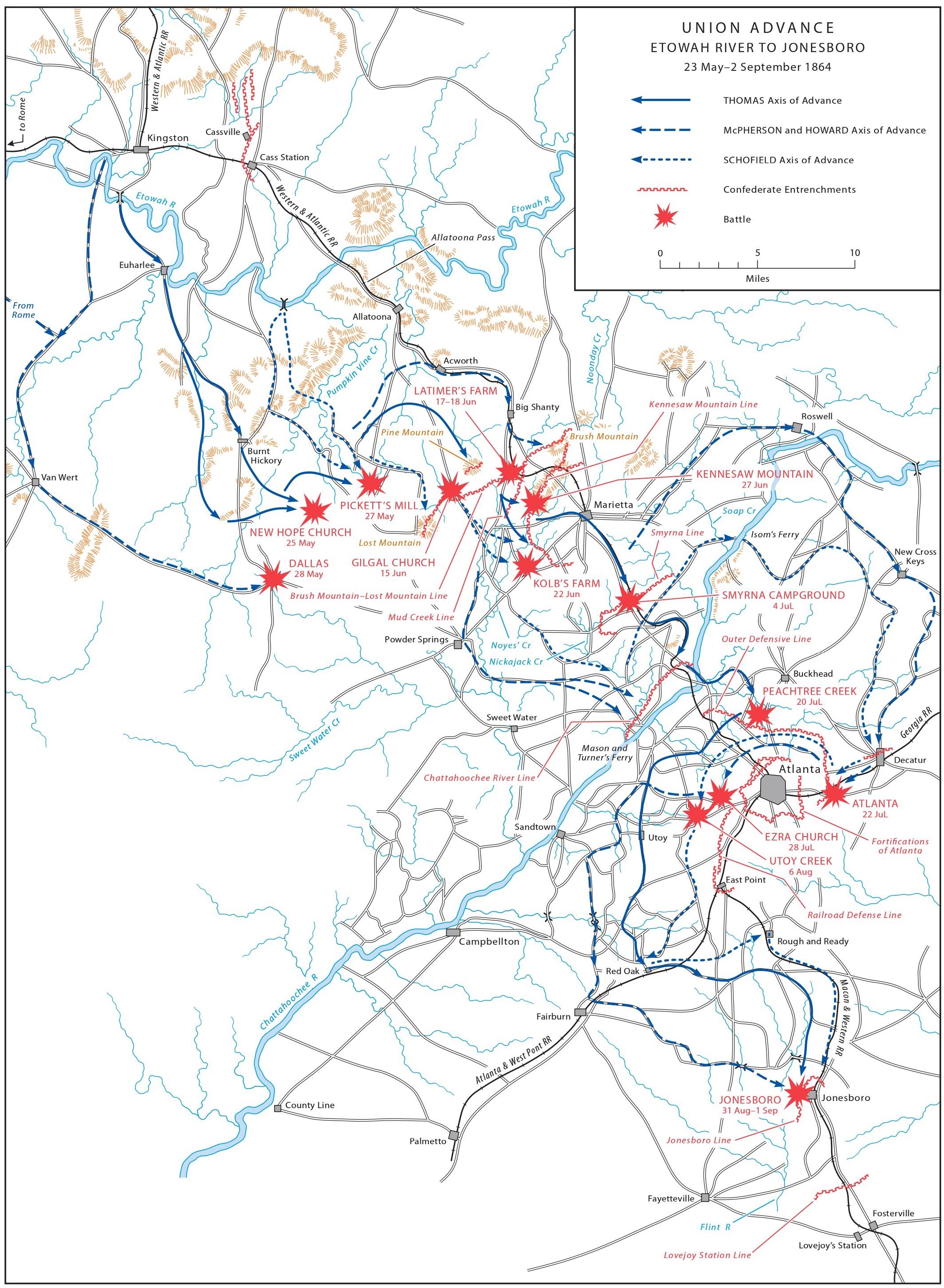
Sherman's men had a boast: their general could flank the devil out of hell if necessary. Through the summer of 1864, from May to September, William Tecumseh Sherman proved them right -- not once, but a dozen times across a hundred miles of northwest Georgia. The Atlanta campaign was not a single battle but a grinding chess match fought through mountain gaps, along railroad lines, and across river crossings, as Sherman's 98,500 troops pursued Joseph E. Johnston's 50,000 Confederates southward from Chattanooga toward the rail hub of Atlanta. It was a campaign defined not by dramatic charges but by the relentless geometry of the flanking maneuver, and its conclusion would reshape the American Civil War.
The Gateway Opens
The campaign grew from Ulysses S. Grant's grand strategy for 1864: coordinated pressure across every front. While Grant accompanied Meade's army against Robert E. Lee in Virginia, Sherman was given command of the Western armies and a clear mission -- destroy Johnston's Army of Tennessee, capture Atlanta, and strike through the Confederate heartland. The starting point was Chattanooga, known as the "Gateway to the South" after its capture in November 1863. Sherman assembled three armies: James B. McPherson's Army of the Tennessee, John M. Schofield's Army of the Ohio, and George H. Thomas's Army of the Cumberland. Together they outnumbered their opponent nearly two to one. In early May, Sherman advanced into Georgia, and the long southward chase began.
The Art of the Flank
Johnston was a master of defensive warfare, entrenching his army in positions that dared Sherman to attack head-on. At Rocky Face Ridge in May, Johnston's troops sat on a long, high mountain that seemed impregnable. Rather than assault it, Sherman demonstrated against the front with most of his force while sending McPherson's column through Snake Creek Gap to threaten the railroad at Resaca. The pattern repeated itself through Resaca, Adairsville, New Hope Church, and Dallas. Sherman would find Johnston dug in, probe the line, then swing a column around the Confederate flank, forcing Johnston to fall back toward his next prepared position. The one major exception came at Kennesaw Mountain on June 27, when Sherman gambled on a frontal assault. His troops surged forward after an artillery bombardment but were cut down by entrenched defenders. He suffered roughly 3,000 casualties against 1,000 for the Confederates. Sherman never repeated the mistake.
Hood Takes the Fight
By mid-July, Confederate President Jefferson Davis had grown furious with Johnston's strategy of trading ground for time. On July 17, Davis stripped Johnston of command and installed John Bell Hood, a general known for aggressive tactics forged at Gettysburg. Sherman was reportedly pleased by the change -- Hood would fight in the open, giving Sherman's superior numbers an advantage. Hood delivered exactly that. At Peachtree Creek on July 20, he attacked Thomas's army as it crossed the creek but was repulsed. Two days later at the Battle of Atlanta, Hood sent Hardee's corps on a grueling fifteen-mile night march to strike the Union left. The attack caught McPherson off-guard enough that he rode forward to investigate and was shot and killed -- one of the highest-ranking Union officers to die in combat. But massed Union artillery and a counterattack by Logan's XV Corps restored the line. At Ezra Church on July 28, Hood attacked again and was again repulsed with heavy casualties.
The Railroads Break
By late August, Sherman concluded that cutting Hood's supply lines was the key to capturing Atlanta. Previous cavalry raids had torn up track, but the Confederates repaired the damage within days. Sherman decided to send six of his seven infantry corps against the Macon and Western Railroad. On August 31, Hardee attacked two Union corps at Jonesborough but was easily repulsed, not realizing Sherman's full army was concentrated there. The next day, Union forces broke through Hardee's thinned line. That night, September 1, Hood evacuated Atlanta, ordering 81 rail cars of ammunition and supplies destroyed. The resulting fire and explosions were heard for miles. Union troops under Henry W. Slocum occupied the city on September 2.
The War Turns on Atlanta
The campaign's cost was staggering: 31,687 Union casualties and 34,979 Confederate, a proportionally devastating blow to the smaller Southern army. Hood limped away with approximately 30,000 men; Sherman retained 81,000. Yet the campaign's greatest impact was political. In the summer of 1864, Abraham Lincoln believed he would lose re-election. War weariness had gripped the North, and the Democratic platform called for a negotiated peace. The fall of Atlanta changed everything. Sherman's telegram -- "Atlanta is ours, and fairly won" -- electrified the Union and made Lincoln's November victory all but certain. Sherman occupied the city through the autumn, then ordered the civilian population evacuated and destroyed everything of military value. On November 15, his army marched out of the ruins of Atlanta, heading southeast. Without railroads for supply, they would live off the land. The March to the Sea had begun.
From the Air
Located at 33.749N, 84.388W, the campaign stretched roughly 100 miles from Chattanooga, Tennessee (KCHA) southeast to Atlanta (KATL). Key battlefield sites visible from altitude include Rocky Face Ridge near Dalton (KDNN), Kennesaw Mountain (now a National Battlefield Park, clearly visible as an isolated ridgeline northwest of Marietta), the Chattahoochee River crossings, and the Atlanta city center. Peachtree Creek flows through north Atlanta. The Western and Atlantic Railroad corridor, which defined the campaign's axis of advance, roughly follows modern I-75. Best viewed at 3,000-5,000 feet AGL to appreciate the terrain that shaped the campaign. Nearby airports include Cobb County McCollum Field (KRYY) near Kennesaw Mountain, and DeKalb-Peachtree Airport (KPDK) near the Battle of Atlanta site.